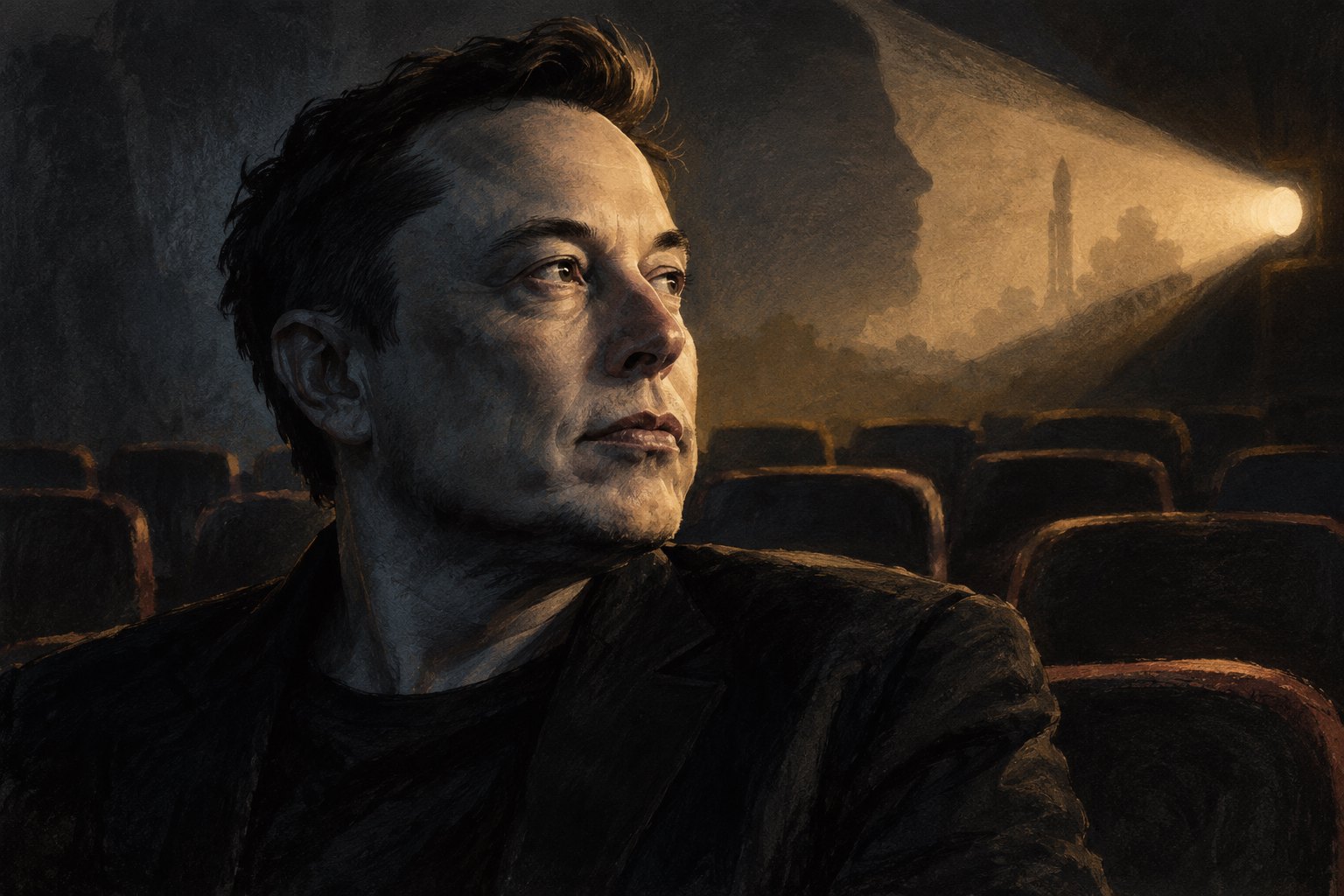
Alex Gibney’s Musk raises a problem that extends beyond whether viewers like its subject: can a critical documentary make a powerful man seem even more impressive? The argument that Elon Musk’s enemies strengthen his case identifies a real possibility in filmmaking. A portrait intended to expose someone’s failings can also enlarge his stature by making him the center of every conflict.
But that possibility is not a verdict. Being the object of sustained criticism establishes neither greatness nor innocence. The useful question is whether the film helps audiences distinguish accomplishment, personal mythology, and accountability—or lets those different subjects collapse into a single argument about admiration.
Spoiler-free critical commentary: This article examines the competing interpretations surrounding Musk, rather than offering a firsthand, scene-by-scene review.
What the disagreement over Musk actually concerns
The Free Press frames its response around the proposition that Musk’s opponents make his strongest case. The New Yorker approaches Gibney’s film as a challenge to Musk’s self-mythology. NBC News emphasizes the importance of his lieutenants’ voices, while The New York Times foregrounds Gibney’s explanation of why the documentary required approximately four hours.
Those approaches concern different things. One asks whether the criticism backfires. Another asks whether the subject’s public image withstands scrutiny. A third directs attention toward people around him. The discussion of length concerns the space required to make the argument. None of these frames, by itself, establishes whether an individual claim in the documentary is accurate.
My view is that the most productive disagreement concerns perspective. Does Musk remain the sole measure of significance, even when the portrait turns hostile? Or can a documentary make the people surrounding its famous subject matter independently? That distinction determines whether criticism changes the story or merely changes the lighting on its star.
Musk as a central character: importance is not vindication
In narrative terms, a central character gains significance through attention. Other people describe him, react to him, and organize their accounts around his decisions. Even unfavorable testimony can reinforce the impression that he is the person who makes things happen.
This creates a plausible route for criticism to backfire. A sympathetic viewer may register the scale of the opposition before considering its substance. The emotional conclusion becomes that someone attracting so much resistance must be unusually consequential. Yet consequence and justification are separate judgments. A person can matter enormously while still deserving exacting scrutiny.
The reverse mistake is equally limiting. If a critical portrait treats every indication of ability as an inconvenience, its argument becomes less persuasive. Viewers should not have to deny an achievement before they can examine a failure. Recognizing competence can make a discussion of responsibility more demanding: someone capable of consequential decisions can reasonably be asked to answer for them.
For a documentary about Musk, this means that admiration should be a subject of investigation. What do people admire? What evidence supports that admiration? When does respect for a particular accomplishment become trust in unrelated judgments? These questions offer more explanatory value than simply sorting everyone into supporters and enemies.
Why the lieutenants’ perspective matters
NBC News’s emphasis on Musk’s lieutenants suggests an especially useful way to approach the debate. It directs attention toward the relationship between a prominent individual and the people associated with his power. That perspective complicates the assumption that the relevant story consists only of Musk confronting hostile outsiders.
A lieutenant occupies a different narrative position from an opponent. Proximity can provide knowledge, but it can also create incentives to defend decisions, preserve relationships, or distribute blame. The value of such a voice depends on what the person knows and how that knowledge can be assessed. Neither loyalty nor disillusionment automatically establishes credibility.

For viewers, the key distinction is between a judgment about personality and an account of conduct. Someone describing a powerful figure as admirable or intolerable offers an interpretation. Someone explaining a decision, its circumstances, and its consequences offers material that can be examined. A documentary earns confidence by making that difference legible.
The supporting figures also deserve attention as people with agency. Treating them only as extensions of Musk would reproduce the very concentration of attention that a critical film might want to question. Their choices matter too: what they support, what they contest, and how they understand their own responsibility.
This concern connects with our commentary on wealth, filmmaking, and who controls the view. In both discussions, the frame shapes whose presence becomes important and whose experience remains peripheral.
Four hours must deliver more than accumulation
The discussion surrounding the film’s approximately four-hour length introduces another distinction: comprehensiveness is not the same as explanation. A long documentary can establish connections that shorter coverage cannot accommodate. It can also repeat a conclusion until familiarity begins to feel like proof.
The test is what additional time allows audiences to understand. Does a later section complicate an earlier impression? Does it clarify competing accounts? Does the argument develop, or does each new example merely invite the same response? These are questions about structure, not a demand that serious subjects fit a convenient runtime.
Length can strengthen a subject’s mythology in another way. Devoting an expansive film to one person inevitably announces that he deserves sustained attention. That is not a reason to avoid the project. It is a reason to ensure that the attention reveals relationships and consequences beyond the fascination of the central personality.
How to judge the film without inheriting someone else’s verdict
A useful viewing approach keeps several judgments separate:
- Assess the claim before the speaker’s allegiance. Sympathy and hostility may explain a perspective; they do not settle whether an account is reliable.
- Distinguish evidence from emphasis. A striking presentation can make information memorable without making it more conclusive.
- Ask what an achievement actually establishes. Success in one area does not automatically resolve questions about another.
- Notice whether other people retain agency. A film becomes more illuminating when those around its subject have motivations and responsibilities of their own.
These habits apply to film criticism as well. A review should explain how an argument works before declaring that it triumphs or collapses. Our analysis of provocation and critical judgment considers a related problem: an intense reaction is a starting point for evaluation, not its completion.
The deeper issue: who gets to remain the hero?
The claim that Musk’s enemies make his best case is most interesting as a warning about storytelling. A culture accustomed to interpreting public life through exceptional individuals may absorb even a hostile portrait as another chapter in an exceptional individual’s legend.
Breaking that pattern requires more than changing praise into condemnation. It requires examining how influence operates between people, how credit is assigned, and whose consequences receive attention. That is where the lieutenants’ perspective becomes conceptually important: it opens the possibility of discussing power as a relationship rather than a personality trait.
My judgment is that neither admiration nor hostility offers an adequate standard for evaluating Musk. The stronger standard is whether its argument makes responsibility clearer. An opponent’s weakness does not prove the subject right, and a subject’s achievement does not make every objection disappear. A worthwhile documentary leaves viewers better equipped to hold those thoughts together.
Original content by this site's editorial team. Published: October 11, 2026 at 04:51:45 PDT (Los Angeles time)