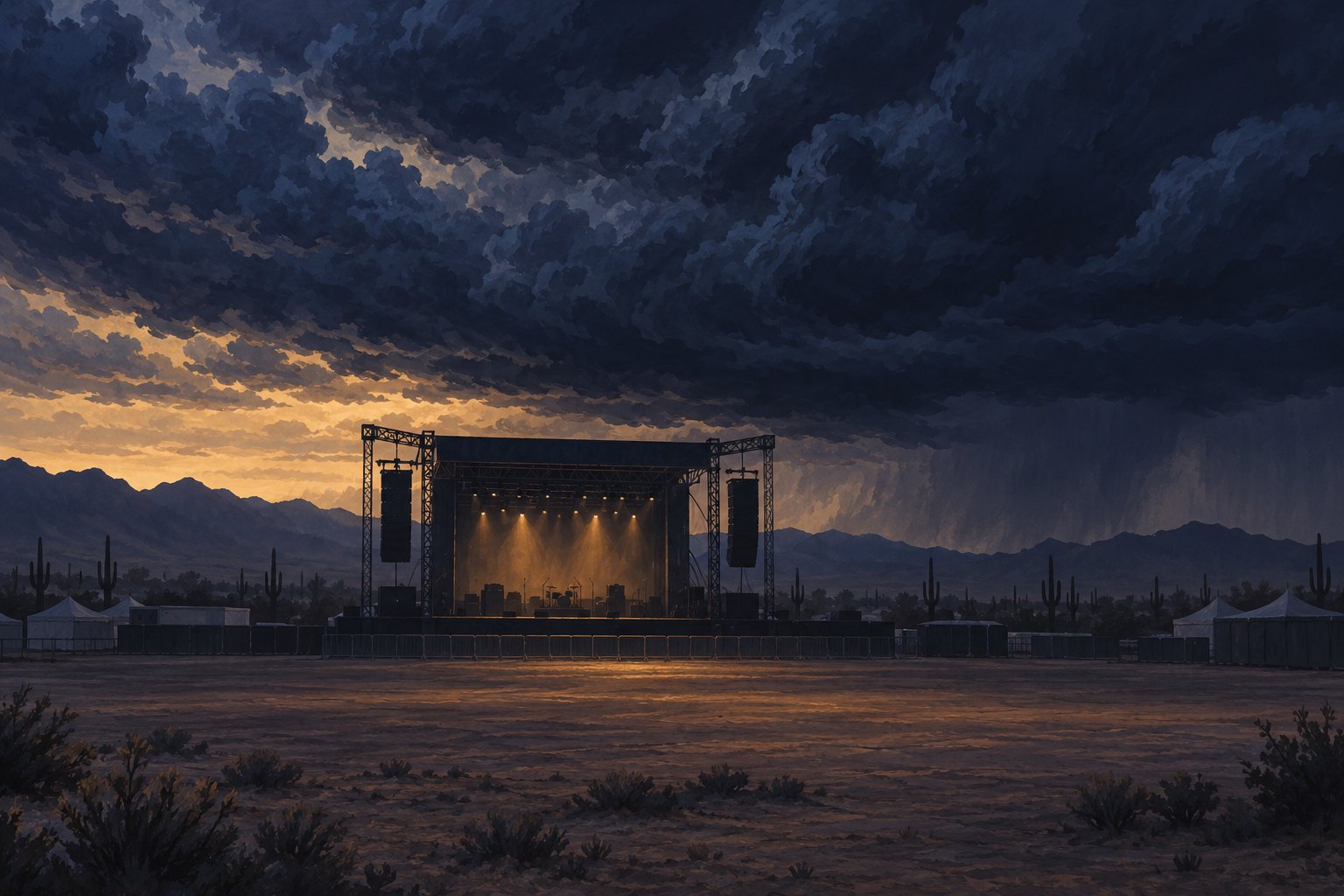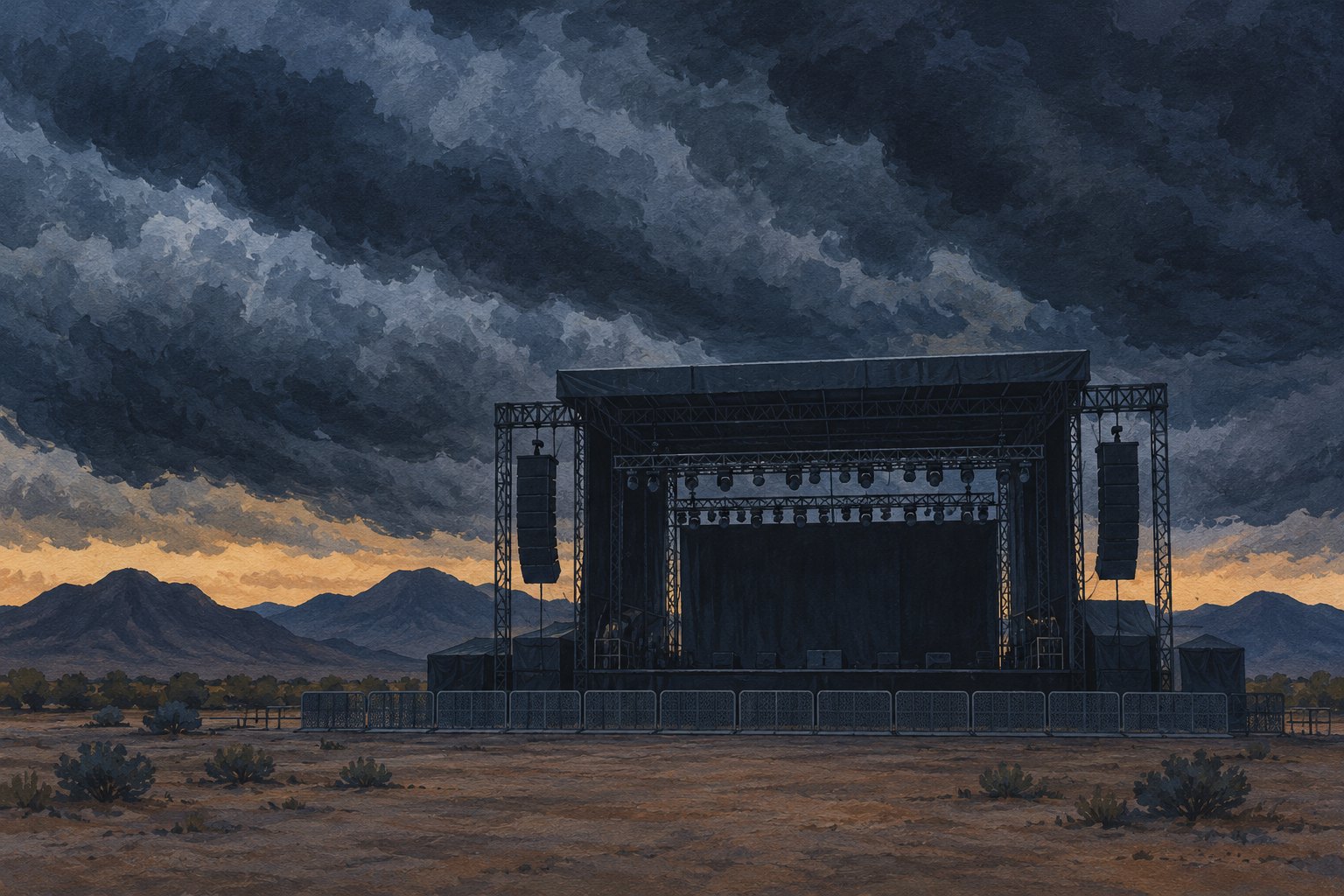
Calvin Harris’s Head Trip set was canceled, and the festival venue in Indio, California, was evacuated amid severe weather. The Desert Sun reported the cancellation and evacuation, while ABC7’s coverage identified lightning as the reason the night ended early. For anyone looking for an assessment of Harris’s performance, that leaves an essential distinction: there is a cancellation to discuss, but no completed set to review.
The interruption also leaves an experience that deserves consideration beyond the operational update. A festival ticket buys access to a program, but audiences bring personal priorities that a running order cannot fully describe. For someone whose evening revolved around seeing Harris, losing that performance could change the meaning of the entire night.
This is commentary on the canceled performance and its significance for audiences, rather than an eyewitness concert review. Our Head Trip cancellation and evacuation overview addresses the immediate news. Here, the question is what happens to an entertainment experience when its most anticipated moment disappears.
What the cancellation tells us about Harris’s set
The reporting establishes an interrupted festival night and a canceled Calvin Harris appearance. It does not establish a musical failure. There is no basis here for assessing his transitions, pacing, track selection, stage presence, or connection with the crowd. Those judgments require a performance, and each would become speculation if attached to an evening he could not deliver.
Likewise, naming Harris in the cancellation headline does not establish that he personally made the decision to stop the event. His name identifies the performance audiences lost. It should not silently become an explanation of who controlled the weather response or why particular operational decisions were made.
This distinction matters because entertainment coverage can compress very different events into the same language of disappointment. An artist can give an unsatisfying performance; a performance can also become impossible. Both may leave an audience unhappy, but they call for different criticism. Head Trip’s interruption belongs in the second category on the facts available.
Why one missing performance can outweigh hours of entertainment
My view is that festival value is rarely experienced as simple arithmetic. Dividing a ticket price by the number of scheduled acts might describe one measure of access, but it cannot explain why someone chose this particular event. A single artist may be the reason for the purchase, the journey, or the gathering of friends.
That is a possible audience perspective, not a claim that every Head Trip attendee came for Harris. Some people may prioritize discovering artists; others may care most about a shared outing. The same cancellation can therefore produce sharply different assessments without either group misunderstanding what happened.
Anticipation also changes how time feels. When a listener expects a particular performance later in the evening, everything before it can become part of the approach: the trip, the wait, the earlier music, the conversations between sets. Remove the anticipated performance, and those hours may feel unfinished even if they contained genuine pleasures.
There is a useful comparison with dramatic structure. A film builds expectations through arrangement, giving certain moments greater weight because of what precedes them. A festival running order can encourage a similar sense of arrival. The difference is that a live event remains exposed to circumstances beyond the program. Its intended emotional destination is never guaranteed.
Disappointment does not require a villain
One unhelpful response to a weather cancellation is to treat disappointed fans as though acknowledging their loss means rejecting the decision to end the show. Those positions do not follow from each other. Someone can accept that an event has stopped and still feel that an eagerly anticipated experience has been taken away.
The reverse shortcut is equally weak: the scale of someone’s disappointment does not establish negligence. A canceled appearance alone cannot tell us whether the relevant decisions were timely, whether contingency planning was adequate, or whether an alternative was feasible. Those questions need evidence about the event’s operation.
A fair account should leave room for emotion without turning emotion into proof. The fan’s frustration is part of the experience. Responsibility for particular decisions is a separate question. Keeping those ideas distinct makes criticism more useful, because it directs attention toward claims that can actually be examined.
Our commentary on Barry Manilow’s interrupted return to the stage considers a related tension between audience expectation and an interrupted appearance. The circumstances differ, but both invite care with the assumption that an advertised performance must reach its expected conclusion.
How to assess the night without rewriting it
For anyone describing their Head Trip experience, specificity will be more revealing than an all-purpose verdict. Calling the entire event a triumph or a disaster can obscure the difference between music that was heard, music that was missed, and the experience of having to leave.
- Evaluate performances individually. Describe what an artist actually played and how it worked before drawing conclusions about musical quality.
- Identify the personal significance of the missing set. Saying Harris was the main reason for attending explains disappointment more clearly than assuming everyone shared that priority.
- Separate observed conditions from inferred motives. What someone saw or heard can support an account; assumptions about what artists or organizers were thinking cannot.
- Keep later arrangements separate from the canceled appearance. Any replacement performance or ticket remedy would need its own confirmation and assessment.
This approach also protects the work of other performers from being erased by the headline. A lost appearance can dominate an attendee’s memory without providing a verdict on every artist involved. Conversely, enjoying earlier music does not oblige someone to describe the missing Harris set as insignificant.
The performance audiences cannot recover through imagination
There is a temptation to fill the absence with an imagined ideal: the songs Harris would have chosen, the moment the crowd would have recognized an opening, the release that might have followed. That imagined set can explain longing, but it cannot serve as a record of the night. No specific track, surprise, or artistic decision should be assigned to a performance that did not happen.
The deeper significance of Head Trip’s interruption is the difference between buying entry and receiving the moment one hoped for. Live entertainment depends partly on that hope. People arrive with private associations and expectations that cannot be fully replaced by another recording or another date.
Harris’s canceled set leaves those expectations unresolved. The most honest critical response is to recognize the missing experience precisely: an anticipated appearance lost to a weather-disrupted evening, with real disappointment for those who came to hear it. That is substantial enough to discuss without inventing either a performance or a culprit.
Original content by this site's editorial team. Published: October 11, 2026 at 03:03:46 PDT (Los Angeles time)