
Kelly Clarkson says a Brooklyn store treated her as though she could not afford its merchandise, prompting her comparison to Pretty Woman. Her reported declaration, “You just lost a huge sale,” recalls the movie’s most satisfying retail reversal. Yet the film has another response to snobbery that gets considerably less attention: someone can simply decide to help before a humiliated customer needs a triumphant comeback.
That quieter possibility belongs to hotel manager Barney and saleswoman Bridget. Reconsidering the movie through their work gives Clarkson’s comparison a different emphasis. The question becomes less about how an excluded shopper wins and more about which people make exclusion possible—and which people interrupt it.
Spoilers follow for Pretty Woman, including its shopping and hotel scenes.
What Clarkson’s comparison establishes—and what it cannot
Clarkson’s account describes her perception of an encounter at a New York store. It should remain attributed to her, rather than become an established finding about an employee’s intentions. Coverage also describes the business promoting its staff’s kindness amid the controversy. Neither a customer’s movie comparison nor a business’s general statement of values supplies a complete account of an individual interaction.
The comparison nevertheless has an immediately recognizable emotional meaning. It invokes the experience of entering a commercial space and discovering that someone appears to have decided whether you belong before helping you.
Our earlier examination of Clarkson’s comparison and the sting of being judged considered that humiliation. Here, the more revealing material lies between Vivian’s rejection and her eventual revenge: the small acts of assistance that allow the story to move forward.
Vivian needs assistance before she needs applause
In Garry Marshall’s 1990 romantic comedy, Julia Roberts plays Vivian Ward, a sex worker hired by businessman Edward Lewis, played by Richard Gere, to accompany him during a week of engagements. Shopping for suitable clothes becomes one of her first encounters with the social expectations attached to the arrangement.
From Vivian’s perspective, the task is practical. She needs clothing for an unfamiliar setting. The boutique employees turn that task into an assessment of her appearance. Their refusal is especially cutting because they withhold the very service that would help her meet the standards being used against her.
Later, her explanation to Edward is devastatingly plain: “They were mean to me.” The sentence is more affecting than an elaborate speech would be. It names an injury without dressing it up as a sophisticated argument. My reading is that this directness supplies the emotional foundation for the larger shopping fantasy. Before viewers can enjoy Vivian’s victory, they must understand why she needs reassurance.
Roberts makes that need compatible with Vivian’s wit. The character can be observant and funny while still being hurt. That combination matters: resilience does not mean an insult has failed to land.
Barney’s kindness begins with an imperfect decision
Barney, played by Héctor Elizondo, initially approaches Vivian as someone who may be out of place in his hotel. He does not enter the story free of the assumptions the film is examining. His position involves maintaining an institution’s standards, and his first response reflects that responsibility.
What makes him interesting is the change in how he uses his authority. After hearing about Vivian’s difficulty, he contacts Bridget to arrange help finding a dress. He also teaches Vivian how to negotiate a formal place setting.
These are modest interventions, but they change the texture of her experience. Barney possesses information and connections that Vivian lacks. He can use that difference to embarrass her, or he can make the information available. His better choice turns expertise into something useful.
There is a limitation here. His assistance still operates within a world where Edward’s standing helps make Vivian acceptable. Barney does not dismantle the rules of the hotel. Nevertheless, his willingness to reconsider her gives the film a more credible human movement than instant, flawless acceptance would have done.
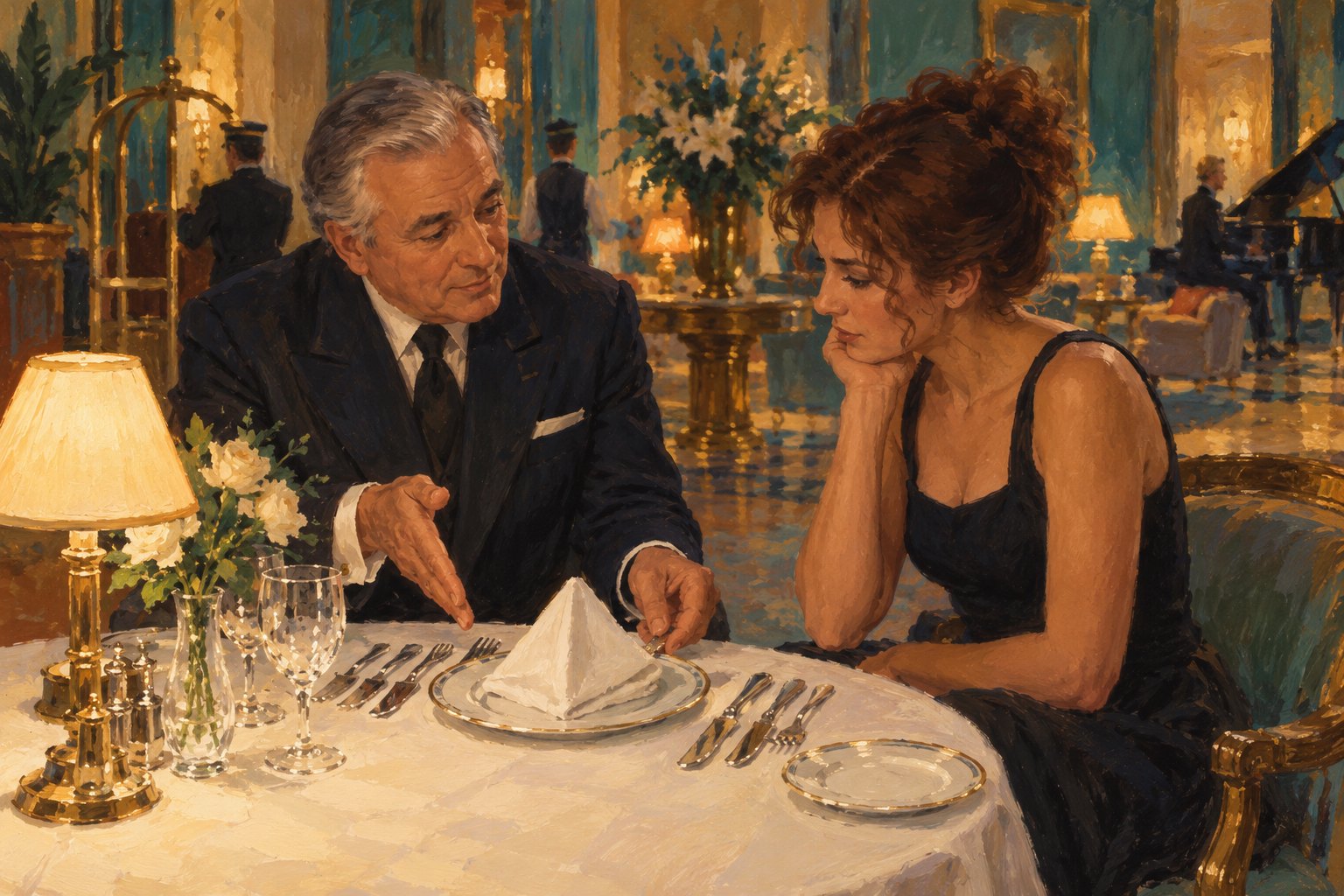
Bridget provides the scene the revenge story needs
Bridget’s role is brief: she helps Vivian select a cocktail dress and treats her respectfully. Dramatically, that ordinary professionalism offers a useful comparison with the earlier rejection. The service Vivian requested was possible all along.
From Bridget’s position, the encounter is a job to perform rather than a social boundary to defend. That distinction is the scene’s value. She does not need to become Vivian’s confidante or deliver a lesson about tolerance. She can listen, respond, and make the situation easier.
For a film so closely associated with extraordinary wealth, this is an appealingly ordinary source of relief. The helpful person does not need to purchase an entire new life for someone. She needs to do the immediate thing well.
This also gives the supporting cast a structural purpose beyond adding warmth. If everyone Vivian encountered were cruel, the movie’s world would become a flat obstacle course. Bridget and Barney show that people working within similar hierarchies can make different choices.
Why the shopping comeback still gets the biggest laugh
When Vivian returns to the boutique that rejected her, carrying purchases made elsewhere, her verdict is brisk: “Big mistake. Big. Huge!” The scene converts an earlier embarrassment into a performance she controls.
Its appeal is partly grammatical. Those short fragments leave little room for negotiation. Vivian does not request another assessment or wait for permission to feel vindicated. She delivers the conclusion and moves on.
As comedy, the sequence is wonderfully efficient. As an answer to mistreatment, it is narrower than the scenes with Barney and Bridget. A spectacular lost sale makes poor service look foolish, but practical assistance demonstrates what better service would have looked like before the confrontation.
The difference is especially relevant to a celebrity complaint. Audiences may instinctively imagine a satisfying reversal when a recognizable person says they were underestimated. A movie can deliver that reversal with complete control over motives, timing, and reactions. An actual retail encounter does not come with the same access to everyone’s perspective.
The film’s deeper promise is permission to learn
Viewed through these supporting characters, Pretty Woman becomes a story about how people acquire confidence in unfamiliar surroundings. Clothes contribute, but so do explanations, introductions, and the freedom to ask a question without being punished for asking.
That is why the etiquette lesson deserves more attention than its modest scale suggests. Knowledge of a formal setting is learned knowledge. Treating it as an innate measure of someone’s worth mistakes experience for character. Barney’s instruction quietly exposes that mistake.
Our discussion of the importance of tenderness in Moonlight considers a very different film, but the attention to small, consequential gestures offers a useful viewing habit here too. Supporting actions can carry an argument that the biggest dramatic moment only partly expresses.
Clarkson’s complaint understandably brings the shopping comeback to mind. On another viewing, however, watch who helps Vivian before she can produce that comeback. The film’s most repeatable act of decency is not a grand purchase or a cutting exit. It is the decision to make an unfamiliar room easier for another person to enter.
Original content by this site's editorial team. Published: October 11, 2026 at 05:27:24 PDT (Los Angeles time)