MASHLE: MAGIC AND MUSCLES is heading into live action, with a March 19, 2027 release announced in Crunchyroll’s reporting. The news gives fans a date to anticipate and a particularly interesting filmmaking question: how do you translate a collision between magic and muscle into comedy that works with flesh-and-blood performers?
The announcement establishes an upcoming adaptation, not its artistic success. This is a spoiler-free critical preview, not a review of the completed movie. There is no basis here for judging its performances, quoting its screenplay, explaining its ending, or identifying screen-specific Easter eggs. What can be assessed is the creative challenge suggested by the title’s central contrast—and the choices that would make that contrast worth a feature-length film.
What the release announcement actually tells viewers
The useful headline is straightforward: a live-action MASHLE movie has been announced for March 19, 2027. Readers should distinguish that announcement from practical availability where they live. A release date alone does not establish local theater bookings, subtitled or dubbed screenings, streaming access, or ticket availability.
It also tells us little about the experience of watching the film. Neither recognition of the property nor enthusiasm for its premise can establish pacing, chemistry, or satisfying dramatic development. Those qualities emerge through scenes, and scenes need to be watched before they can be reviewed.
Our discussion of what a film announcement and teaser can actually tell viewers makes a useful companion here. Promotional material can introduce a tone or an image; sustaining that tone across a complete story is a separate achievement.
The strongest adaptation would begin with a point of view
Magic and muscles offer an immediately readable visual opposition. One suggests extraordinary power expressed through spells; the other suggests extraordinary power expressed through the body. But an opposition is only the starting point for a character. The interesting question is what each kind of power means to the person using it.
For this adaptation, I would look for scenes that establish the protagonist’s understanding of a problem before displaying his ability to solve it. Does he notice the same obstacle everyone else notices? Does an intimidating situation look ordinary from his perspective? Is his response driven by confidence, practical necessity, or an entirely different set of priorities?
These are criteria for the film, not descriptions of confirmed scenes. They matter because a physical solution can reveal personality as efficiently as dialogue. A carefully held glance, an unhurried movement, or a refusal to share another character’s alarm can make the audience understand someone before the screenplay explains him.
The danger would be treating the central character as a delivery system for spectacular feats. Viewers might admire the effects while learning little about the person at their center. A successful comic performance should remain interesting in the seconds before and after the impossible thing happens.
Physical comedy needs readable space
My strongest expectation for a live-action MASHLE is clear physical staging. When a joke depends on the difference between an elaborate magical solution and an unexpectedly direct physical one, viewers need to understand the obstacle, the available space, and the result.
That does not require every shot to be wide or every effect to be practical. It requires continuity of attention. The audience should know what a character is attempting, see enough of the action to understand the surprise, and have time to register the aftermath. Cutting away at every moment of contact can remove precisely the physical connection that makes a gag funny.
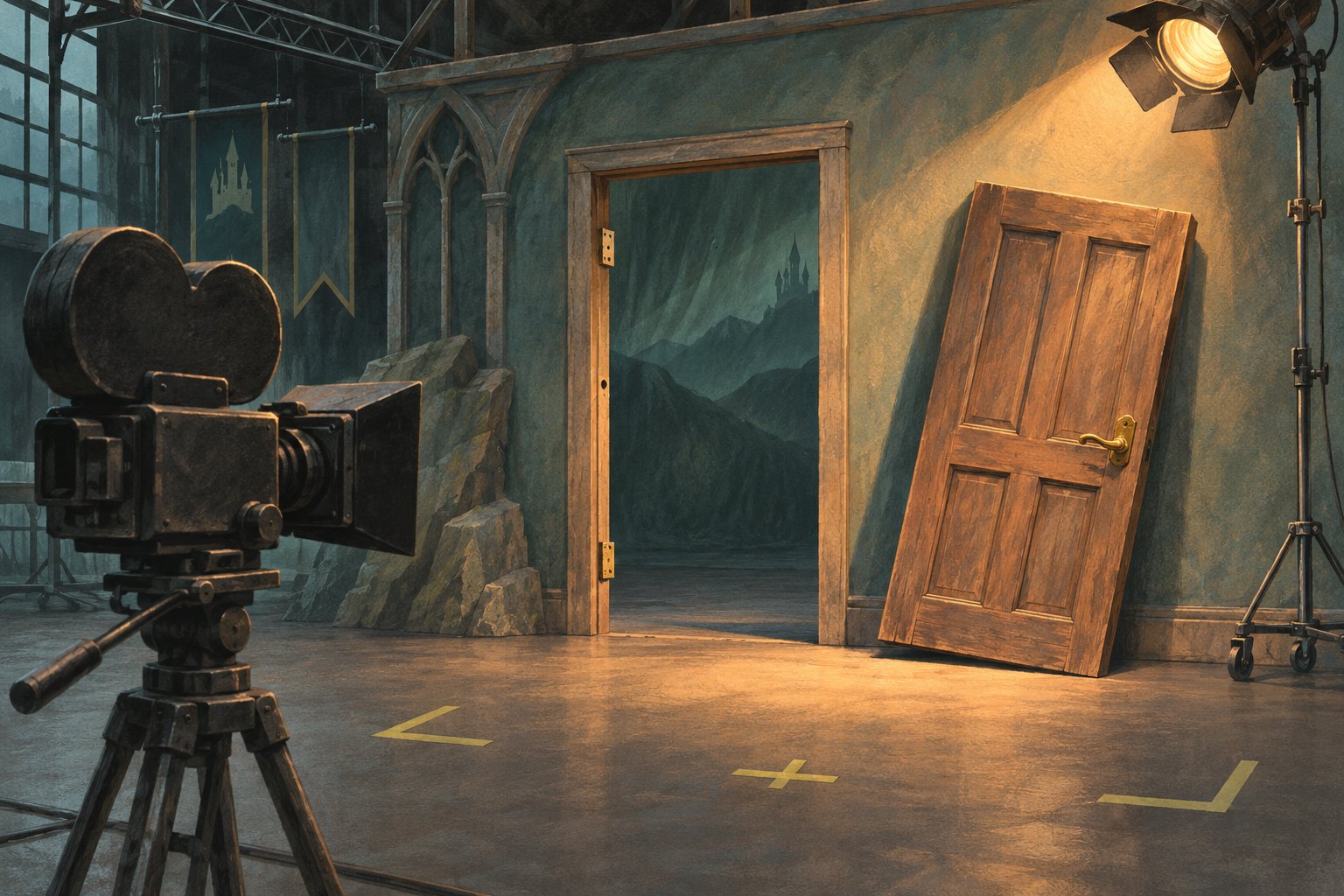
Consider a general filmmaking example: a door coming loose is not automatically a joke. The comedy could depend on how casually it happens, whether the person holding it recognizes the problem, or how long another character waits before responding. The image above illustrates that staging principle; it does not depict a confirmed sequence from the movie.
Sound deserves equal attention. A small, matter-of-fact noise can sometimes make an impossible action funnier than a thunderous impact. Silence can leave room for embarrassment or disbelief. If every feat receives the same triumphant musical treatment, the film risks flattening different emotional beats into one repeated announcement of strength.
The other characters must have more to do than react
A central physical performer benefits from a surrounding cast with distinct priorities. Surprise becomes repetitive if everyone expresses it in the same way. One person might experience an unexpected display of strength as a threat, another as reassurance, and another as an inconvenience. Those are possible dramatic approaches, not casting or plot claims.
What matters is that reactions emerge from relationships. A rival’s frustration should mean something different from a friend’s concern. Authority figures need reasons for expecting obedience. Without those differences, an ensemble can become a collection of faces waiting for the next punch line.
Our character-focused look at the live-action Naruto project raises a related adaptation question: recognizable abilities can attract attention, but relationships give those abilities emotional consequences. For MASHLE, the particular challenge would be preserving room for comic surprise while making the people around the central figure matter.
What would make an early trailer persuasive?
A trailer cannot prove that a feature works, but it can offer better evidence than a succession of impressive images. For this film, these would be the most useful things to watch for:
- A complete comic exchange: enough setup, action, and reaction to reveal timing rather than merely promise humor.
- Distinct performance rhythms: characters who respond differently instead of sharing one exaggerated register.
- Understandable physical action: movement whose direction and consequences remain clear through the editing.
- A personal stake: some indication of what success or failure means beyond winning a confrontation.
These measures leave room for different creative approaches. A broad, theatrical performance could work; so could a restrained one. The question is whether the surrounding filmmaking supports the choice consistently. Fidelity should include the function of a moment—why it is funny or affecting—not just its outward appearance.
The deeper test: what does strength prove?
The most promising interpretive question is whether physical power merely changes who wins or changes how the world judges a person. Those possibilities can produce very different films. One offers the pleasure of superiority; the other asks why superiority became a condition of acceptance in the first place.
That distinction gives this adaptation something substantial to explore beneath its comic contrast. An audience can enjoy an outrageous feat while also recognizing the absurdity of measuring someone’s entire worth through a single approved ability. Humor could make that idea tangible without requiring a speech to explain it.
For now, that remains a possibility rather than a verdict. March 19, 2027 gives the live-action MASHLE a destination. The artistic test will be whether the film can make an impossible physical act reveal a recognizable person—and whether the laugh still matters once the spectacle has passed.
Original content by this site's editorial team. Published: November 4, 2026 at 02:39:35 PST (Los Angeles time)