Sister Brother Manhole Cover has won the top prize at the Tokyo International Film Festival, according to Variety. The recognition brings attention to a film whose unusual title connects family intimacy with an object most people barely notice. That combination offers a useful starting point for understanding its appeal: the relationship between people trying to survive and a city whose physical possessions can become their means of survival.
Milcho Manchevski’s film received the Tokyo Grand Prix at the festival’s 39th edition. Reporting on the decision describes a jury response centered on the film’s compassion and its combination of comedy and suffering. Those are the jury’s assessments, rather than conclusions that an award alone can establish for every viewer. [Screen’s awards report](https://www.screendaily.com/news/tokyo-film-festival-unveils-2026-winners/5222049.article)
Premise spoilers follow. This is a critical reading of the documented story and the filmmaker’s public comments, not a firsthand screening review. It does not assess the ending, quote unverified character dialogue, or assign a rating.
Two Siblings and a Livelihood Built From the Street
The festival’s account introduces Malina and her older brother, Viktor, who steal metal objects in Skopje, North Macedonia, and sell them as scrap. Their targets include manhole covers and commemorative busts. When a bust falls on Viktor’s foot and seriously injures him, the siblings’ struggle becomes a search for medical help that takes them into the criminal underworld. The festival also describes Malina as protective of her brother, who has a developmental disability. [Tokyo’s official film discussion](https://2026.tiff-jp.net/news/en/?p=21083)
The shift from earning money to obtaining care gives the premise its emotional force. Before the injury, the siblings’ activity already involves danger and consequences for other people. After it, the immediate stakes become bodily and personal. What might initially sound like an eccentric crime comedy becomes a story about how quickly a precarious life can lose its remaining stability.
From Malina’s perspective, the central problem is practical: her brother needs help. That urgency offers a stronger foundation for character analysis than treating her simply as a representative of poverty. A person trying to secure treatment must assess whom to trust, what to risk, and which choices are still available. The moral question becomes inseparable from the conditions under which a decision is made.
Reading Malina Without Reducing Her to a Caregiver
Malina’s protectiveness is an important part of the published characterization, but it should not become the whole interpretation of her. Calling someone devoted can obscure the effort devotion requires. It can also make care sound like an instinct that costs nothing, rather than an ongoing responsibility carried through uncertainty.
A useful viewing question is how the film gives Malina room to exist beyond that responsibility. Does a moment reveal what she wants for herself? Does her judgment change when protecting Viktor becomes more difficult? These are questions to bring to the film, not claims about scenes that have not been independently examined.
They matter because social drama becomes more persuasive when its characters remain particular. A sister can love her brother and still have conflicting needs. A story need not make her exemplary to make her deserving of attention. Our discussion of how perspective shapes the stories a festival brings forward explores a related issue: visibility matters most when it includes agency.
Viktor’s Injury Changes What Survival Means
Viktor should likewise be understood as more than the event that sets Malina’s struggle in motion. The premise identifies an injured brother; a complete character reading must also ask how his own wants and decisions shape their relationship.
That distinction is especially important when discussing disability. Dependence in a particular situation does not erase someone’s personality or perspective. A responsible review would look closely at whether Viktor participates in the film’s humor, makes choices, and affects how others understand their circumstances. Without examining the performance, it would be premature to declare how successfully the film achieves that balance.
The injury nevertheless establishes a clear dramatic pressure. Survival is no longer only a matter of finding something saleable. It requires access to another person’s skills, resources, or willingness to help. Money and care become connected without becoming identical: possessing something of value does not necessarily mean having a dependable route to treatment.
Why the Metal Objects Matter
The premise places two kinds of public objects beside one another. A commemorative bust preserves a public image of importance. A manhole cover performs an ordinary protective function. Sold as scrap, both can be reduced to material and weight.
My reading is that this contrast gives the story a particularly sharp conceptual foundation. An object can hold historical meaning for one observer and immediate economic possibility for another. The difference does not automatically excuse theft. It reveals how radically circumstances can alter what someone sees when looking at the same street.
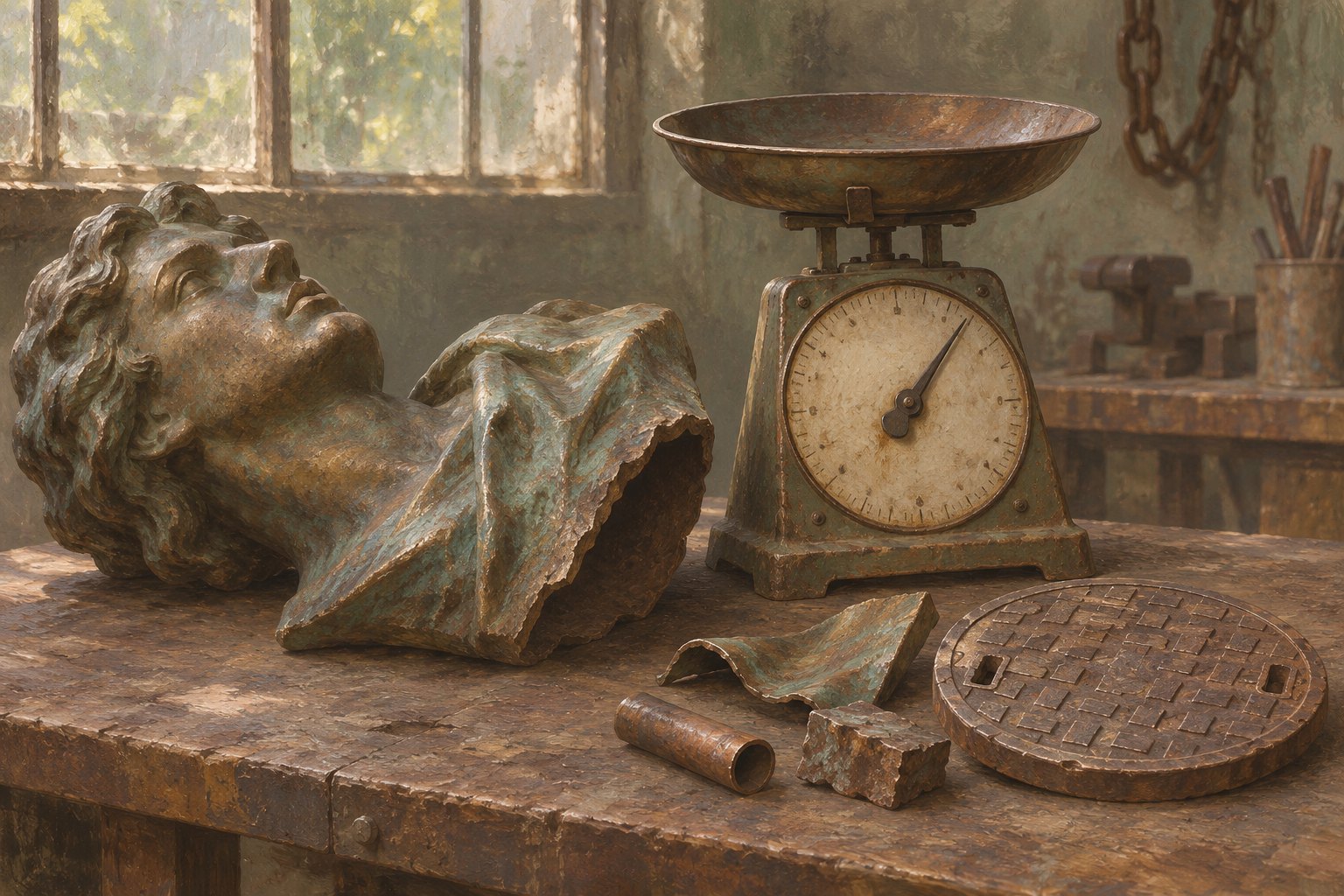
The bust that injures Viktor makes that tension physical. A symbol of public honor becomes a source of private suffering. Read as an allegorical setup, the accident connects the weight of a celebrated past with the vulnerability of a person living in the present. That interpretation follows the premise; it does not establish the meaning of every later event.
The manhole cover adds a less ceremonial dimension. Removing one compromises something shared. This prevents an easy reading in which survival makes every action harmless. The siblings’ needs and the consequences of meeting those needs can both deserve attention.
Humor, Compassion, and the Limits of an Awards Verdict
Comedy introduces another question: where does the laughter land? Humor can allow characters to retain appetite, inventiveness, and pleasure under pressure. It can also turn hardship into a spectacle. Distinguishing those effects requires attention to individual scenes, especially whose perspective determines the joke.
Tokyo’s recognition makes that distinction worth investigating, but it cannot settle it. A jury’s enthusiasm is a reason to seek out the film and form a judgment. Readers following festival discoveries can also use our guide to moving from festival attention to an informed watchlist. A prize announcement does not itself establish American theatrical or streaming availability.
A Deeper Reading: What Is a Person Worth?
The most compelling interpretive possibility in Sister Brother Manhole Cover lies in the difference between measurable value and human value. Metal can be weighed. Treatment can have a price. A sibling’s importance cannot be adequately expressed through either calculation.
Seen through Malina and Viktor’s documented predicament, the film’s premise asks what happens when urgent human needs must pass through systems of exchange. Its Tokyo win gives that question a larger audience. The eventual critical test is how fully the film allows these siblings to remain people—with desires, contradictions, and a relationship—inside a story that so readily invites symbolic interpretation.
Original content by this site's editorial team. Published: November 4, 2026 at 09:26:38 PST (Los Angeles time)