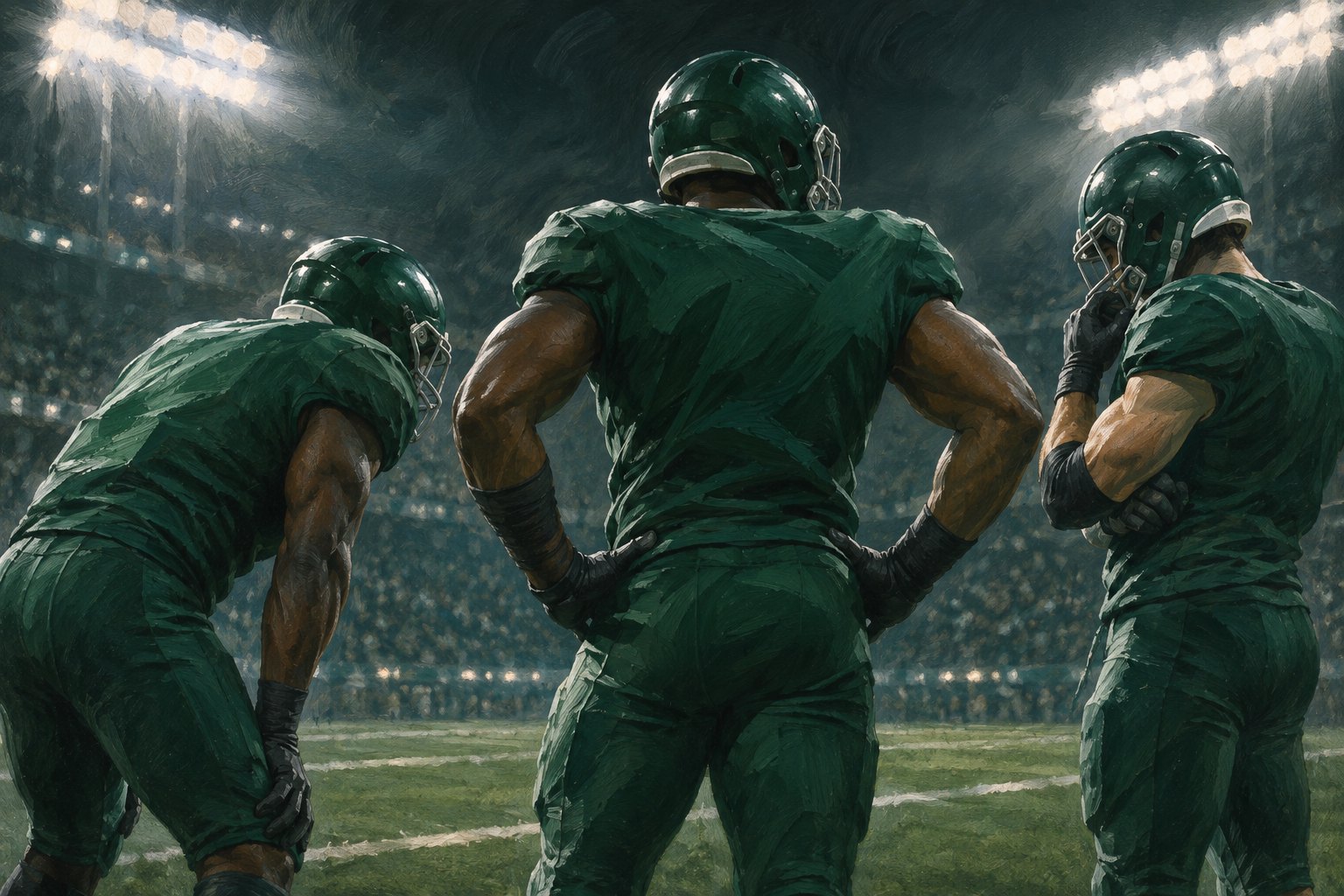
Drake Maye’s pump-fake touchdown against the Dolphins puts a small, potentially decisive gesture at the center of the action: the suggestion of a throw before the ball leaves the quarterback’s hand. The New England Patriots’ feature, Lazar’s Film Breakdown: Rewinding Drake Maye’s Pump-Fake TD vs. the Dolphins, identifies that moment as its subject. For viewers, the useful question is what the fake changes—and what the footage would need to show to establish its effect.
This is football film study, with “film” referring to game footage. There is no fictional plot to review or screenplay dialogue to quote. There is, however, a worthwhile connection to screen criticism: both reward attention to gestures, spatial relationships, and the difference between what someone sees and what an audience already knows.
Scope: The identified subject establishes Maye, the Dolphins, and a touchdown involving a pump fake. It does not, by itself, establish the scoring distance, receiver, defensive coverage, or precise sequence of reactions. The discussion below is a viewing guide and interpretation of that premise, rather than a frame-by-frame account of the play.
Start With the Fake, Then Look Beyond the Ball
A pump fake is an aborted throwing motion intended to suggest that a pass is coming. Its value depends on whether that suggestion influences an opponent. A visible arm movement can look impressive in isolation, but the more revealing evidence lies elsewhere: a defender’s footwork, a shift in balance, or a change in the space available to the offense.
For Maye’s touchdown, that distinction should guide the rewind. The existence of the fake and the eventual score do not automatically explain everything between them. To credit the gesture with creating an opening, a breakdown needs to connect the quarterback’s movement with a relevant defensive response and then with an advantage the offense uses.
That chain matters because successful plays can encourage convenient explanations. Once we know a possession ends in a touchdown, an earlier movement may appear inevitable or masterful. Close viewing asks a harder question: what changed at that particular instant, and how much did it contribute?
Maye’s Perspective: Selling a Possibility
Viewed from the quarterback’s position, the interesting problem is credibility. A defender has to consider that the suggested throw could actually happen. The ball, shoulders, feet, and surrounding action can all contribute to that impression. No single cue should be treated as decisive without seeing it in context.
There is also a cost to delaying a release. In general, an extra movement takes time while defenders continue moving and protection continues being tested. The useful analytical question is therefore whether a fake creates an advantage worth that delay. Simply counting an additional gesture tells us less than examining what becomes possible afterward.
It would be speculative to assign Maye a detailed internal monologue or declare exactly what he recognized. Observable behavior offers firmer ground. Where is his body oriented? Does the ball remain controlled? How does his next action relate to the space in front of him? Those questions keep an assessment focused on execution rather than imagined thoughts.
That attention to choices also informs our discussion of character decisions in television writing. The connection is limited but useful: a moment becomes more legible when we understand the available options and the consequence of selecting one.
The Dolphins’ Perspective: A Decision Under Uncertainty
A replay gives the audience an enormous advantage. We know a fake is coming, can watch repeatedly, and may have a view unavailable to anyone on the field. A defender must respond while the action remains unresolved. Judging that response fairly means resisting the temptation to confuse hindsight with an easy decision.
Depending on the assignment, a defender might be tracking an opponent, watching the quarterback, protecting an area, or balancing several threats. Without verified coverage information, it would be unfair to identify a particular responsibility or blame a player for abandoning it.
Instead, watch for a visible commitment. Does someone plant a foot, turn their hips, raise their hands, or redirect their path? Then ask whether the timing supports a connection to the fake. A movement that begins earlier may have a different explanation. A movement that follows the fake may still reflect another cue.
The distinction makes the play more interesting. Deception operates through a plausible alternative: something the defense has reason to respect. Understanding that alternative gives the offensive action meaning without reducing the opposition to a convenient supporting cast.

A Four-Pass Method for Watching the Touchdown
A useful rewind separates observation into manageable stages. Trying to track every player at once often leaves the viewer following the ball and missing the relationships that explain the outcome.
- Watch once at normal speed. Establish the rhythm of the action. Notice how quickly the fake and the subsequent movement occur, without assigning motives.
- Follow only Maye. Track his orientation, ball movement, and transition into the next action. Separate what is plainly visible from what the camera cannot reveal.
- Follow the relevant defenders. Look for changes in movement around the fake. Avoid assuming that everyone reacts to the same signal.
- Return to the wider sequence. Consider teammates, protection, and available space. Then watch at normal speed again to test whether the proposed explanation still fits.
This method also helps distinguish a useful slow-motion observation from an exaggerated one. Slowing footage can reveal the order of movements, but it expands the apparent time available for making them. A hesitation that seems prolonged on replay may be barely perceptible at playing speed.
Camera position imposes another limit. If a defender or receiving option leaves the frame, the missing action remains unknown. A responsible explanation should acknowledge that boundary rather than complete the picture with confident guesswork.
What Makes a Breakdown More Than a Highlight?
A highlight presents an outcome. A strong breakdown explains a mechanism and shows enough evidence for the viewer to evaluate it. For this Maye play, the most useful analysis would identify the apparent passing threat, examine any visible response, and connect that response to the touchdown sequence.
It should also leave room for shared credit. Football action occurs across the field, even when the replay centers on the quarterback. A pump fake may contribute to a successful play without being its only cause. The other contributions require footage before they can be described specifically.
For readers accustomed to movie criticism, this resembles the distinction between admiring spectacle and explaining how it works. Our commentary on how character choices give spectacle emotional weight explores that relationship in a cinematic context. Here, the relevant work is to connect a visible action with a demonstrable consequence.
The Deeper Appeal: Watching a Possibility Become an Outcome
My interest in the premise of Maye’s touchdown lies in its use of expectation. A pump fake offers one possible future—a pass now—while preserving another. Its effectiveness, when the footage establishes it, comes from making an opponent respond before the real action is complete.
That is why the rewind can be more rewarding than the initial celebration. It invites us to reconsider a gesture we might otherwise overlook. The touchdown supplies the payoff; attentive viewing investigates the decisions and movements that made it possible.
The strongest reading of this play will therefore remain specific and proportionate. Notice the fake, examine the response, account for the surrounding action, and distinguish visible evidence from interpretation. Maye’s moment deserves that kind of attention: curiosity about how it worked, paired with enough discipline to let the footage determine the answer.
Original content by this site's editorial team. Published: November 4, 2026 at 08:10:55 PST (Los Angeles time)