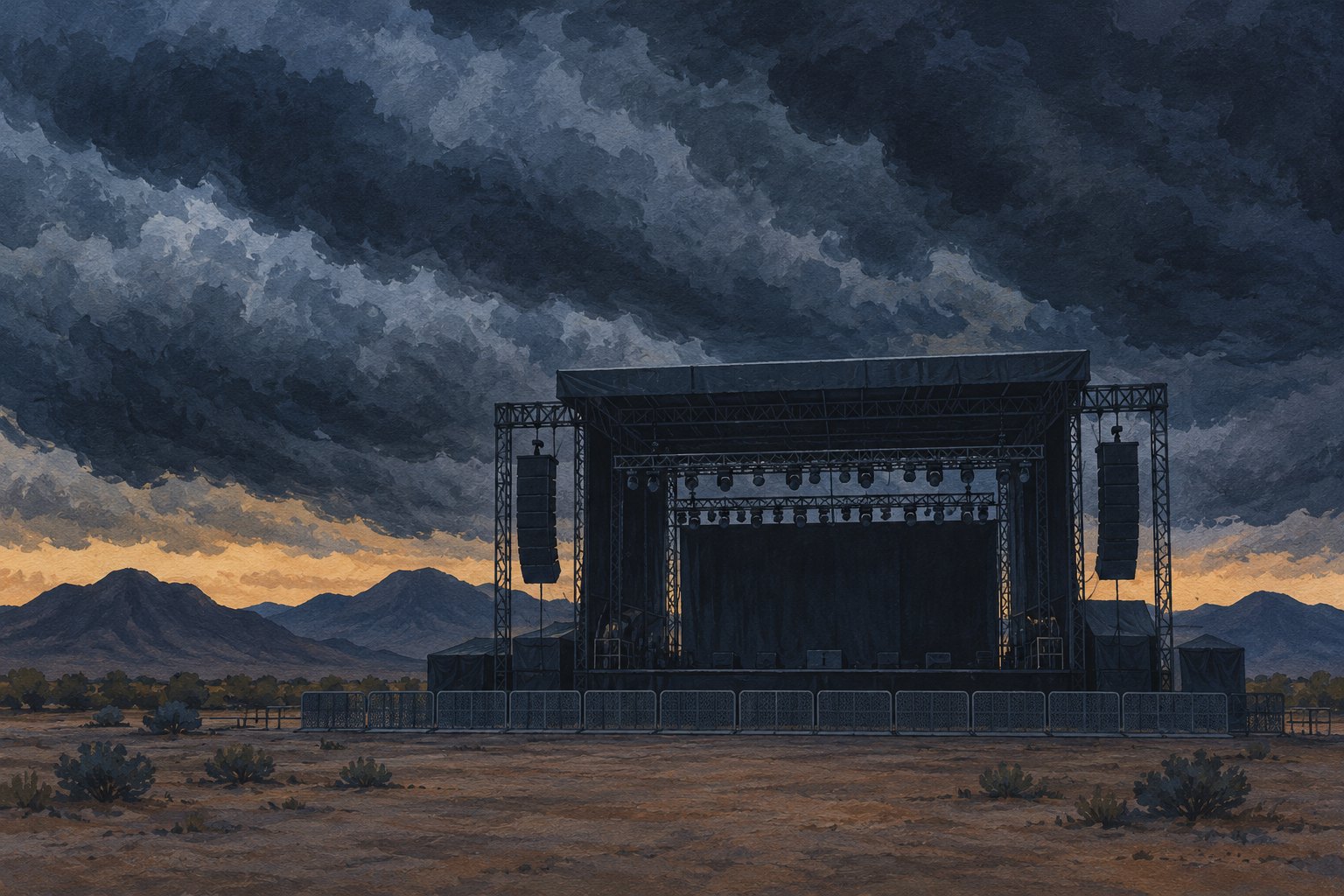
Head Trip’s Saturday night performances were canceled as the venue was evacuated amid a severe weather threat in Indio, California. The Desert Sun reported the cancellation and evacuation, while KESQ described a weather-related suspension and ABC7 Los Angeles identified lightning as the reason the music festival ended its show early.
For anyone trying to understand whether the interruption was simply a delay, the essential distinction is that Saturday’s remaining performances were reported canceled. That does not, by itself, establish the status of subsequent programming, replacement performances, or refunds. Each requires its own announcement.
The immediate story concerns an interrupted live music event. The broader question is how a festival communicates when the experience people expected becomes impossible to deliver. The assessment below separates the reported circumstances from editorial judgments about what audiences need next.
What the Head Trip reports establish
The central facts are limited but consequential: Head Trip’s opening night ended early; Saturday night sets were canceled; the venue was evacuated; and coverage connected the interruption to severe weather and lightning. These points describe the scope and reported cause of the shutdown without establishing every detail of how it unfolded.
They do not provide a complete account of which artists performed, how much of each set took place, or which scheduled appearances never began. A published timetable describes an intended program. After a disruption, it cannot serve as a reliable record of what audiences actually heard.
Similarly, the word evacuation should not become shorthand for unverified scenes of panic, injuries, or damage. None of those circumstances follows automatically from the fact that people were directed to leave a venue. A responsible account can explain the seriousness of the interruption without decorating it with dramatic details.
For readers following developing coverage, three questions belong in separate categories:
- What happened Saturday? The remaining nighttime performances were reported canceled as the venue was evacuated.
- Why did the event stop? Reporting identified severe weather and lightning.
- What happens afterward? Subsequent programming, ticket remedies, and replacement appearances require specific confirmation.
Suspension, cancellation, and evacuation mean different things
Those three terms can appear together while describing different decisions. A suspension means a performance has stopped, potentially while conditions are assessed. Cancellation means the affected performance or program will not proceed as scheduled. Evacuation concerns people leaving the venue, rather than the artistic program alone.
For Head Trip attendees, the difference is practical. A notice announcing a pause leaves open the possibility of a restart. A cancellation closes that possibility for the performances it covers. An evacuation instruction addresses an immediate action. People should not have to infer one from another.
This is also why an earlier schedule or suspension notice can become misleading when circulated without later context. The useful question is whether a message addresses the same date, the same portion of the program, and the latest decision. A screenshot can accurately preserve an announcement that no longer describes the situation.
Saturday’s cancellation should therefore be understood at its stated scope. It is neither evidence that every planned festival activity was canceled nor a promise that anything else will proceed.
What ticket holders can usefully check next
The next useful information will be operational: what happens to affected admission, whether any programming changes, and how ticket holders receive instructions. Those answers should come from explicit festival or ticketing communications. There is no basis here for promising an automatic refund, credit, or rescheduled set.
Attendees can make follow-up easier by keeping their purchase confirmation and saving notices relevant to their ticket. If a remedy is announced, the details matter more than the headline: which dates and ticket categories it covers, whether action is required, and whether a deadline applies.

A concise checklist helps keep separate questions from becoming one frustrating search:
- Check whether a notice concerns Saturday’s canceled performances or a different part of the event.
- Look for explicit confirmation of any revised admission or performance arrangements.
- Keep the ticket receipt and relevant cancellation messages together.
- Read the conditions of any announced remedy before assuming it covers a particular purchase.
- Direct unresolved ticket questions to the seller associated with the order.
These steps do not guarantee a particular outcome. They help ticket holders identify which announcement actually answers their question.
Why an early ending changes the whole experience
As an editorial judgment, a festival’s value cannot be measured only by the number of minutes it remains open. Audiences organize an evening around anticipation: the act they most want to see, the friends they meet, and the progression from one performance to another. When the program ends early, that anticipated shape disappears.
This does not establish what any individual Head Trip attendee felt. It explains why disappointment can persist even when someone understands the reported reason for stopping. Recognizing a weather threat and mourning a lost experience are compatible responses.
Our commentary on Barry Manilow’s interrupted return to the stage explores a related tension between audience expectations and the circumstances that prevent a performance from continuing. Head Trip presents a different cause, but the audience’s need for an understandable explanation remains.
The temptation in entertainment coverage is to turn an abrupt ending into a verdict on the entire event. That would outrun the evidence here. The cancellation establishes that the night could not continue as planned; it does not independently establish the quality of the performances that occurred.
How to judge the response without inventing a verdict
The reporting summarized here is insufficient to grade the evacuation’s execution. Such a judgment would require evidence about announcements, staff instructions, exit conditions, accessibility, and the experience of people moving through the venue. The fact of evacuation alone cannot answer those questions.
There is, however, a clear standard against which subsequent communication can be assessed. Useful notices identify what has been decided, whom it affects, and what recipients should do. When a decision remains pending, acknowledging that uncertainty is more helpful than leaving audiences to interpret silence.
That emphasis on practical support connects with our discussion of the shared resources that sustain film communities. Cultural events depend on more than what happens onstage or onscreen. Their surrounding organization shapes whether audiences can participate with confidence.
The next chapter belongs in clear announcements
Head Trip’s Saturday night ended with canceled performances and an evacuation amid reported lightning and severe weather. That is the central development. Questions about subsequent arrangements remain separate and should be answered on their own terms.
The deeper significance is straightforward: when the performance stops, the organizer’s relationship with the audience continues. Clear explanations, specific next steps, and accurate expectations become the most meaningful part of that relationship. For fans whose evening ended early, those are the updates that can turn an unresolved disappointment into an understandable outcome.
Original content by this site's editorial team. Published: October 11, 2026 at 01:51:19 PDT (Los Angeles time)