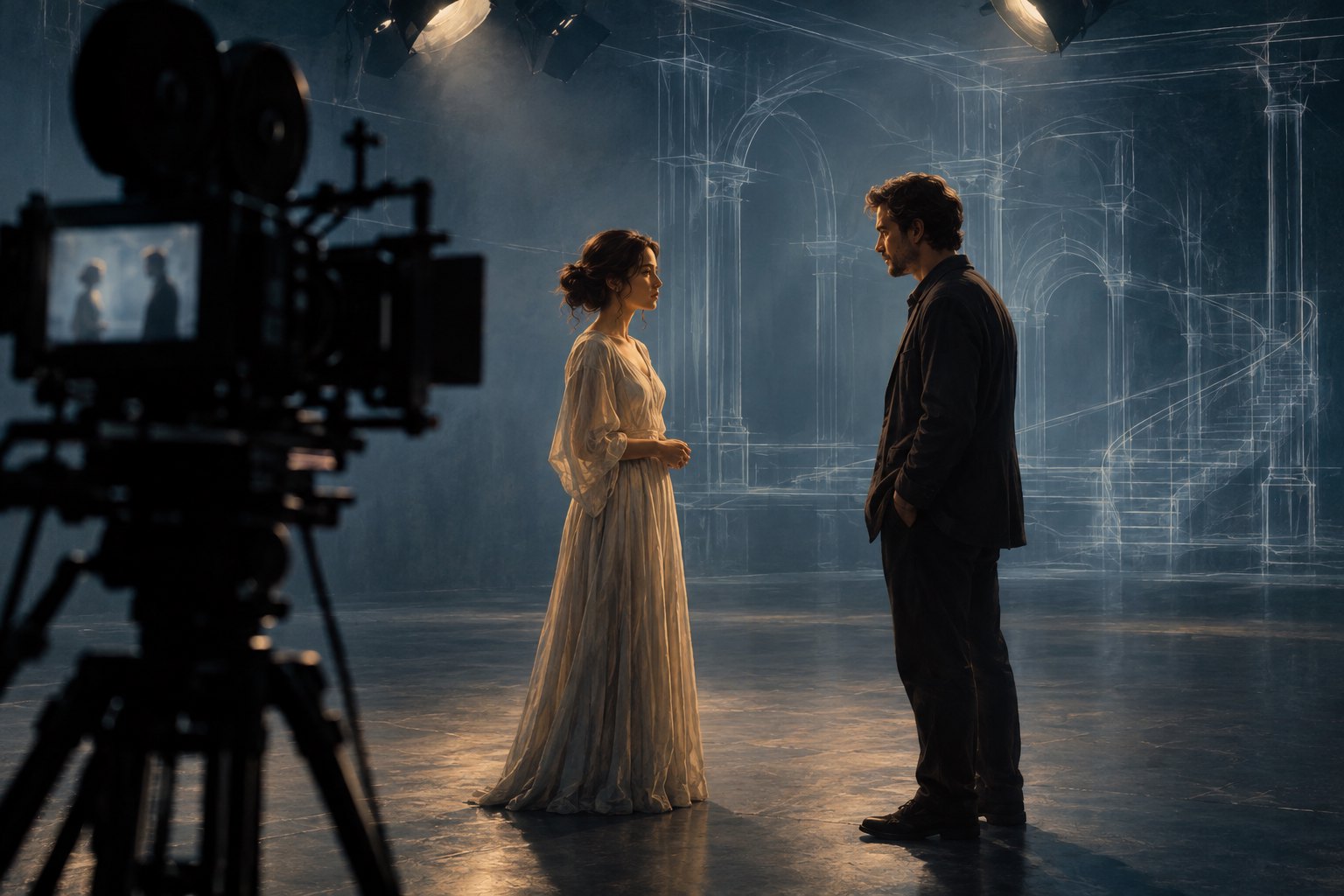
An AI-hybrid film can put human actors at the center of the frame while leaving the world around them to be constructed through other means. Variety’s report on a production with actors but no conventional set brings that possibility into focus. For moviegoers, the interesting question is what happens to the relationship between a character and the place they supposedly inhabit.
A convincing face can carry a scene. But a room also tells a story: who feels comfortable entering it, who stays near the exit, and who has the authority to sit while everyone else stands. My critical starting point is that an imagined environment earns its place when it helps us understand those relationships.
This is spoiler-free production commentary, not a review of a completed film. The available reporting establishes the broad premise, but does not provide enough verified story material here to assess individual characters, quote dialogue, or identify Easter eggs.
What the report establishes—and what remains open
The narrow basis for this discussion is Variety’s account of visiting an AI-hybrid production involving actors and the absence of a conventional set. That description does not, by itself, establish the precise tools, the extent of digital alteration, or how the final images will look.
It would be a mistake to turn that premise into claims about the entire production. We cannot infer its budget, shooting speed, staffing, or artistic quality. Nor does the presence of actors settle how their recorded performances might be treated afterward. Those questions require specific reporting.
The term AI-hybrid is therefore a starting point for inquiry. It is not a sufficiently detailed description of a filmmaking process, and it certainly is not a genre. A viewer still needs to know what kind of story the film tells and whether its formal choices serve that story.
A character needs somewhere to belong
Consider a hypothetical confrontation between two people in a kitchen. One knows the room intimately; the other is an unwelcome visitor. Before either speaks, their movements can establish the imbalance. The resident reaches for something without looking. The visitor hesitates before touching a chair.
This is an illustrative scenario, not a scene from the reported film. Its purpose is to show how much characterization can live in ordinary physical behavior. Familiarity with a space can communicate ownership, class, anxiety, or memory without explanatory dialogue.
When the surroundings are not physically present during a performance, those relationships still need to be designed. Where is the doorway? How far must someone move to escape the conversation? Is the object they glance toward within reach? The answers affect intention as well as blocking.
That concern connects with our discussion of how a borrowed location can acquire a convincing screen identity. In both cases, the critical issue is whether the setting expresses a lived relationship between people and place.
Physical contact gives emotion something to work against
A hand pressed against a table can reveal more than a carefully composed expression. It may suggest someone steadying themselves, restraining anger, or claiming authority. The meaning depends on pressure, timing, posture, and the surrounding action.
For me, this is one of the most useful ways to evaluate a film built around heavily constructed imagery: look at the points where bodies meet their world. Do people appear to carry weight? Does reaching for something interrupt their speech naturally? Does the environment seem capable of resisting them?
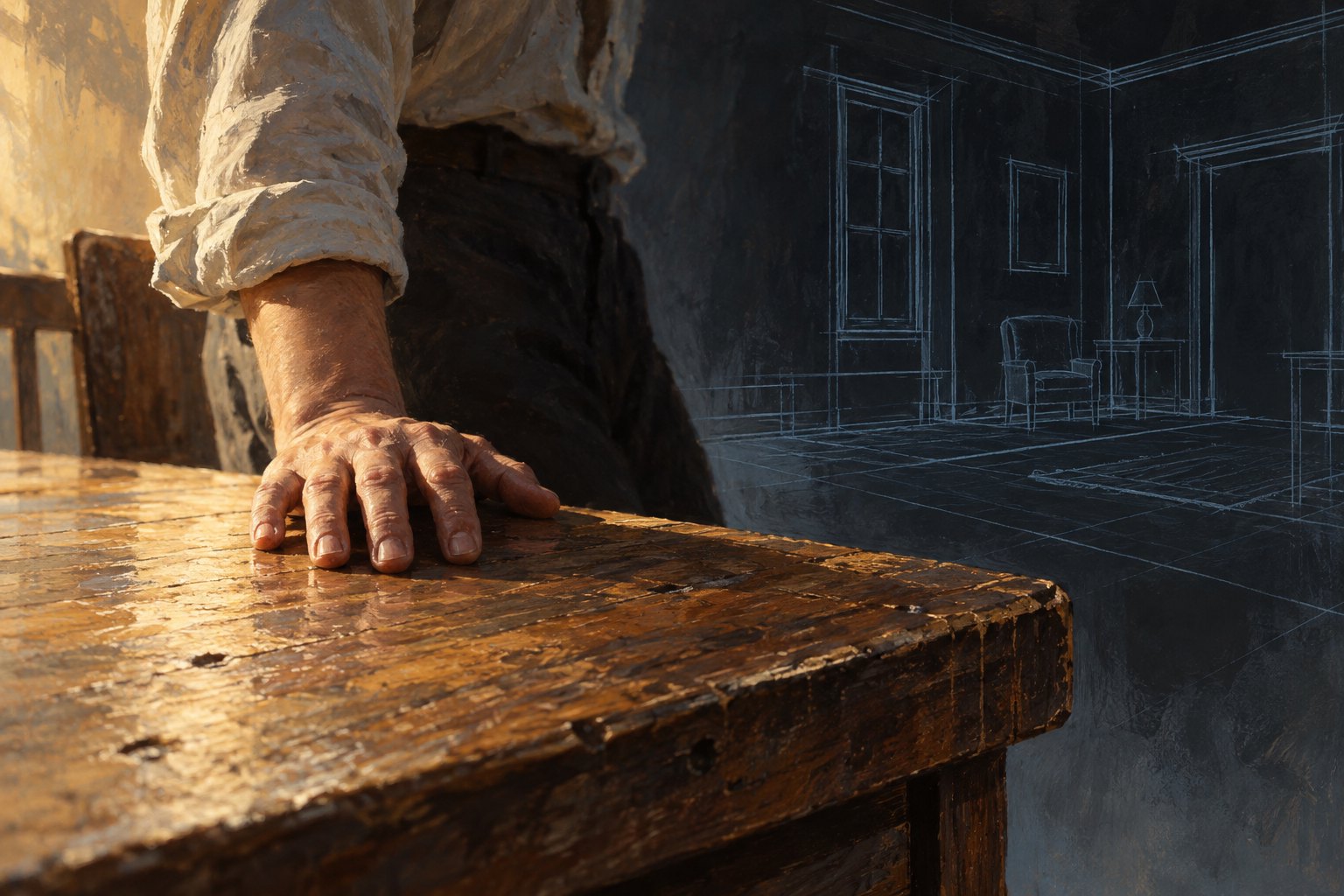
These questions do not require photographic realism. An openly stylized film can make its physical rules legible and emotionally persuasive. A dreamlike room might stretch or dissolve for a clear dramatic reason. What matters is whether the relationship between movement and consequence feels intentional.
The illustration above visualizes that principle; it does not depict the reported production. Nothing in the limited account establishes which practical objects, if any, its performers used.
The background can change what a performance means
Imagine the same restrained expression framed against two different environments. In a cramped room, it might feel like someone suppressing panic. Against an enormous empty landscape, it might suggest isolation. The actor’s expression has not changed, but its dramatic context has.
That is why decisions about scenery belong inside a discussion of performance. If an environment can be extensively reshaped after filming, the creative question becomes whether those changes preserve the intention of the scene. A more spectacular image might make a character’s small gesture harder to notice.
My preference would be for visual choices that protect meaningful behavior. If a pause is the turning point of a conversation, the composition should give us a reason to watch it. If distance expresses estrangement, the geography should remain clear enough for that distance to register.
The same principle informs our analysis of why striking individual moments still need coherent dramatic structure. A memorable image contributes most when it develops a relationship or changes our understanding of a character.
How to judge the finished film fairly
A production experiment deserves scrutiny without a verdict being decided by its label. When finished footage becomes available for assessment, four questions would make the discussion more useful:
- Is the space understandable? Viewers should be able to follow important entrances, distances, and obstacles unless disorientation has a clear dramatic purpose.
- Does the environment support character perspective? Framing and scale should help communicate what a person notices, fears, or wants.
- Do interactions hold together across cuts? A glance, reach, or change in position should remain believable as the viewpoint changes.
- Does the imagery develop? Repeated settings should acquire meaning through events rather than merely supply fresh decoration.
These are viewing criteria, not findings about this production. They also leave room for surprise. A film might deliberately break spatial consistency to place us inside a character’s unstable perception. The relevant question would then be whether the disruption builds an intelligible emotional experience.
The deeper issue is whether the world answers back
The premise of actors working without a conventional set invites fascination with what filmmaking can remove. The more revealing artistic question concerns what the finished film must retain: resistance, consequence, and a sense that people belong to a world larger than the frame.
A character becomes legible through choices made under particular conditions. A doorway can offer escape. A familiar room can hold an unwelcome memory. A table can separate two people who cannot say what they mean. However those elements reach the screen, their dramatic work remains essential.
Variety’s report presents an intriguing production premise. It does not yet justify praise or dismissal of the resulting film. The standard I would bring to it is straightforward: do the actors and their surroundings create a shared experience that makes the characters’ choices matter? That is where the experiment could become cinema worth discussing long after its method stops being novel.
Original content by this site's editorial team. Published: October 6, 2026 at 07:13:27 PDT (Los Angeles time)