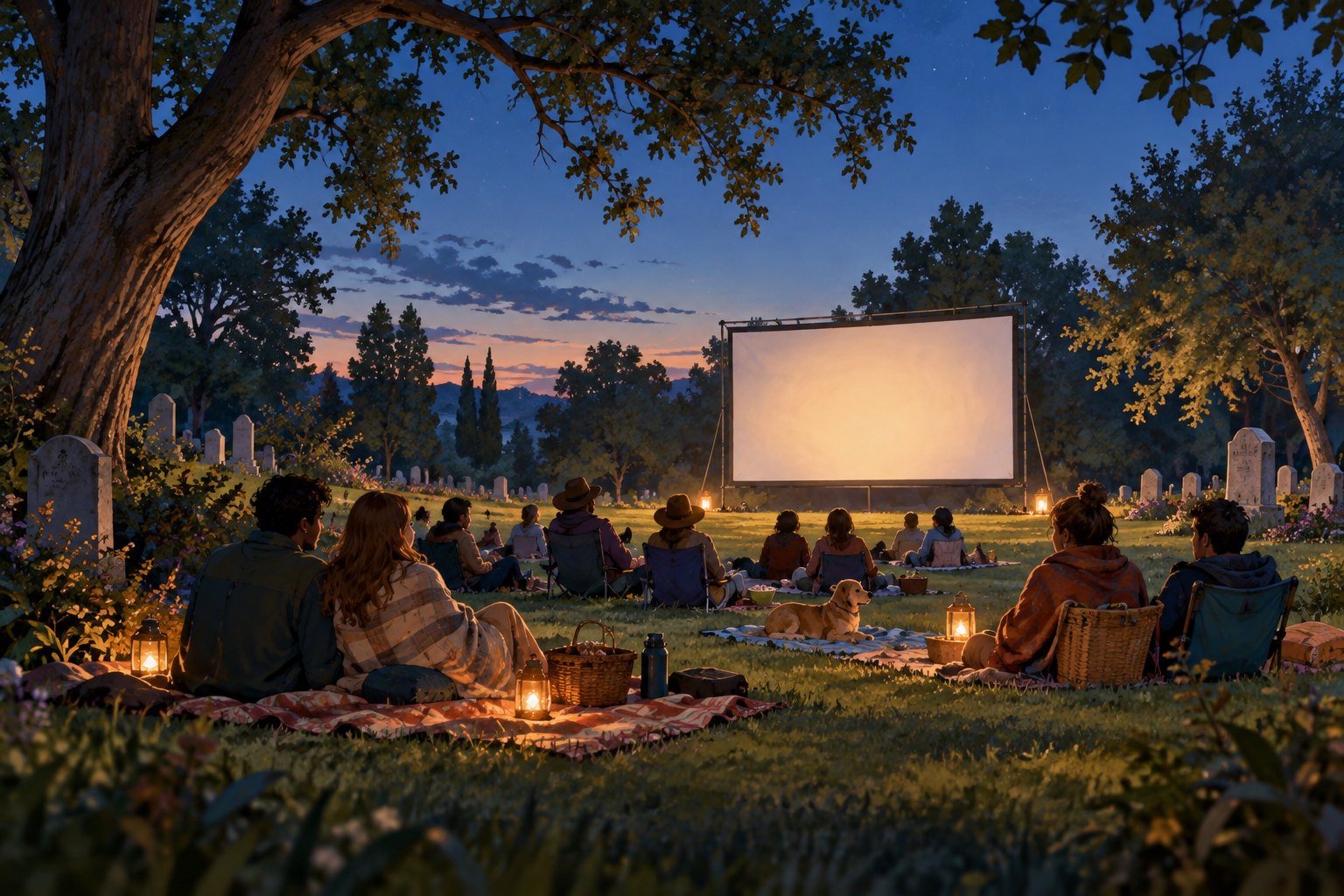
Picnic & a Movie in the Eastside Cemeteries gives a familiar adventure an unexpectedly thoughtful setting. San Antonio’s May 14, 2026, announcement named the original Jumanji as the selection for a free May 16 screening organized by the Office of Historic Preservation. That announcement concerns a past date, rather than an upcoming October performance. The city connected the gathering with Preservation Month and its work caring for historic burial grounds. [City of San Antonio announcement](https://www.sa.gov/Directory/News-Releases/Picnic-a-Movie-in-the-Eastside-Cemeteries).
The choice invites a closer look at a movie remembered for rampaging animals. Beneath its noisy adventure, Jumanji asks what happens when a child loses the chance to grow up alongside the people he loves. A cemetery setting brings that question into focus: the film’s deepest wish is to recover time that ordinary life cannot return.
Spoiler warning: This review discusses the original film’s major character developments and ending. The accompanying illustrations are conceptual, rather than photographs of the San Antonio event.
Alan returns home, but home has moved on
The 1995 film begins its central ordeal when young Alan Parrish encounters a mysterious board game. Playing with Sarah Whittle, he is pulled into its jungle. Twenty-six years later, Judy and Peter Shepherd release him, leaving the four players to finish what Alan and Sarah started. Robin Williams plays the adult Alan, with Bonnie Hunt as Sarah, Kirsten Dunst as Judy, and Bradley Pierce as Peter. [Sony Pictures’ film overview](https://www.sonypictures.com/movies/jumanji).
For Alan, rescue initially seems to promise restoration. He can leave the jungle, find his family, and become himself again. Williams makes the flaw in that expectation painfully visible. Alan has an adult body and survival instincts, but neither automatically gives him the emotional resources of someone who has experienced an ordinary adulthood.
His impatience is therefore more revealing than his competence. He knows that danger can arrive without warning, yet struggles with the needs of the children beside him. The performance works because Williams allows Alan to be frightened, irritable, and occasionally unfair. Survival has kept him alive without resolving the conflicts he carried into the game.
Alan’s discovery that his parents have died gives the adventure its strongest emotional interruption. Escaping a prison cannot restore the life that continued outside it. In my reading, this is the moment when the film becomes more than an elaborate exercise in household destruction: the real damage exists beyond the board.
Sarah’s experience deserves equal weight
Sarah challenges Alan’s assumption that he alone suffered. Her protest is direct: “Last time I played this game, it ruined my life.” She remained in the ordinary world, but nobody believed her account of his disappearance. Her reluctance to resume playing follows from that experience. [Film dialogue transcript](https://www.springfieldspringfield.co.uk/movie_script.php?movie=jumanji).
Hunt gives Sarah a defensive humor that makes her more than the person who needs persuading. Her hesitations register as an attempt to preserve the stability she has managed to build. Alan wants her to accept an emergency immediately; she needs him to recognize that his return also reopens a wound.
Their argument exposes an uncomfortable habit: measuring pain competitively. Alan treats the extremity of his ordeal as proof that Sarah’s distress should come second. The scene becomes more interesting when the children offer reassurance instead of another comparison. Cooperation begins to look possible when fear receives acknowledgment.
That is also a useful distinction for viewers revisiting the film as adults. Sarah’s participation matters because the game requires it, but the emotional question is whether the group can make participation feel less like abandonment repeated. Her perspective prevents Alan’s homecoming from becoming the only experience that counts.

Judy and Peter turn survival into responsibility
Judy and Peter have lost their parents, giving them an understanding of absence that Alan initially overlooks. Peter’s attempt to manipulate a roll triggers his transformation toward a monkey; later, winning the game returns Alan and Sarah to childhood. Those events make the rules consequential while giving the ending its extraordinary opportunity to change the future. [Plot and cast reference](https://en.wikipedia.org/wiki/Jumanji_(film)).
Through the children, the film tests Alan’s idea of adulthood. Being the oldest person in the room does not make him the most patient or dependable. He must learn to protect people whose mistakes resemble the impulsiveness he would rather forget in himself.
Peter’s predicament is especially effective because the attempted shortcut is understandable. He wants the ordeal to stop. The punishment is frightening, but the more revealing question is how Alan responds to a frightened child who has made things worse. Authority becomes useful only when it includes sympathy.
This emphasis on behavior connects with our discussion of why action stories need personal consequences. Spectacle gains force when it changes what characters owe one another. Here, every new disaster makes the players’ dependence harder to ignore.
The thrills work best when they reveal character
My judgment is that Jumanji remains an engaging, emotionally uneven adventure. Its escalating hazards create momentum, but they sometimes crowd out the very relationships that make the danger matter. Sarah’s experience, in particular, could sustain more attention than the film’s rapid movement allows.
The effects are also uneven to contemporary eyes. Some animals have a conspicuously synthetic appearance, while the invasion of familiar domestic spaces still has a strong imaginative pull. A house should offer shelter; watching it become unreliable makes the premise immediately legible.
That relationship between a performer and an unstable environment echoes the question explored in how physical surroundings shape a convincing performance. The lasting impression comes from reactions, resistance, and vulnerability as much as from the creature itself.
Families considering the film should also distinguish its playful premise from its intensity. Pursuit, threatening animals, bodily transformation, and parental loss make it a potentially unsettling experience for sensitive younger viewers. The comedy provides relief, but does not erase those elements.
The ending makes courage an act of repair
Alan’s brief admission, “I’m terrified,” is more persuasive than a triumphant declaration of fearlessness. His final confrontation lets courage coexist with vulnerability. After the game’s resolution, he can approach his father differently, accepting responsibility and asking for a relationship with room for affection. [Film dialogue transcript](https://www.springfieldspringfield.co.uk/movie_script.php?movie=jumanji).
The ending’s fantasy is generous, perhaps excessively so. It allows the characters to avert losses that gave the story much of its weight. Yet its emotional logic remains clear: remembering suffering should alter how someone behaves when another opportunity arrives. Alan’s growth matters because he uses it beyond the immediate task of winning.
That makes Jumanji a resonant film to consider alongside Picnic & a Movie in the Eastside Cemeteries. Historic preservation cannot grant the movie’s impossible reversal. It can encourage attention to lives, relationships, and places that remain vulnerable to neglect. The connection is an interpretation of the pairing, rather than a claim about what attendees felt.
A casting detail worth noticing
Jonathan Hyde plays both Alan’s father, Sam Parrish, and the hunter Van Pelt. That double role is a visible connection rather than a secret cameo. [Cast reference](https://en.wikipedia.org/wiki/Jumanji_(film)).
To me, the shared face makes Alan’s childhood fear of judgment recur inside the adventure. The two characters are not interchangeable, but their resemblance invites us to see how an old anxiety can inhabit a new threat. Alan’s final achievement is learning that he can confront fear without reproducing its cruelty. That is the part of Jumanji most worth carrying away after the screen goes dark.
Original content by this site's editorial team. Published: October 6, 2026 at 07:51:15 PDT (Los Angeles time)