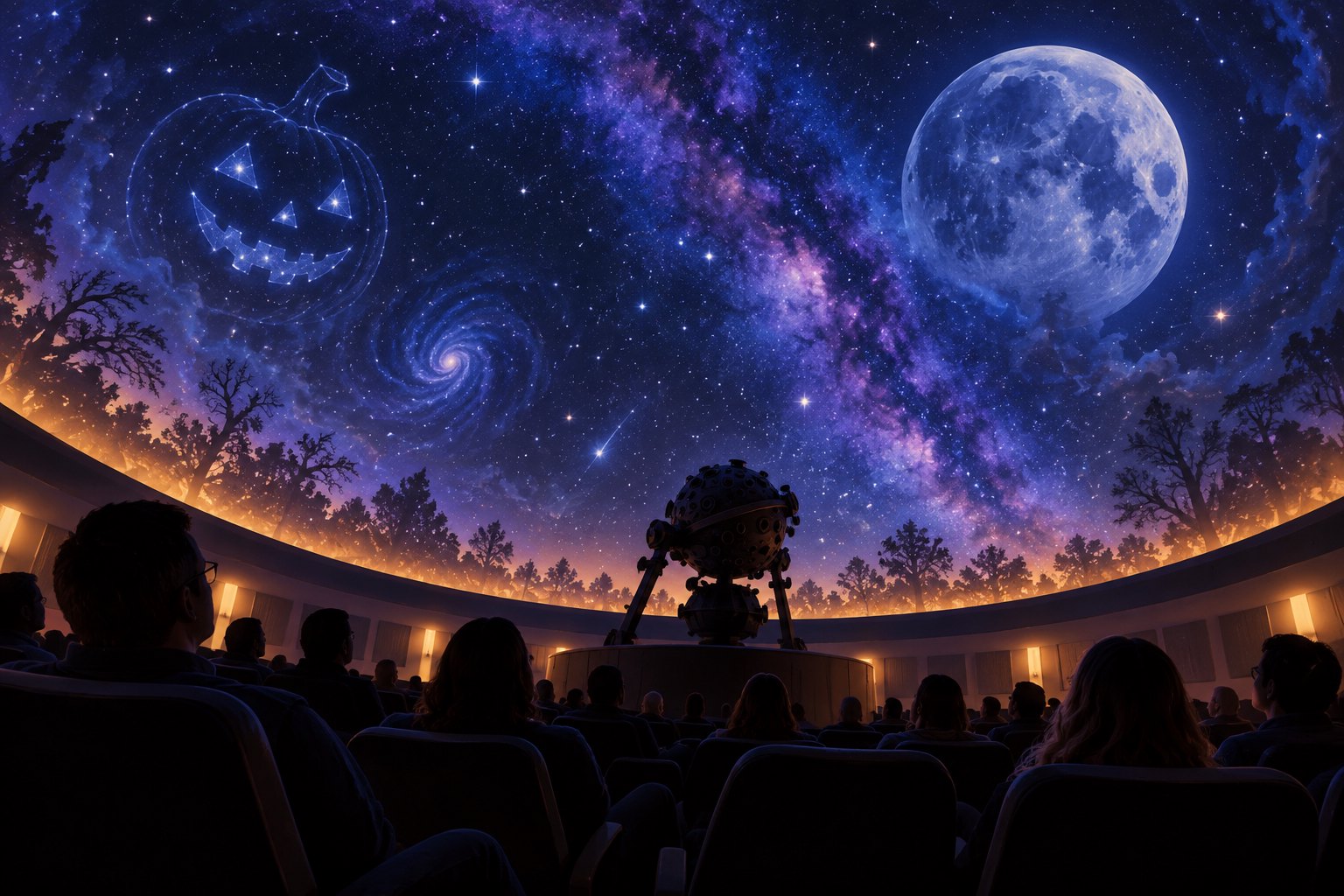
The University of Wyoming planetarium plans to premiere a new film and celebrate the Halloween season during October. For moviegoers looking beyond a conventional theater outing, that combination has an appealing premise: an evening built around discovery, with seasonal atmosphere adding another reason to step into the dark.
The university’s announcement establishes the film premiere and the October celebrations. It does not, by itself, establish that the new film is a horror movie or that the premiere and Halloween activities are the same event. That distinction matters when choosing a program. A new screen experience and a spooky seasonal outing can share a calendar without promising identical entertainment.
This is a spoiler-free preview and editorial analysis, rather than a review of a completed viewing. The interesting question is what this pairing can offer an audience—and how to judge the experience beyond the initial spectacle.
Why This October Pairing Makes Editorial Sense
A planetarium and Halloween share an unusually productive ingredient: darkness. In one setting, darkness invites people to observe. In the other, it encourages them to imagine what they cannot see. Bringing those associations into the same month creates room for curiosity and apprehension to sit beside each other.
That is the strongest reason to pay attention to UW’s announcement. Seasonal programming can make an unfamiliar venue feel approachable. Someone drawn by Halloween may become interested in the film program; someone attracted by a premiere may discover another way to enjoy the season. These are possibilities, not reported audience outcomes, but they explain the pairing’s appeal.
From an editorial perspective, the opportunity is more interesting than simply adding spooky decoration to a movie night. A thoughtful program can invite viewers to notice how quickly a change in context changes their response. Darkness can feel peaceful, mysterious, or threatening before a story has introduced a single antagonist.
The Viewer’s Perspective Becomes Part of the Experience
Character-focused criticism usually begins with a person on screen: what they know, what they want, and what they misunderstand. Without a verified account of this film’s characters or narrative, assigning those qualities would be speculation. There is, however, another perspective worth considering here: the viewer’s.
In a conventional movie, framing directs attention toward a selected part of the world. An immersive presentation raises a related question about orientation. Where does the audience look, and what makes one detail more significant than everything surrounding it? A large visual field still needs a clear dramatic or explanatory focus.
For me, the most promising use of immersion is to make a change in understanding feel tangible. Scale can help an audience reconsider its position within a scene. Movement can create anticipation. A sustained image can leave time for observation. None of those techniques automatically produces meaning, but each can serve it.
The useful test is whether viewers leave with more than a memory of impressive imagery. Can they explain how their understanding changed? Did the presentation help them notice a relationship or ask a more precise question? Those are fair standards to bring to UW’s new film without pretending to know its scenes in advance.
Halloween Atmosphere Does Not Require a Horror Plot
Halloween programming carries expectations, but those expectations vary widely. Some visitors want a frightening experience. Others want mystery, music, an autumn outing, or an event they can enjoy with family. The seasonal label alone cannot settle which experience a particular program provides.
For that reason, the film premiere should not inherit an imagined horror plot from its place on the October calendar. Nor should the Halloween celebrations automatically be treated as suitable for every age. Program descriptions, recommended audiences, and presentation details are more useful than assumptions about either the holiday or the venue.

As a matter of criticism, unease becomes interesting when it changes perception. An image can be beautiful while making a viewer feel small or uncertain. The emotional response does not have to resolve into a monster, a pursuit, or a jump scare. Sometimes the compelling element is the distance between seeing something and understanding it.
That attention to perspective also runs through our discussion of how viewpoint can shape an anthology’s suspense. The connection is a storytelling principle, not a claim that UW’s film shares that project’s genre or material: an audience’s knowledge helps determine what an image feels like.
Three Things Worth Watching Beyond the Visuals
Does the presentation guide attention?
A visually expansive experience can still become difficult to follow. Look for the relationship between the most prominent image and the idea being developed. Effective direction gives the audience a reason to focus, then rewards that attention. Constant visual activity is not necessarily the same as progression.
Does the pacing leave room to think?
An absorbing sequence needs time to register. If each new image immediately replaces the last, impressions may accumulate faster than understanding. My preference is for a rhythm that allows surprise, observation, and reflection to have distinct moments. Whether UW’s premiere achieves that balance remains a question for the screening.
Does the experience earn its emotional response?
Music, darkness, and scale can announce that something is momentous. Strong filmmaking makes the audience understand why. A useful distinction is whether the emotion comes from the subject and its development or chiefly from the presentation insisting on a reaction. The best experience would make those elements reinforce each other.
How to Choose the Right October Visit
Start by identifying what you want from the outing. If the attraction is the new film, prioritize the premiere’s program information. If the attraction is Halloween, examine the seasonal event descriptions individually. Do not assume that attending one means experiencing everything announced for the month.
- Check the specific event: Confirm its date, starting time, and whether it is a film screening or another kind of presentation.
- Match the audience: Look for age guidance and descriptions of intensity before planning a family visit.
- Understand the format: Ask about motion, lighting, sound, or accessibility needs that could affect your enjoyment.
- Confirm attendance details: Check current admission and reservation arrangements directly with the venue before traveling.
This is also a useful approach to a crowded film calendar: choose according to the experience you want, then check the practical details. Our discussion of building a thoughtful festival shortlist considers a similar problem of selection, even though a festival and a planetarium offer different settings.
The Deeper Appeal: Making Uncertainty Worth Exploring
UW’s October pairing suggests an interesting relationship between learning and seasonal entertainment. Halloween often invites us to enjoy uncertainty. An exploratory screen experience can encourage us to stay with uncertainty long enough to investigate it. The emotional starting point may be similar even when the destination differs.
That is my reason for finding the announcement promising. Its appeal lies in the possibility of turning a familiar fall outing into an exercise in attention: looking longer, noticing how atmosphere influences judgment, and distinguishing what feels mysterious from what remains unexplained.
The new film will ultimately need to stand on its own images, structure, and ideas. The Halloween programming will need to deliver the experience each event advertises. For now, the combination offers a clear invitation to moviegoers: consider a different kind of darkened room, and arrive ready to look closely.
Original content by this site's editorial team. Published: September 30, 2026 at 22:08:03 PDT (Los Angeles time)