The Transformers: The Movie remains my choice for the franchise’s best film because its robots have something more difficult to survive than an enormous battle: the disappearance of the leader who made their world feel dependable. The 1986 animated adventure is noisy, uneven, and occasionally impatient with its own emotional consequences. Yet its central question holds everything together. When Optimus Prime is gone, what does being worthy of him actually require?
Spoiler warning: This review discusses major deaths, Hot Rod’s transformation, and the ending.
Optimus Prime’s death changes the meaning of the action
The early violence establishes a frightening new baseline. Familiar Autobots fall during the shuttle attack, and the siege of Autobot City makes survival feel uncertain. These are mechanical bodies, but the film treats their destruction with enough finality to make the colorful battlefield uncomfortable.
Optimus initially appears to restore the familiar order. His arrival promises that courage, experience, and sufficient firepower can still solve the problem. “One shall stand, one shall fall” makes his confrontation with Megatron sound decisive. The tragedy is that defeating an enemy and surviving him are different achievements.
The deathbed scene succeeds through a drastic reduction in energy. After the running, shooting, and crashing, the Autobots can do little except watch. Optimus’s fading body gives loss a visual simplicity that the battle scenes deliberately lack. A figure who occupied the frame with authority becomes someone his friends cannot help.
This is also where the film earns its menace. As in our discussion of how vulnerability makes survival stories frightening, danger matters when the audience loses confidence in protection. Here, the strongest protector becomes the proof that protection has limits.
Hot Rod’s mistake is more interesting than a perfect hero
Hot Rod intervenes when Megatron threatens Optimus, only to become a hostage and complicate the confrontation. His intention is protective; his timing is disastrous. That distinction matters. Treating him as the sole author of Optimus’s death lets Megatron’s deliberate violence disappear behind the younger character’s mistake.
Nevertheless, the scene makes Hot Rod’s eventual elevation difficult in a productive way. He cannot simply arrive as an uncomplicated replacement. The audience has seen the distance between his eagerness and his judgment.
The film could explore that distance more fully. It does not give him a sustained confession or an extended reckoning with guilt. Reading his entire journey as an explicit redemption narrative overstates what the screenplay dramatizes. What it does show is a young fighter continuing to participate after an intervention has gone terribly wrong.
His relationship with Kup supplies a practical education. Their exchanges put youthful speed beside experience, while their shared danger makes each dependent on the other. Hot Rod’s growth emerges through cooperation more clearly than through introspection. He has to learn how to help without assuming that enthusiasm makes him sufficient.
That is a useful standard for action protagonists generally, and it connects with the question of strength and vulnerability in a prospective Helldivers lead: physical confidence becomes dramatically interesting when it cannot settle every problem.
Ultra Magnus shows why appointment is not certainty
Ultra Magnus gives the succession story its most sympathetic complication. Optimus chooses him to carry the Matrix of Leadership, but Magnus does not interpret that choice as proof of his own greatness. His hesitation makes the responsibility feel real.
When he cannot open the Matrix, the film separates holding office from possessing every answer. His failure need not mean that he is cowardly or morally deficient. He continues trying to protect the others. A leader can behave honorably and still be unable to deliver the particular miracle everyone needs.
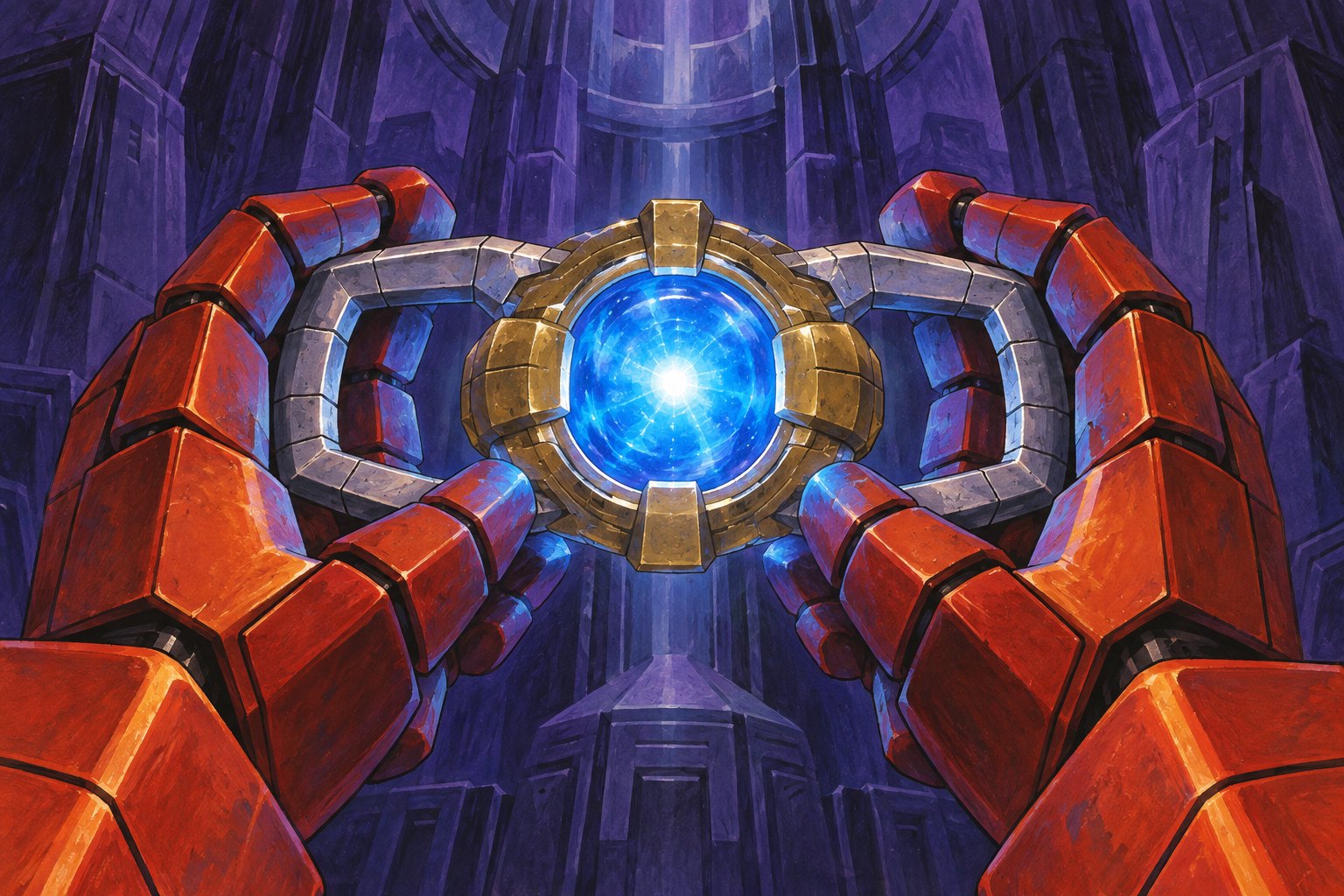
This makes the Matrix more interesting as a symbol than as a device. Its physical transfer is straightforward; the transfer of confidence, authority, and purpose is not. Magnus inherits the object before anyone understands what inheriting Optimus will demand.
Galvatron gains power and loses freedom
Megatron’s transformation into Galvatron provides the dark counterpart to Hot Rod’s journey. Unicron gives him a renewed body and a mission, but survival comes with subordination. The conqueror has become someone else’s instrument.
His return to interrupt Starscream’s coronation is wonderfully vicious theater. “This is bad comedy” punctures the ceremony before Galvatron destroys its beneficiary. The scene makes Decepticon leadership look absurdly brittle: legitimacy lasts only until someone more dangerous enters the room.
Yet Galvatron’s restored dominance is incomplete. He can terrify his followers, but Unicron can compel him. His attempt to turn the Matrix against his master exposes the difference between possessing power and being able to use it.
That parallel gives the climax substance beyond its scale. Magnus carries the Matrix as a duty; Galvatron treats it as leverage; Hot Rod ultimately becomes capable of releasing it. My reading is that the film’s competing models of leadership are embedded in those relationships to the same object. Responsibility, coercion, and possibility briefly become visible things.
The spectacle works, even when the storytelling rushes
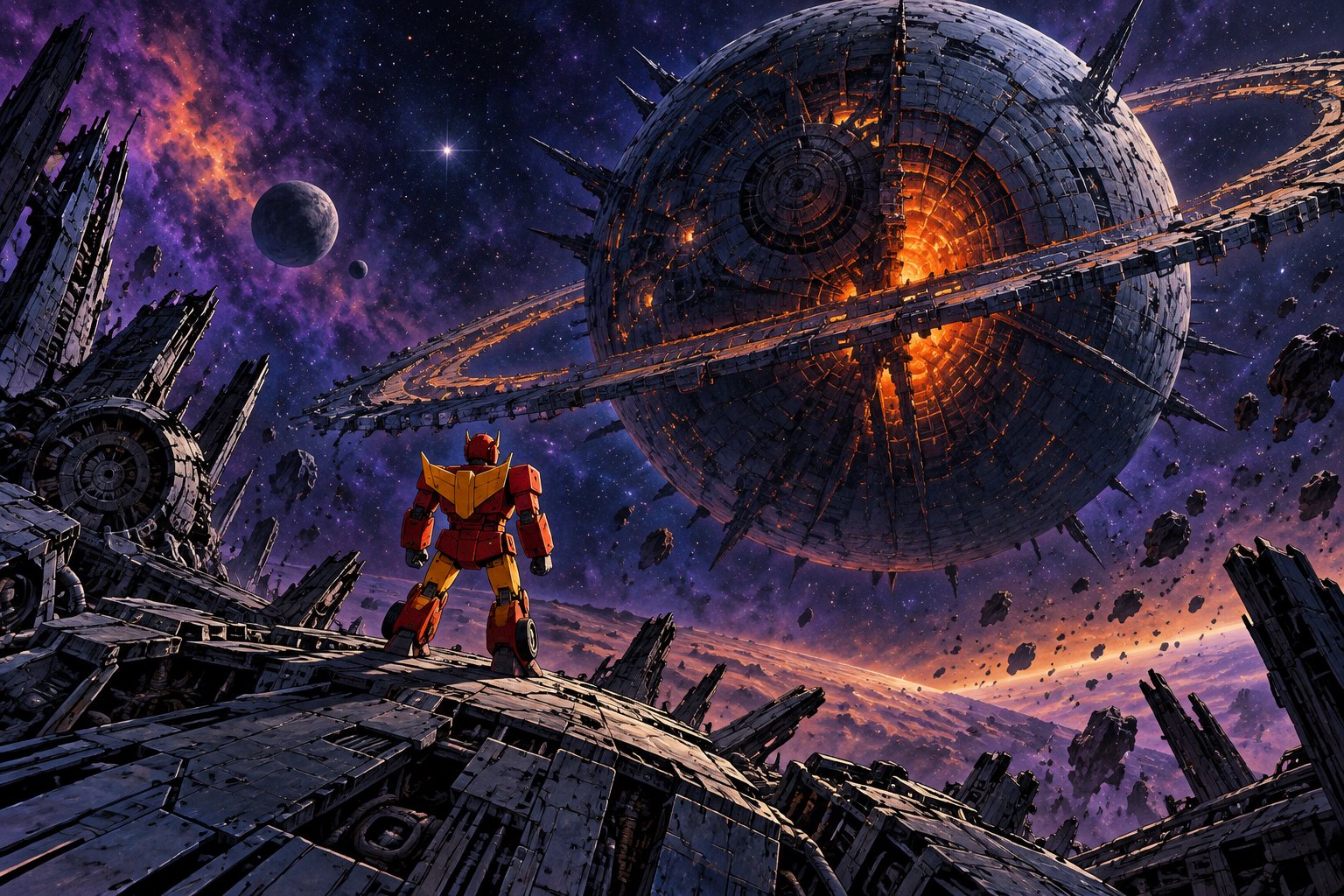
The animation’s strongest quality is its appetite for scale. Unicron makes ordinary combat seem almost provincial. Against a being that consumes worlds, the Autobots and Decepticons are suddenly small inhabitants of a much less manageable universe.
The music gives that universe a wonderfully excessive emotional register. Stan Bush’s “The Touch” makes heroism feel like something the film believes in without embarrassment, while Vince DiCola’s electronic score supports its stranger machinery and cosmic unease. The contrast between triumphant rock and threatening synthetic sound helps distinguish aspiration from dread.
The weaknesses are equally visible. The journey sometimes becomes a succession of encounters that must be cleared before the finale. Emotional aftermath receives less space than the next chase. Arcee remains capable and involved but gets little interior development, while several other characters function primarily as memorable voices or silhouettes.
The Junkion material also tests the tonal balance. Its comic energy can feel abrupt after the earlier losses. Still, repair and reconciliation offer a necessary alternative to the film’s repeated destruction. The adventure needs some evidence that these bodies, relationships, and communities can be put back together.
What the ending really passes on
When Optimus’s voice announces, “Arise, Rodimus Prime,” the climax makes recognition as important as transformation. Hot Rod receives an identity that links him to the lost leader, but the story does not literally turn him into Optimus. Continuity requires someone new.
Watch the earlier handoff of the Matrix again: Hot Rod catches it before passing it to Magnus. This is clear visual foreshadowing rather than a hidden Easter egg. The eventual successor has already touched the responsibility before he understands its significance. The return of “The Touch” similarly connects the younger hero’s emergence to Optimus’s earlier charge.
The deeper tension is between two kinds of unity. Unicron consumes difference until everything becomes part of himself. The Autobots’ closing aspiration, “Till all are one,” can instead be read as solidarity among distinct individuals. One vision achieves unity through annihilation; the other depends on people surviving together.
That distinction is why the film still lands. Its most meaningful transformation is the movement from needing an invulnerable protector to accepting shared responsibility after that protector falls. The plotting is rough, and the emotional transitions can be brusque. But beneath the guitars and planetary machinery is an unusually forceful adventure about carrying hope without the person who first gave it to you.
Original content by this site's editorial team. Published: September 19, 2026 at 08:01:11 PDT (Los Angeles time)