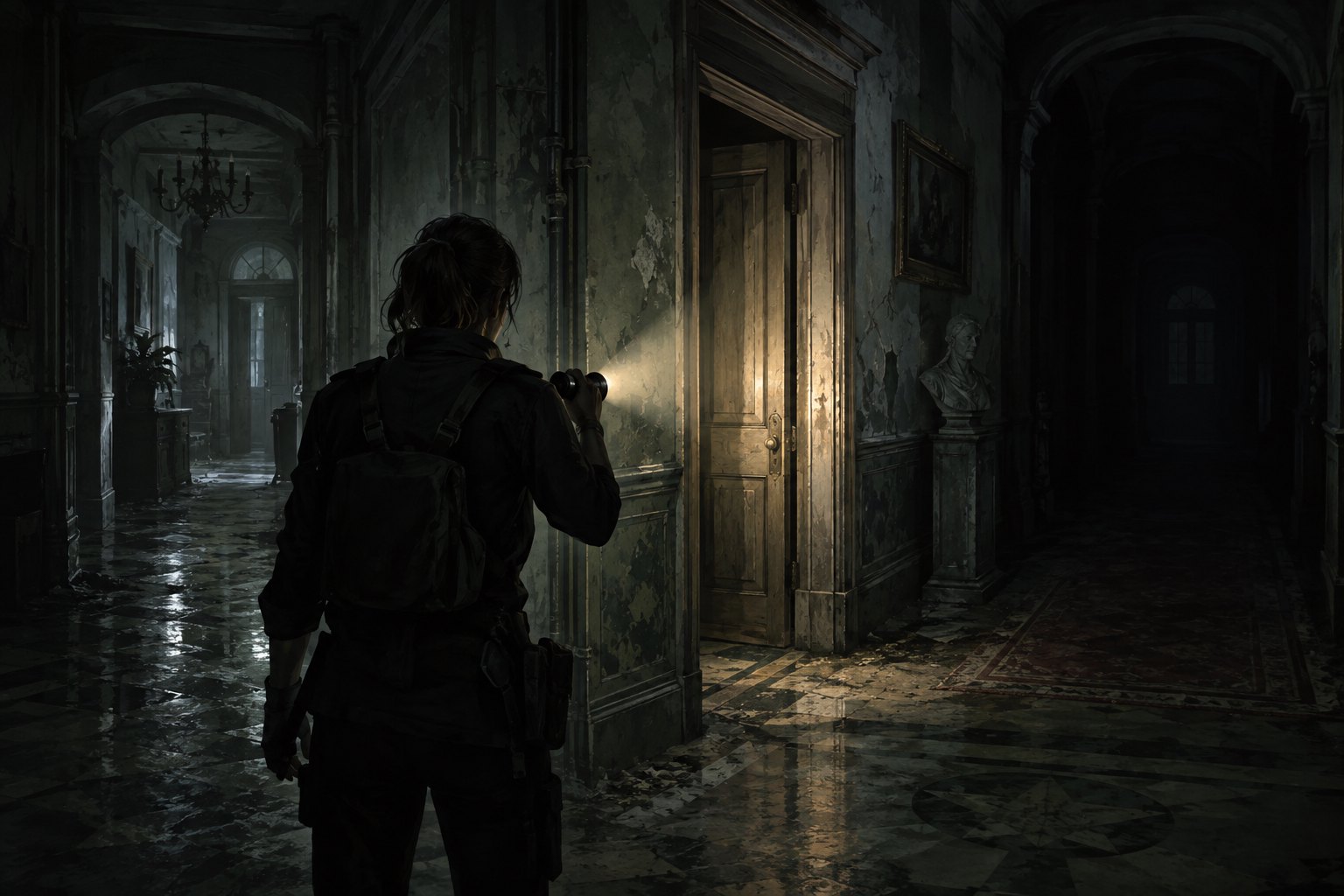
Zach Cregger’s Resident Evil makes a medical delivery into a nightmare about the limits of being useful. Following Weapons, his new horror film places Austin Abrams’s Bryan inside a system he barely understands, carrying something he believes matters while the people around him become increasingly impossible to help. The unsettling question is how long his ordinary sense of responsibility can survive the journey.
The most productive way to read this story is through Bryan’s changing understanding of care. He can transport a package. He can stop for an injured stranger. He has considerably more trouble answering someone who needs emotional certainty. By bringing those different obligations together, the film gives its grotesque ordeal a more uncomfortable shape than a simple test of courage.
Major spoilers follow, including Bryan’s fate and the ending. This is a character-focused critical interpretation of the film’s reported plot and dialogue.
A delivery offers the comfort of a manageable problem
Bryan’s girlfriend, Michelle, has told him she is pregnant. His response leaves their future unresolved. Meanwhile, another courier assignment offers double pay and a clear destination. He accepts it despite the snowy conditions and his inadequate preparation.
There is a revealing imbalance here. A delivery comes with an apparent definition of success: take this object to that place. An intimate conversation offers no such reassurance. Listening properly might require Bryan to admit that he does not know what he wants, or that another person cannot carry the uncertainty for him.
His “your body, your choice” response respects a principle while also functioning, in this context, as an emotional retreat. The problem is not the principle. It is his apparent hope that stating it will discharge his responsibility to participate honestly in the conversation. Michelle needs to know where he stands; he reaches for language that allows him to remain indistinct.
That makes the extra assignment psychologically persuasive. Work can become a refuge from a problem precisely because it looks like responsibility. Bryan is doing something necessary, earning money, moving forward. Yet movement and commitment are different things. The road gives him distance before it gives him perspective.
The injured stranger complicates an easy judgment
After his car strikes a woman on the snowy road, Bryan tries to help her. He does not initially understand the nature of her condition. What the audience can recognize as a horror-film threat still registers to him as a person who needs assistance.
This matters because it prevents his earlier evasiveness from becoming his entire identity. Someone can be disappointing in an intimate relationship and still respond decently to an emergency. Bryan’s ethical instincts arrive unevenly. His problem is not an absolute absence of concern.
From his perspective, stopping is also an acknowledgment of involvement. Whatever happened before the collision, he cannot simply behave as though the injured woman is somebody else’s problem. The film then makes that reasonable impulse frightening. Help requires proximity, and proximity becomes dangerous.
My reading is that this is where the story begins to acquire its particular cruelty. Horror frequently punishes curiosity or arrogance. Here, ordinary assistance can expose a person to disaster. The resulting tension is harder to dismiss with advice about making smarter choices: refusing every vulnerable stranger would produce a safer protagonist, but a diminished human being.
His jokes reveal the gap between knowledge and control
“I only use guns in video games,” Bryan says while struggling with a weapon. “It’s confusing in real life!” The joke works because it admits a humiliating difference between recognizing a tool and being able to operate it under pressure.
For Bryan, the admission is practical. For the audience, it punctures the confidence that screen heroes often acquire as soon as they pick up a firearm. Familiarity has not prepared his hands. Knowing the general shape of an action does not remove its awkward physical steps.
The distinction also applies to responsibility. He knows what helpful behavior should look like, just as he knows what a weapon should do. Neither kind of knowledge gives him reliable control over the consequences. His talk becomes a way to keep experience small enough to process.
That is why the comic voice can support the horror, although it also presents a risk. Repeated complaints can make each new catastrophe feel survivable simply because Bryan still has a response ready. The film’s eventual brutality depends partly on breaking the expectation that verbal resilience amounts to protection.
Our discussion of how Resident Evil turns limited control into survival horror explores the broader suspense mechanism. Bryan’s dialogue gives that mechanism a personal dimension: he keeps trying to describe events in language less terrifying than the events themselves.
The hospital turns completion into a false promise
The final act exposes the terrible inadequacy of Bryan’s original assignment. His cargo is connected to a potential cure, and he reaches the hospital while infected. Delivering it does not stop his transformation in time. The destination he has struggled toward cannot provide the rescue he needs.
This reversal brings the film’s medical imagery into focus. A courier belongs to a chain of care without necessarily knowing what happens elsewhere along it. He is trusted to move something important, yet that trust does not mean he has been given meaningful knowledge or protection.
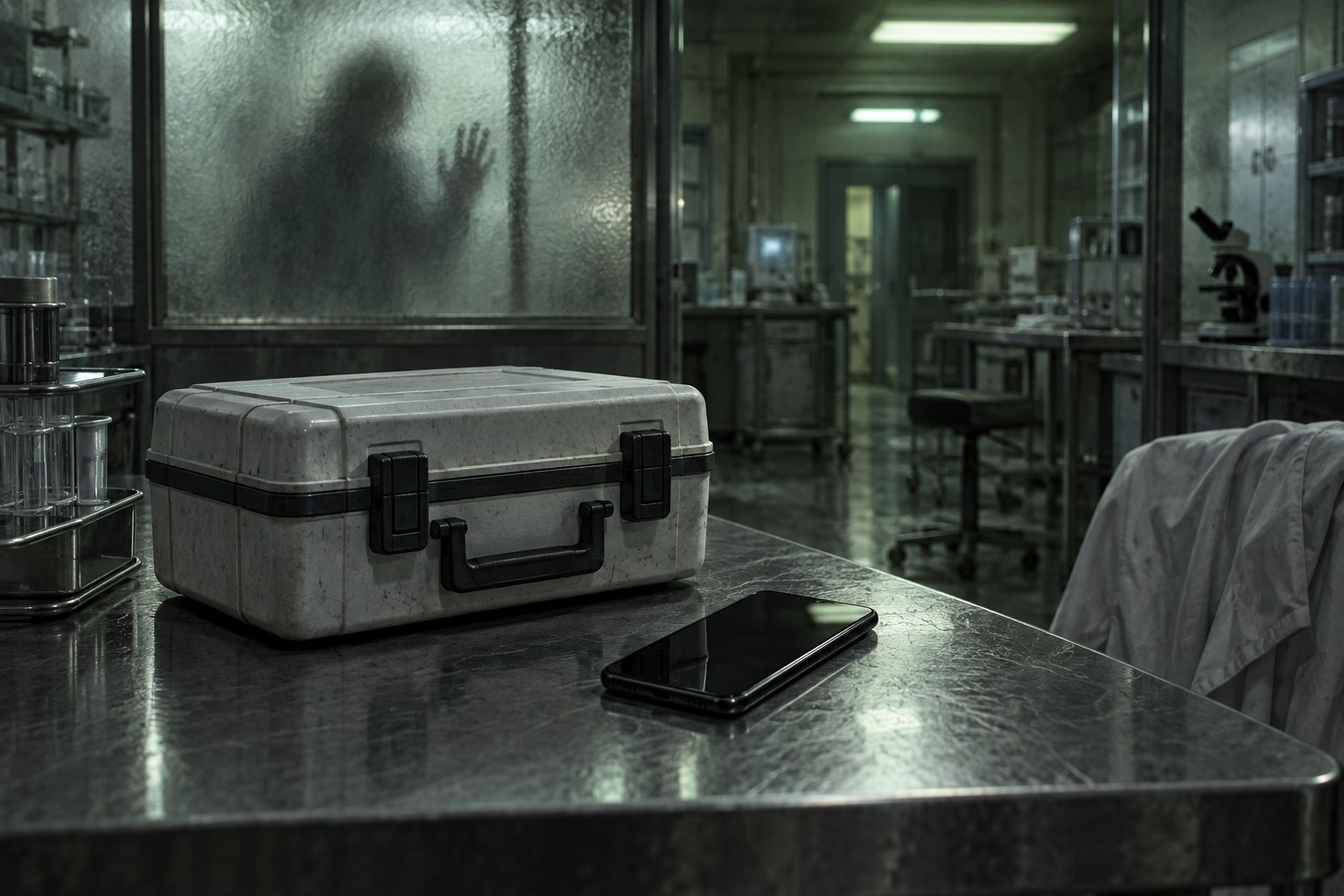
The hospital should be the place where his limited responsibility ends and someone else’s expertise begins. Instead, completing the task leaves him exposed. My interpretation is that the sequence makes a bleak distinction between being necessary to a process and being valued by it.
That distinction gives the ending force beyond its creature spectacle. Bryan has spent the journey treating arrival as an answer. The institution at the end of the road cannot honor the promise he has attached to it.
Does the ending deepen his story or overwhelm it?
Bryan’s final transformation follows his attempt to communicate remorse and his readiness for fatherhood. Emotional recognition and physical survival fail to coincide. Becoming more honest does not grant him additional time.
There is a serious dramatic idea in that refusal. Stories often reward personal growth with escape, allowing an ordeal to become the difficult experience a character needed. Here, insight cannot undo exposure. The body does not wait for the character arc to finish.
But the shift into grotesque spectacle also invites a fair objection. Michelle has comparatively little space in the story, and Bryan’s newly expressed commitment must bear substantial emotional weight. If the audience experiences the transformation chiefly as another outrageous escalation, his recognition can feel abbreviated rather than devastating.
For me, this is the film’s most interesting fault line. Its comedy asks us to enjoy the inventiveness of Bryan’s punishment; its emotional material asks us to recognize what that punishment destroys. Those responses can coexist, but their collision is not automatically depth. The viewer has to decide whether the final excess preserves his humanity or crowds it out.
The deeper horror is that care offers no immunity
Bryan’s fate should not be reduced to a punishment for hesitating about fatherhood. That reading would make the story mechanically moralistic and confuse immaturity with deserving annihilation. His fear at the beginning is recognizable. The scale of what happens to him is monstrous.
A stronger interpretation follows the contradictions in his behavior. He can avoid Michelle and help a stranger. He can want extra money and believe his delivery serves someone else. He can learn something important without acquiring the power to survive. These possibilities make him more than a cautionary example.
Where our earlier analysis considered Bryan’s appeal as an ordinary person inside an extraordinary disaster, the ending pushes that ordinariness toward tragedy. Good intentions remain meaningful even when they fail to produce a good outcome.
That is the disturbing thought beneath Cregger’s elaborate bodily chaos: care is a choice, not a guarantee. Bryan’s mistakes help define him, but so do his attempts to help. The nightmare becomes most powerful when both remain visible after the possibility of rescue has disappeared.
Original content by this site's editorial team. Published: September 19, 2026 at 07:23:42 PDT (Los Angeles time)