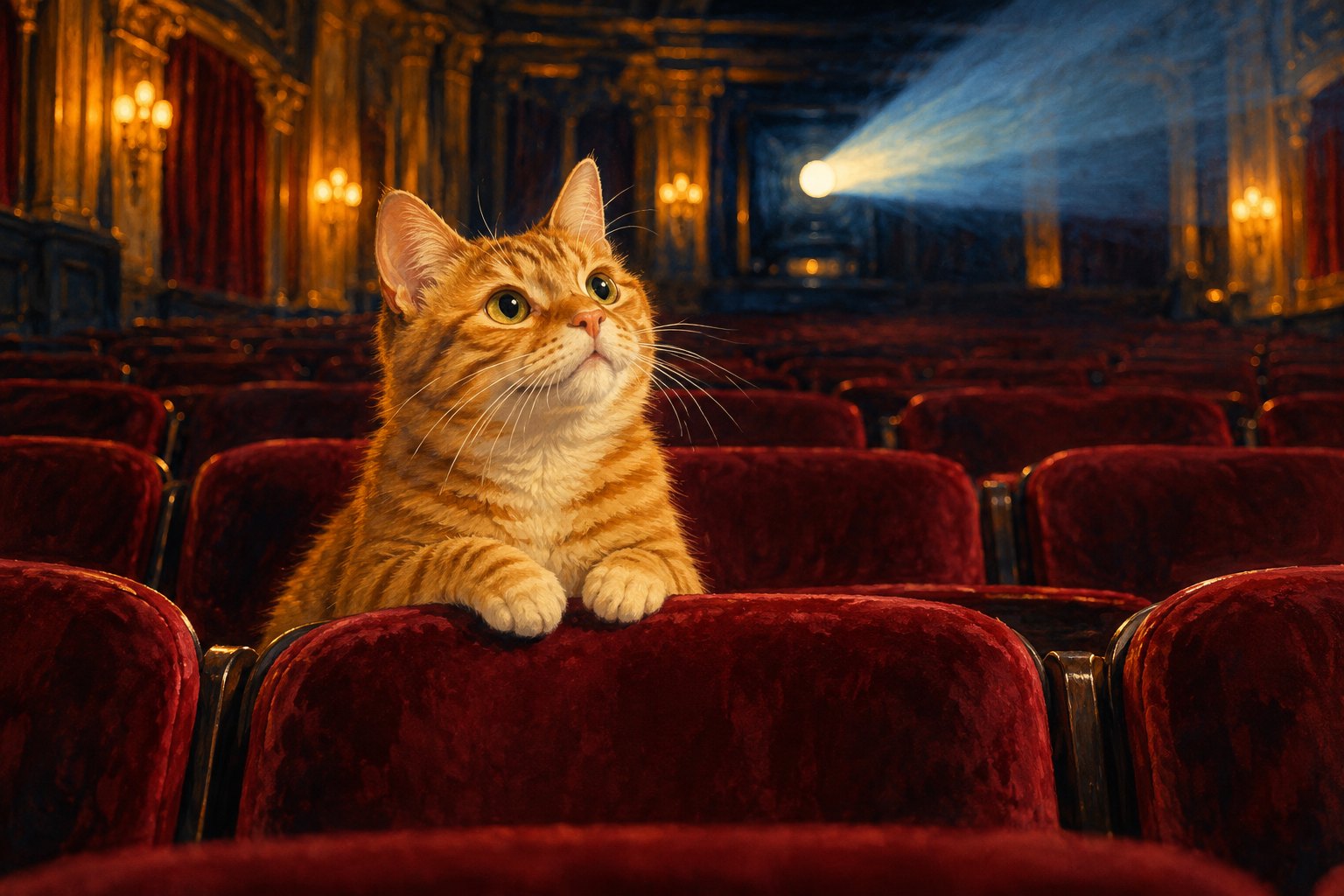
The Encyclopedia of Movie Cats puts an irresistible supporting cast at the center of film history: the felines that wander through our screens and sometimes walk away with our attention. Colossal describes the project as an exhaustive index of screen cats. Its appeal is immediately understandable. A viewer may forget a subplot yet remember a small animal waiting by a doorway, occupying somebody’s lap, or looking spectacularly unimpressed.
The more interesting question is what happens after recognition. What does watching the cat reveal about the movie around it? My view is that a feline-centered index offers a useful invitation to reconsider character and visual storytelling. That is the focus here: the critical possibilities of the project’s premise, rather than a verdict on the accuracy or completeness of every entry.
What an Encyclopedia Changes About Where We Look
Organizing cinema around cats shifts attention away from the usual categories of directors, stars, and genres. It encourages viewers to connect films through a presence that conventional plot summaries might barely mention. An animal can occupy only a small part of the frame while contributing substantially to its emotional meaning.
Consider the difference between noticing that a character owns a cat and watching how that character shares space with it. Does the person interrupt a conversation to offer food? Move the animal aside without looking? Wait for it to approach? These are hypothetical examples, but they demonstrate a concrete principle: behavior toward a dependent creature can reveal priorities without explanatory dialogue.
An index makes such appearances easier to notice. Interpretation begins when we return to the scene and ask what the appearance accomplishes. Identification supplies a starting point; the surrounding action supplies the evidence.
The Cat Can Reveal the Human Character
Care becomes visible through small decisions
A character announcing that they are compassionate gives the audience a claim. A character taking time to meet an animal’s needs gives us behavior to assess. Even then, context matters. Feeding a cat might communicate habitual kindness, an attempt to win someone’s approval, or a responsibility performed reluctantly.
The strongest analysis follows the sequence of choices. Who notices the animal? Who acts? What does that action cost in time, attention, or comfort? A brief gesture becomes meaningful when it fits—or contradicts—the person we have been watching.
This attention to action also helps separate an appealing design from a developed character, a question explored in our discussion of how Kuromi’s movie could build drama around a familiar mascot. Recognition draws us in; choices sustain our interest.
Affection can complicate a judgment
A threatening character’s tenderness toward an animal does not automatically make that character trustworthy. It can instead expose how selectively they distribute care. Equally, a sympathetic character’s impatience with a pet need not cancel everything else we know about them.
For me, these contradictions are more revealing than treating every cat as a ready-made symbol. The animal becomes a point of comparison between a character’s self-image and conduct. What matters is the relationship the film establishes, including moments when affection and control become difficult to separate.
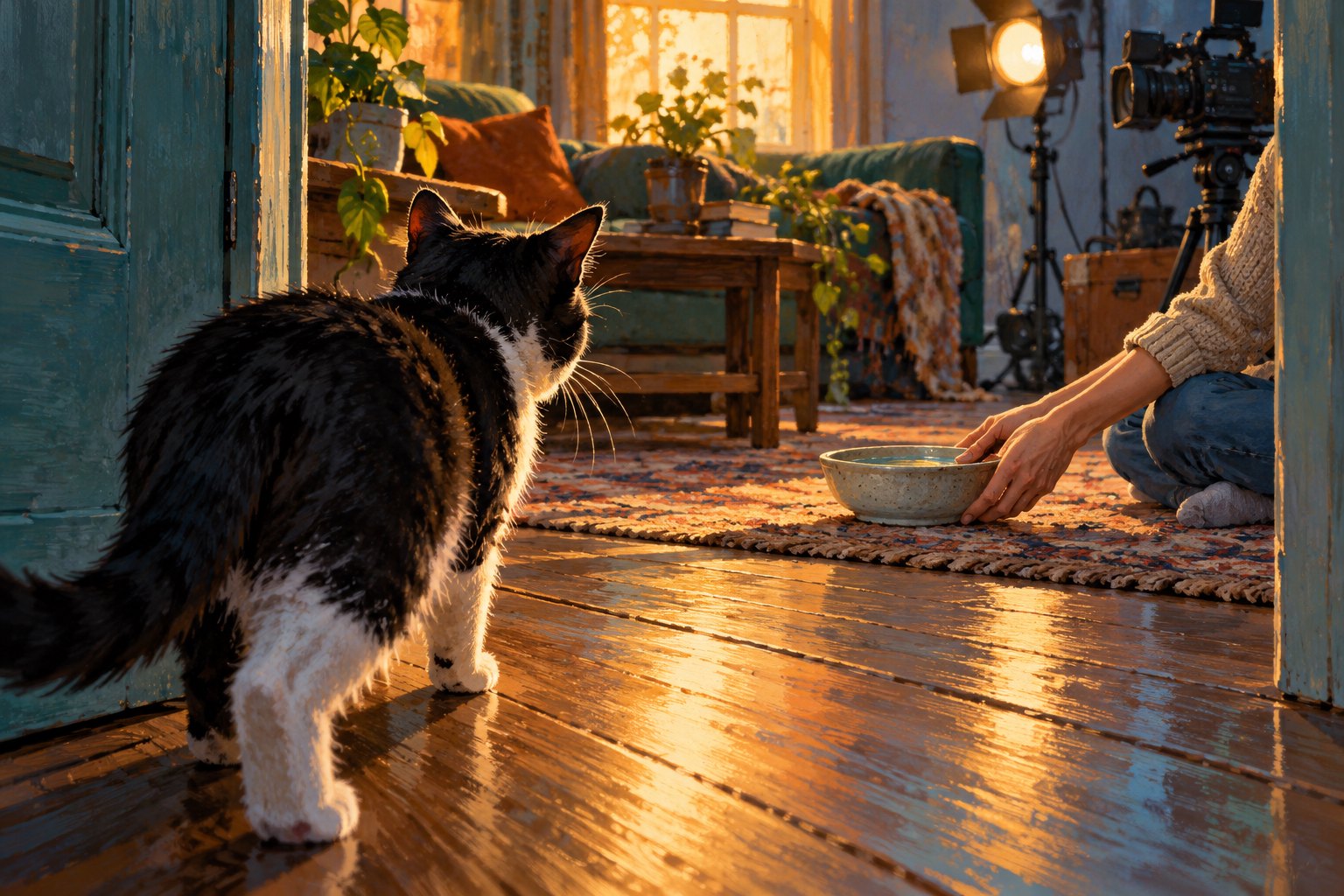
Watching a Scene From Floor Level
Thinking from the cat’s position can change how we read a setting. A doorway becomes access or confinement. A crowded room becomes a set of moving obstacles. A raised voice becomes an interruption whose significance may be different for the animal than for the people arguing.
This is an interpretive exercise, not a claim that we know an animal’s thoughts. It asks us to track what the film actually shows: available exits, proximity to people, movement toward shelter, and reactions to sound. Those observations keep a character-focused reading grounded in visible details.
The approach also reveals how tightly a film controls our attention. If the camera stays with the humans after the cat leaves, the animal may function chiefly as atmosphere. If the camera follows it into another space, that movement can open a new strand of the scene. The change is measurable in framing and editing, without assigning a secret meaning to every twitching ear.
Why the Same Cat Can Suggest Comfort or Danger
A cat resting in a quiet room can suggest domestic ease. Place a similar image after an unexplained noise, hold it longer, and withhold a view of the adjacent hallway, and that stillness can become uneasy. The difference lies in the arrangement of information.
Sound is especially important. An ordinary movement can become startling when it interrupts silence. Conversely, a familiar household noise can soften a tense scene by restoring a sense of routine. When analyzing these moments, the useful question is how the film directs our expectations before the animal appears.
Comedy depends on a related relationship between preparation and interruption. A person may behave as though a moment is enormously important while an animal continues its own business. The humor comes from that mismatch. The cat appears to inhabit a world in which human status has very little purchasing power.
That apparent independence is part of the attraction of screen cats. It creates the impression that life continues beyond the principal characters’ concerns. A fictional room feels inhabited when everything in it does not seem to exist solely for the protagonist.
How to Turn Recognition Into a Better Rewatch
The encyclopedia’s premise suggests a simple viewing exercise. Choose one feline appearance that stays in your memory, then revisit the surrounding sequence rather than isolating the cutest image.
- Establish the scene’s immediate problem. Identify what the human characters want before the cat draws attention.
- Track the animal’s visible behavior. Describe movement and interaction before interpreting either.
- Watch the filmmaking. Notice camera height, cuts, sound cues, and whose reaction receives emphasis.
- Test the consequence. Ask what would change emotionally or narratively if the appearance were removed.
That final question distinguishes decoration from dramatic function without suggesting that decoration is worthless. A brief appearance may contribute texture rather than advance the plot. Texture helps determine whether a setting feels welcoming, lonely, chaotic, or lived in.
The same method applies to meaningful objects. Our analysis of Astrid’s sketchbook in Prelude to The End considers how attention to one apparently small element can clarify a character’s stakes.
The Deeper Appeal: A World Beyond the Protagonist
The most promising idea behind The Encyclopedia of Movie Cats is that film history can be approached through what viewers are usually encouraged to overlook. A small presence can expose a character’s habits, redirect a scene’s rhythm, or make a carefully constructed room feel unexpectedly alive.
My reading is that cats are especially useful subjects for this exercise because their apparent indifference challenges the human hierarchy of a scene. The protagonist may have urgent plans; another creature may simply need somewhere quiet to sleep. Holding both needs in the same frame gives a movie a fuller world.
An exhaustive index promises the pleasure of finding familiar faces. Its more lasting invitation is to look again at the space around them—and discover how much storytelling was happening below eye level.
Original content by this site's editorial team. Published: October 31, 2026 at 01:18:58 PDT (Los Angeles time)