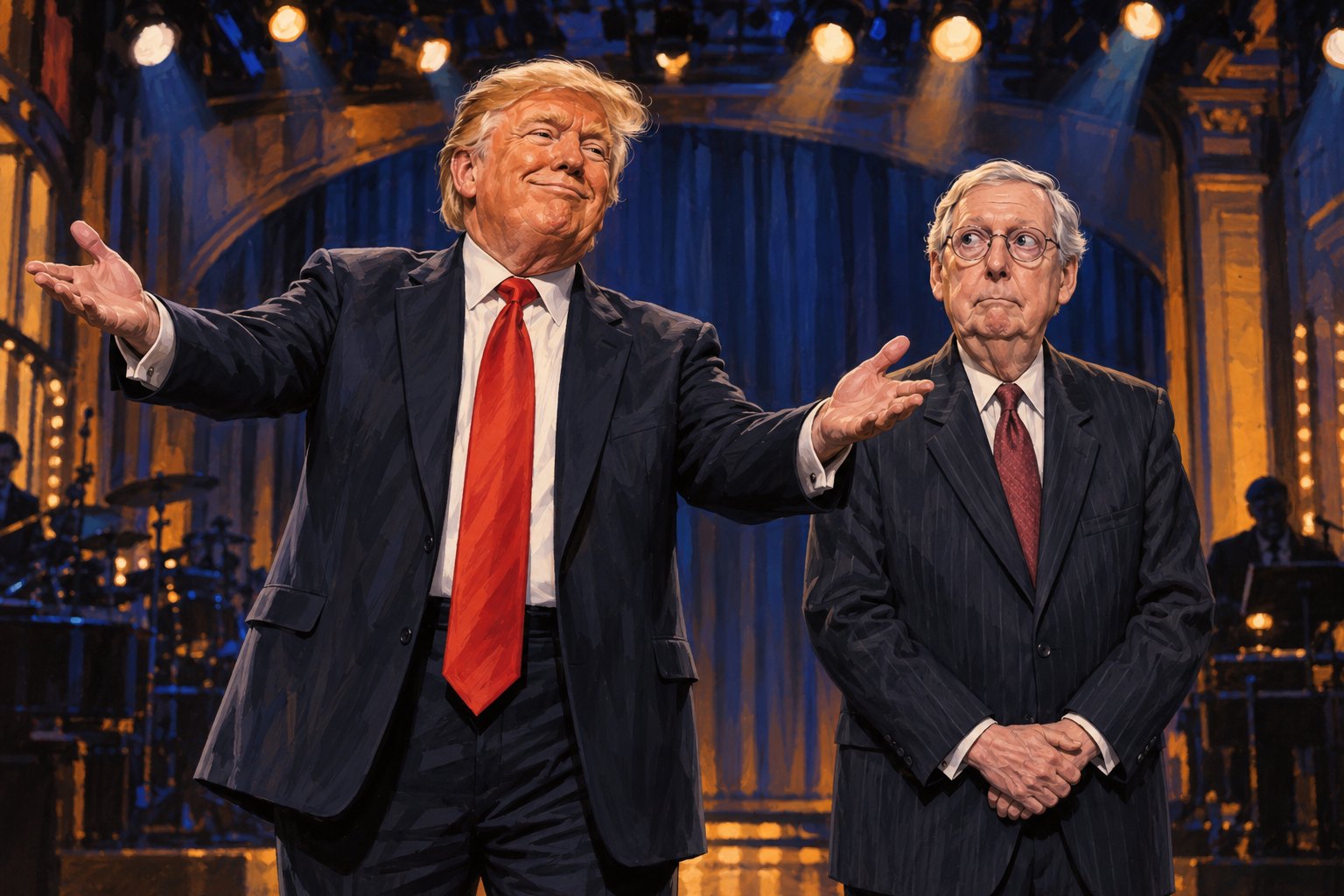
Saturday Night Live’s midterms-themed cold open takes aim at Donald Trump and Mitch McConnell through a premise built for political comedy: a campaign trying to make itself appealing. USA Today identifies both men as targets, while coverage from Rolling Stone and Deadline describes a Republican election pitch and campaign parody. The compelling idea is the tension inside that pitch. A message designed to project confidence can become an advertisement for anxiety.
That is a useful starting point for character-focused television criticism. Campaign satire gives its subjects something to accomplish: persuade an audience, defend a political identity, or make an uncomfortable bargain sound attractive. My reading of the reported premise is that its strongest potential lies in that effort to persuade. The recognizable politicians draw attention; the distance between what they want to communicate and what viewers hear supplies the comic argument.
Premise spoilers follow. This commentary examines the reported setup and its implications; performance timing, exact dialogue, and the sequence of individual jokes are outside its scope.
The Campaign Pitch Gives Trump a Dramatic Objective
A political impression becomes more interesting when the character needs something. In the election-pitch framework described by Rolling Stone, the Trump figure has an immediate objective: make the Republican appeal work. That gives the audience a way to understand the comedy beyond recognizing a voice, a gesture, or a familiar mannerism.
Viewed through this character lens, persuasion creates a productive vulnerability. A speaker may behave as though approval is inevitable, but the act of asking for support acknowledges that the audience has a choice. The more insistently a pitch announces its own strength, the more room there is for viewers to notice the need underneath it.
This is an interpretation of the premise, not a claim about the real Trump’s private thoughts. Satirical characters are constructed versions of public figures. They organize recognizable traits around a dramatic purpose. Here, the campaign setting invites us to watch confidence as a tool: something a character uses to secure an outcome.
For me, that offers a sharper critical angle than asking only whether an impersonation is accurate. An accurate impression can remain static. A character trying to win someone over has somewhere to go—and something to lose if the appeal exposes the wrong qualities.
Why McConnell Matters to the Frame
USA Today’s identification of Mitch McConnell as another target broadens the cold open’s frame. It invites a reading that considers the Republican political organization alongside Trump’s individual persona. The subject becomes a collective electoral appeal, with more than one recognizable face attached to it.
That distinction matters for the distribution of comic responsibility. A sketch centered exclusively on one personality can encourage viewers to treat everything as an extension of that person’s eccentricity. Including another prominent political figure creates an opportunity to ask how the wider group participates in presenting itself to voters.
The reporting summarized here does not establish McConnell’s precise dialogue, physical business, or relationship to the Trump character within individual scenes. Those details should not be filled in from expectations about how SNL usually portrays him. His inclusion supports a broader institutional reading; it does not, by itself, establish how successfully the sketch develops it.
The useful viewing question is whether each figure contributes a distinct pressure to the campaign premise. Political characters become dramatically valuable when their presence changes the situation. Recognition gets a character into the scene. A specific comic function makes the character worth keeping there.
The Mock Advertisement Is Part of the Joke
Deadline’s description of the cold open as campaign mockery, alongside coverage identifying a mock campaign spot, points toward its most useful formal feature. Advertising gives satire an organized language of reassurance. A campaign message asks viewers to accept a selective presentation as a trustworthy account of the whole.
Comedy can work inside that structure by making the selection itself conspicuous. An appeal may try to emphasize generosity, strength, or unity while inadvertently raising questions about motives. The audience then performs two readings at once: the message the fictional campaign wants to deliver and the meaning that escapes its control.
The form also places viewers in an active position. We are the imagined recipients of the appeal, asked to notice its construction. That makes the satire potentially more involving than a string of topical references: the campaign is trying to sell something to the people watching.
What the Reported $5,000 Gag Suggests
Yahoo News Canada’s coverage highlights a $5,000 element and characterizes it as a bribe within the mock campaign spot. That is a description of the comedy’s framing. It should not be treated as independent evidence of an actual payment scheme or as a quotation from the sketch.
As a satirical device, a specific sum makes the idea of transactional politics immediately legible. It brings an abstract question—what does a campaign think support is worth?—down to a concrete offer. The interpretive interest lies in what the offer implies about the relationship between the speaker and the audience.
One possible reading is desperation: the appeal appears to need an extra inducement. Another is condescension: the imagined recipients are treated as people whose support can be reduced to a price. Those readings can coexist, making the fictional sales pitch reveal something less flattering than its intended message.
The exact wording would determine how much weight each interpretation deserves. Without verified dialogue, reproducing supposed punch lines would undermine the analysis. The reported device is enough to identify the tension, but not enough to judge the precision of its delivery.
Recognition Helps, but Character Must Do the Work
SNL benefits from an audience that arrives with associations already attached to famous faces. Our discussion of celebrity persona and character in Taylor Swift’s SNL appearance explores a related performance question: how does existing familiarity become material for a scene?
For political satire, the challenge is especially clear. Recognition can produce an immediate response before a character has done anything. Sustaining the comedy requires development: a goal becoming harder to achieve, a persuasive tactic revealing an unexpected weakness, or a public-facing message becoming impossible to maintain.
My critical preference is for a sketch that makes familiarity do new work. The midterms campaign premise offers that possibility because it ties personality to an objective and gives viewers a standard against which to read the behavior. For the surrounding episode context, our guide to the October 3 SNL episode covers its announced host and musical guest.
The Deeper Target Is the Relationship With the Voter
The most compelling interpretation of this cold open’s reported setup concerns how political appeals imagine their audience. Does the pitch address voters as people capable of judgment? Does it assume that confidence will substitute for explanation? Does an inducement reveal how little the fictional campaign trusts its own argument?
Those questions give the Trump and McConnell premise significance beyond the immediate pleasure of seeing public figures mocked. The campaign advertisement becomes a small character study of power asking to be renewed. Its speakers need consent, even as their presentation may struggle to acknowledge that dependence.
On the evidence available, the premise supports a pointed reading of persuasion turning into self-exposure. Whether every joke achieves that requires the full performance. The central critical insight remains useful: the revealing moment in a political sales pitch is often the one when its attempt to inspire trust tells the audience why trust is being requested so urgently.
Original content by this site's editorial team. Published: October 4, 2026 at 01:16:34 PDT (Los Angeles time)