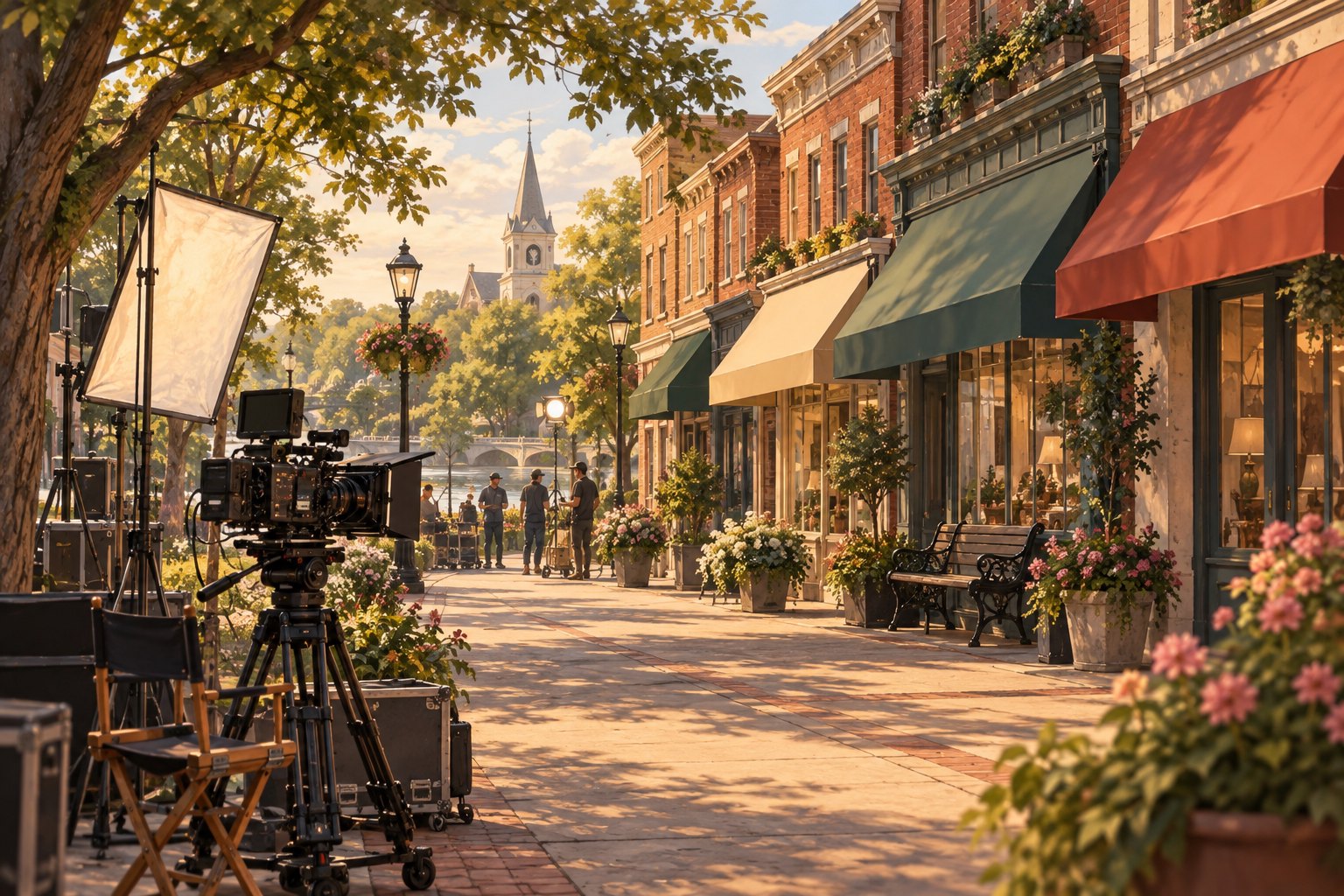
St. Charles, west of Chicago, is becoming part of the screen world of Better Than the Movies. NBC Chicago reports that Town House Books and Cafe will appear in Netflix’s upcoming adaptation of Lynn Painter’s popular romantic comedy novel. For readers waiting to see the story take physical shape, a neighborhood bookstore is an inviting development: a recognizable everyday space entering a romance already concerned with the influence of stories on real expectations.
The location news also gives the adaptation a useful point of scrutiny. A charming setting can attract attention immediately. Making that setting feel meaningful to the people moving through it takes more work.
This is a production preview and adaptation analysis, not a review of the finished film. The discussion covers the announced premise without revealing the novel’s ending. Performance judgments, memorable movie dialogue, and claims about specific scenes must wait for the film itself.
What is filming in St. Charles?
NBC Chicago identifies the location as Town House Books and Cafe at 105 N. 2nd Ave. The report says the City of St. Charles shared production photographs and described the shoot as operating under the codename Big Red. It also reports an expected Netflix arrival in 2027; that is a release window, rather than a specific premiere date.
Netflix separately identifies Julia Hart as the director and a co-writer, with Beatrice Kitsos playing Liz Buxbaum and David Iacono playing Wes Bennett. These announcements establish the project’s central creative team and leads. They do not establish which scenes were filmed at the bookstore or how prominently the location will appear.
That distinction matters for local viewers. A recognizable business might supply an exterior, an interior, or a brief passage between larger scenes. The filming location also does not, by itself, confirm the story’s fictional setting. Recognizing St. Charles on screen and learning where the characters supposedly live are different discoveries.
Why this location is an interesting fit
A bookstore brings an immediate association with imagined lives. In a romance about someone whose expectations are shaped by romantic comedies, that association could be especially apt. It gives the production an environment where the distance between a story someone wants and the experience someone actually has might become visually suggestive.
That is an interpretation of the location’s possibilities, not a description of a confirmed sequence. The bookstore may ultimately serve a straightforward practical purpose. Even so, ordinary commercial spaces can give a romantic comedy something an immaculate fantasy backdrop cannot: the impression that its characters have routines beyond their love lives.
My preference is for locations that allow a little friction. A conversation becomes more revealing when someone must decide whether to linger, move aside, or leave. Physical distance can communicate hesitation. Shared space can expose familiarity. Those choices can make attraction legible without requiring a speech to explain it.
St. Charles therefore offers a promising visual ingredient. The test will be whether the finished movie makes its locations part of the characters’ behavior, rather than simply presenting attractive scenery between plot developments.
Liz’s perspective gives the adaptation its central challenge
Netflix’s announced premise centers on Liz, a high school senior and romantic-comedy enthusiast who enlists her irritating but attractive neighbor to help attract her crush. The setup gives the movie two overlapping stories to tell: what Liz believes she is arranging, and what viewers can observe developing around her.
For the adaptation, the most interesting opportunity is the gap between intention and attention. A character can enter a conversation with a plan and leave remembering an unplanned detail. Film can convey that shift through a delayed response, a glance that lasts slightly too long, or a reaction left visible after the speaker has finished.
These are possibilities for the filmmaking, not claims about Kitsos’s performance. The challenge will be to make Liz’s expectations understandable while allowing audiences to notice their limitations. If viewers only feel superior to her, the romance risks becoming a prolonged exercise in waiting for her to catch up.
A stronger approach would invite viewers to understand why a familiar romantic script feels reassuring. Wanting life to resemble a beloved movie is a recognizable desire for clarity: the right encounter, the right person, the right moment. Comedy can emerge when that clarity fails, while sympathy depends on taking the desire seriously.

Wes needs a perspective beyond being the alternative
The announced neighbor arrangement creates a corresponding challenge for Wes. A romantic lead becomes less compelling when every action exists to demonstrate suitability for someone else. The film will need to make his participation feel like a choice made by a person with his own limits and expectations.
For me, persuasive screen chemistry depends partly on that independence. Two performers can exchange quick dialogue without creating the impression that either character is listening. More revealing moments show a response changing because something unexpected has landed: a joke stops being funny, an assumption becomes uncomfortable, or confidence briefly slips.
This is where the suburban setting could support the relationship. Familiar surroundings can suggest that people have known versions of each other for years. The filmmaking can then ask whether familiarity produces understanding or merely confidence in an outdated impression. The location becomes useful when it helps make that distinction visible.
What readers should watch for in the adaptation
Faithfulness involves more than retaining recognizable incidents. When a novel becomes a movie, the important question is whether the emotional cause and effect remains clear. An action that makes sense alongside written interior narration may need a different setup when audiences can only watch and listen.
- Track changes in attention. Does the film show why a character begins seeing someone differently?
- Look beyond familiar references. A nod to another romance should illuminate this relationship rather than interrupt it.
- Notice the use of space. Do locations affect conversations and choices, or function mainly as decoration?
- Separate recognition from impact. A beloved book moment can survive intact and still need different pacing to work on screen.
That distinction between promise and achievement also underlies our discussion of how artistic ambition should shape film criticism. An appealing intention deserves attention; the finished work must demonstrate how effectively it realizes that intention.
A real neighborhood enters an imagined romance
There is another reason to value the St. Charles connection: these places have lives outside the frame. A business becomes a setting for viewers while remaining a workplace and neighborhood destination for others. Our coverage of residents and businesses affected by location filming explores that separate practical responsibility. It should not be taken as evidence of a dispute in St. Charles.
The deeper artistic opportunity here is a romance about perception. The announced premise suggests a young woman trying to shape experience through stories she already understands. A real suburban location gives that idea a tangible counterweight: an ordinary place that need not look extraordinary to hold an important encounter.
If Better Than the Movies makes that tension felt, the bookstore’s value will extend beyond local recognition. It could help express the difference between finding a setting worthy of a fantasy and learning to pay attention to the person already standing in it.
Original content by this site's editorial team. Published: October 3, 2026 at 22:12:20 PDT (Los Angeles time)