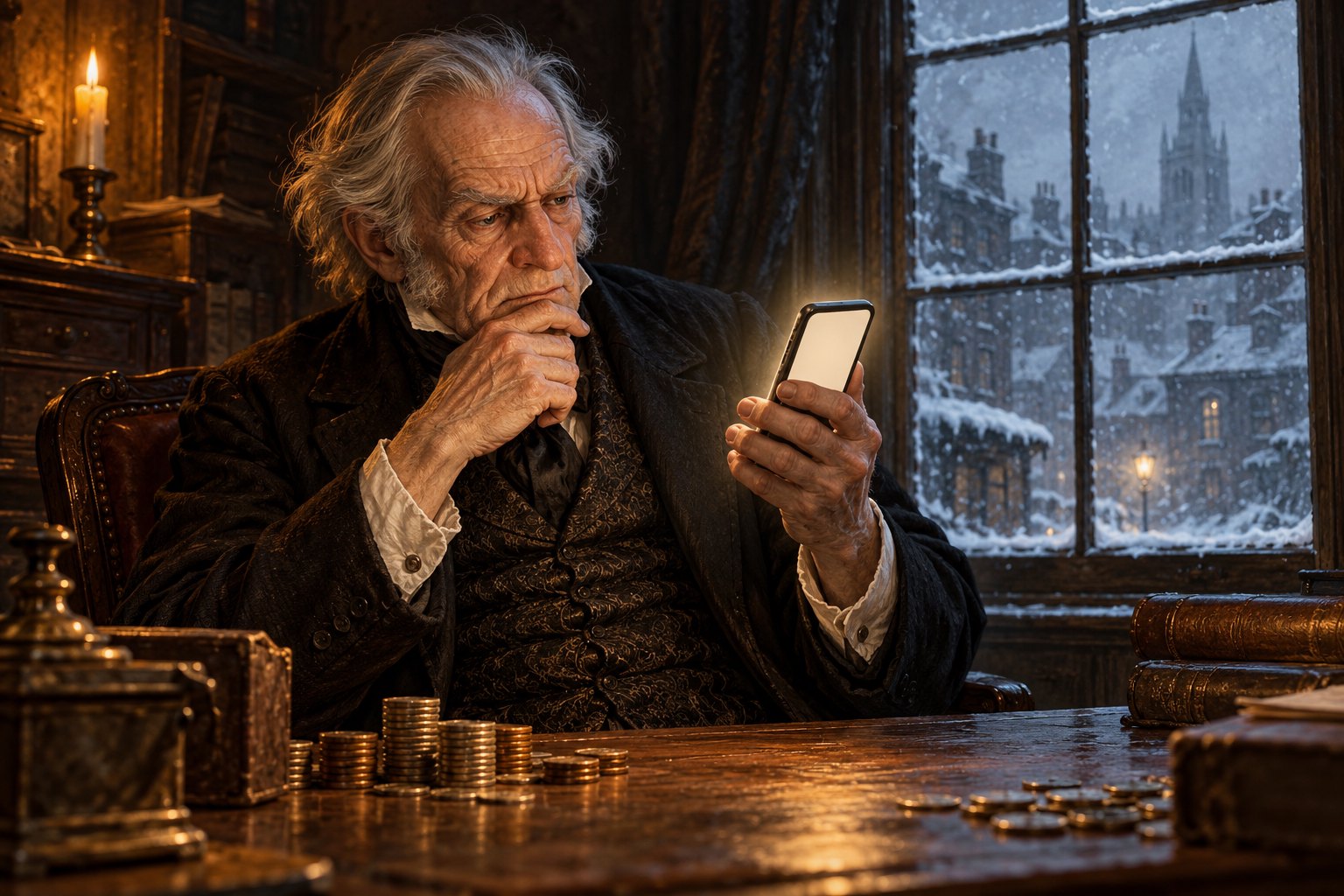
Scrooge has found a thoroughly modern place to keep his money moving in one direction. Variety reports that Ebenezer has created a real Venmo profile for the character, and that it appears to accept money without dispensing any. As a publicity premise, it is immediately legible: give literature’s famous miser a payment account, then let his reluctance to part with anything become the joke.
The qualification matters. An account that appears to receive money without sending it does not establish a complete transaction history, the destination of any funds, or the campaign’s eventual plans. Those questions remain separate from the comic idea. What can be assessed now is the choice to make Scrooge’s relationship with money something audiences can encounter outside a movie.
This is commentary on the reported promotion, not a review of the finished film. Discussion below includes broad spoilers for Charles Dickens’ original A Christmas Carol; literary references and quotations should not be read as confirmed scenes or dialogue from Ebenezer.
Why a payment account is a good character joke
The strongest part of the premise is its economy. Scrooge does not need an elaborate introduction. Place his name next to a mechanism for receiving money and the audience supplies the personality: suspicious, acquisitive, deeply unwilling to reciprocate. The account becomes a tiny performance built around a recognizable habit.
It also translates character more effectively than simply putting Victorian clothing on a contemporary advertisement. The relevant connection is behavioral. A counting desk and a phone belong to different worlds, but either can become the place where someone reduces every interaction to what it costs or yields.
Dickens gives that defensive temperament its famous verbal shorthand: “Bah! Humbug!” In the original story, the exclamation rejects the emotional claims of Christmas. The Venmo premise suggests a modern equivalent without needing to reproduce the line: Scrooge can participate in a social exchange while refusing its spirit of mutual obligation.
My reading is that this makes the promotion a clever piece of characterization. Its humor depends on recognizing what Scrooge would do with an ordinary tool. Whether that recognition produces an interesting movie is a different question, much as publicity images can introduce character expectations without demonstrating a complete performance.
The audience becomes part of the transaction
A poster asks viewers to look. A character’s payment profile introduces the possibility of doing something. That shift changes the relationship between audience and fiction: the miser is no longer merely an amusing figure on a screen. His joke occupies a space associated with actual exchanges.
The intriguing reversal is that people could find themselves entertaining the idea of giving money to a character defined by keeping it. Ordinarily, a Scrooge story invites us to object to his priorities. Here, the premise potentially lets spectators play along with them. The contradiction supplies the gag with an edge that a standard character portrait would lack.
That is an interpretation of the setup, not evidence of why anyone has interacted with the profile. The reported information does not establish participants’ motives, the scale of activity, or whether the campaign is achieving its aims. Amusement, curiosity, and enthusiasm are possible responses, but they should not be presented as measured audience behavior.
The distinction matters critically, too. Participation can make an advertisement memorable without deepening its subject. The useful question is what the interaction reveals about Scrooge after the novelty wears off.
Receiving money is only half of Scrooge’s story
As a portrait of the unreformed character, the one-way-payment idea fits. As a representation of his entire story, it is necessarily incomplete. Dickens’ Scrooge matters because his habits can change, and because that change eventually affects people other than himself.
The original tale treats money as a relationship as well as a possession. Scrooge’s choices bear on his employee Bob Cratchit and the Cratchit household. His isolation is therefore more than a personal quirk. Other people experience the consequences of the boundaries he draws around his comfort and resources.
Viewed through Scrooge’s defensive perspective, keeping money can look like maintaining control. Giving creates an obligation to acknowledge another person’s needs. That is why generosity challenges more than his budget: it challenges his preferred account of what he owes the world.
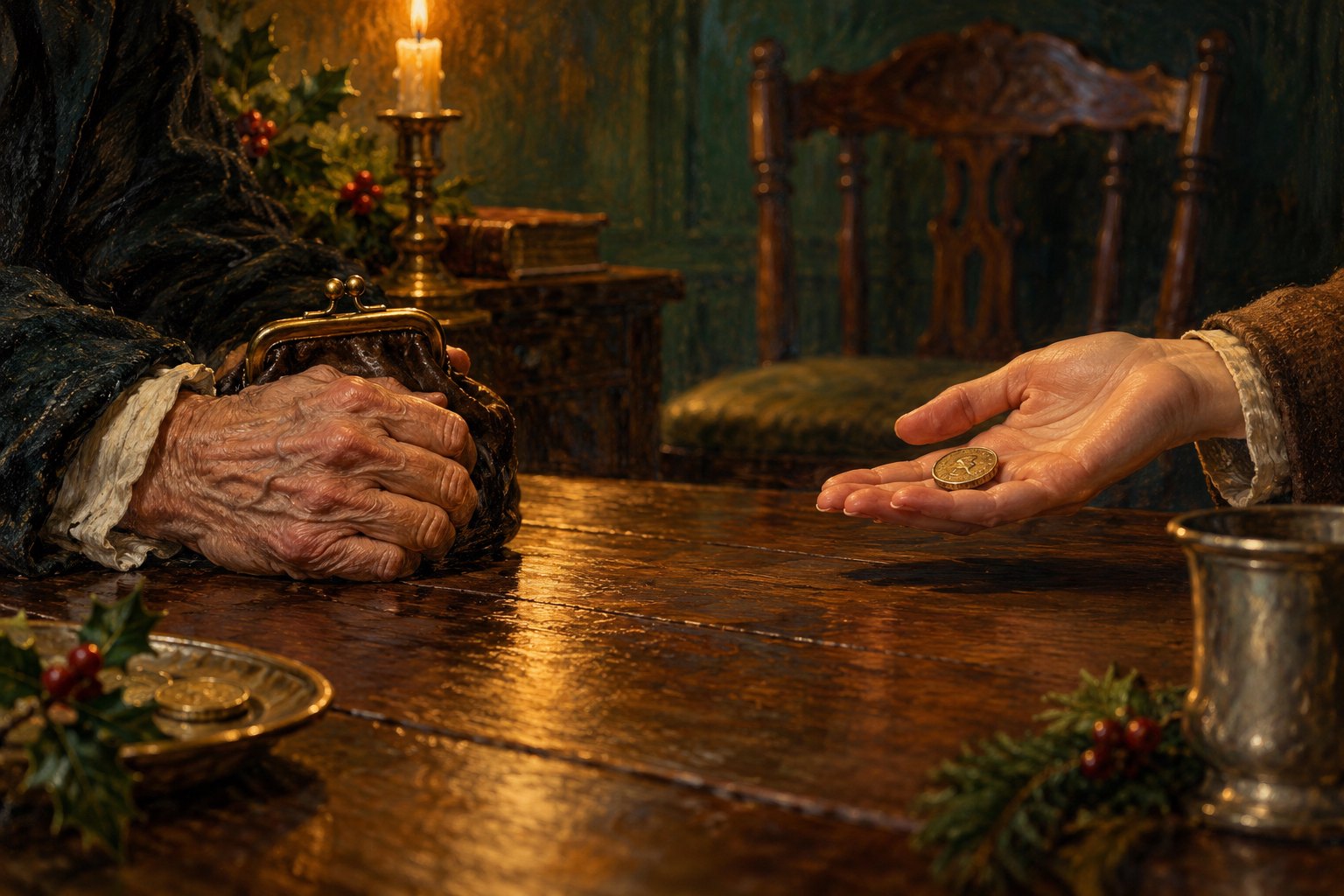
Marley’s declaration in Dickens’ text, “Mankind was my business,” exposes the inadequacy of a life measured only through commercial success. The line changes the meaning of responsibility. Being good at accumulating wealth does not settle whether someone has lived well.
That gives the promotion a built-in dramatic tension. Receiving without giving captures the condition the story must confront. It cannot, by itself, express the transformation that makes the character more than a seasonal punch line.
When staying in character complicates the joke
There is an obvious defense of the premise: of course Scrooge would take money and decline to distribute it. That is the character. Yet the same explanation produces a reasonable editorial question. How far does fictional consistency carry an interaction that may involve real funds?
Answering that question does not require assuming wrongdoing. Nothing in the reported premise alone establishes misuse, deception, or a broken promise. It does require keeping the fiction and the transaction intelligible. Understanding why Scrooge would keep money is different from knowing what happens to a payment made through a promotional account.
Readers should therefore distinguish three things: the existence of the reported profile, the appearance of its activity, and any verified explanation of how the promotion operates. The first two do not automatically supply the third. Nor should a charitable destination, giveaway, refund, or later reversal be inferred merely because one would suit the story.
As with the distinction between a provocative comic setup and what its satire actually reveals, the quality of this gag depends partly on where its target lands. Is the audience laughing at greed, enjoying a fictional miser’s stubbornness, or helping enact the behavior being mocked? The premise leaves room for all three readings.
The deeper test is what generosity changes
For character-focused film criticism, the account points toward a useful question about any Scrooge interpretation: does the story make other people’s lives matter beyond their role in his awakening? A memorable miser can dominate every scene. A convincing redemption must eventually direct our attention toward those who live with his decisions.
Dickens’ “I will honour Christmas in my heart” is a promise whose meaning depends on conduct. Feeling differently is the beginning. Acting differently makes that feeling consequential. Any screen version earns its emotional resolution through the relationship between those two stages, rather than through the audience’s familiarity with the ending.
The Venmo idea is sharp because it compresses a moral problem into an everyday action: money comes in, and Scrooge keeps it. Its limitation is equally revealing. We recognize him immediately through what he refuses to give, but the lasting power of his story comes from discovering that refusal need not define him forever. The promotion has found an effective image of his starting point. The more demanding drama lies in what it would take to move him beyond it.
Original content by this site's editorial team. Published: October 22, 2026 at 18:50:25 PDT (Los Angeles time)