Éric Baudelaire’s For the Moon puts a deceptively simple question at the center of documentary filmmaking: who gets to decide what deserves to become an image? Made with students at the National Institute for Blind Youth in Paris, the film gives its young participants cameras and a role in creating the material audiences encounter. The creative choices of those students are the essential starting point for understanding its premise.
Baudelaire discusses the project in Joshua Minsoo Kim’s Film Show 075 interview. For readers discovering the filmmaker through that conversation, the most compelling subject is the relationship between a director’s intentions and his collaborators’ decisions. What happens when the people a documentary might ordinarily observe begin determining what it can show?
This is a critical preview based on the filmmaker’s interview and confirmed festival information, rather than a verdict based on a screening. Mild structural spoilers follow.
What For the Moon is about
The New York Film Festival lists For the Moon, also titled Car la lune, as an 88-minute French film from 2026, presented in French with English subtitles. Its world premiere is programmed in the festival’s Currents section. The festival describes students making music, creating art, and recording their surroundings, with their contributions assembled by Baudelaire and editor Claire Atherton.
That description suggests an ensemble organized around acts of attention rather than a conventional protagonist pursuing a single goal. For viewers accustomed to character-driven fiction, the useful adjustment is to look for decisions: what someone chooses to record, what attracts their curiosity, and what they want another person to experience. A decision about a camera can reveal agency as clearly as a dramatic confrontation.
It also changes what constitutes useful character analysis. These participants are real people, and their recorded activities do not authorize a critic to invent their private thoughts. Their choices can be interpreted; their motives should remain open unless they explain them. That distinction matters particularly in a film whose premise challenges assumptions about other people’s experiences.
The request that changes the project
In the interview, Baudelaire recalls initially offering sound recorders. The students asked for cameras instead. He remembers their response as: “Film is sound and image—we want cameras.” This is his account of their words during the project’s development, not a verified quotation from the finished film’s soundtrack.
The request deserves attention because it identifies a practical disagreement. An adult has selected a tool; the participants want access to a different one. Read from their perspective, the issue is creative possibility. Receiving equipment chosen around someone else’s assumptions can restrict an experiment before it starts.
My reading is that this exchange supplies the strongest critical lens for the project. Inclusion becomes meaningful when a participant can alter the terms of participation. Being invited into a room is one thing. Being able to challenge what happens there requires a different kind of trust.
That concern also connects with our discussion of collective agency in the Judy Heumann story. In both cases, a productive critical question is whether the people represented can make consequential choices, rather than merely furnish an audience with an uplifting experience.
When the camera changes hands
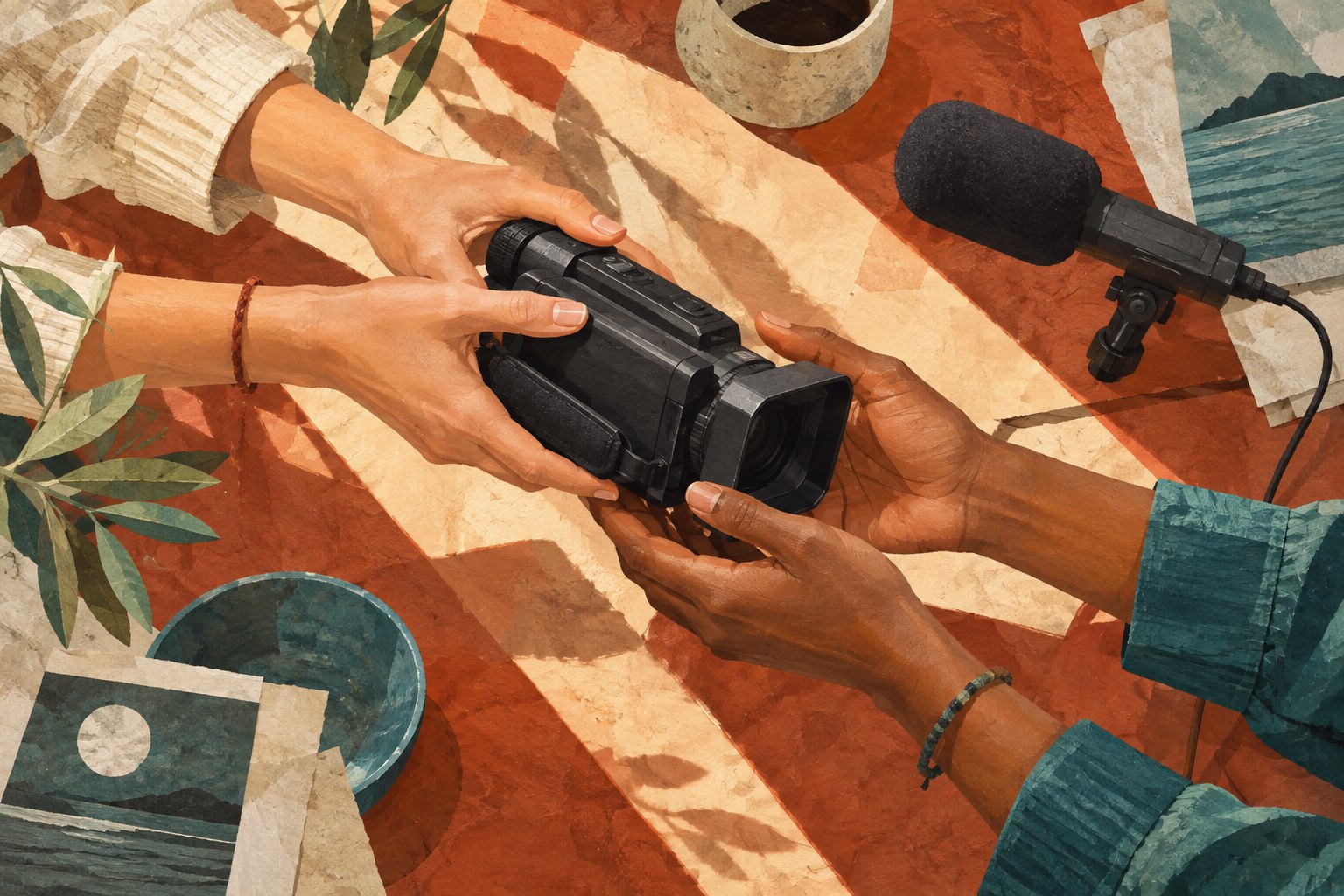
Baudelaire describes a structure that begins with observation inside the school and gradually moves toward the students’ own images. He says approximately half the finished film’s material comes from their cameras.
The distinction is more substantial than a change in photographic style. When someone appears before a camera, viewers can study their behavior. When that person operates it, viewers encounter a selection they have made. The subject becomes an author of the audience’s attention.
For me, the crucial test of that transition is whether individual preferences remain legible. Collaboration can become an empty compliment if everyone’s contribution is blended into a generalized statement about humanity. A more revealing film allows differences to survive: different interests, different rhythms, different ideas of what makes an image worth keeping.
There is also a tension worth preserving. Sharing cameras does not eliminate the director’s authority. Editing still determines duration, sequence, emphasis, and the relationship between one person’s contribution and another’s. The relevant question is how the finished arrangement acknowledges that responsibility. Good intentions alone cannot tell us whether a cut is generous, reductive, funny, or unexpectedly revealing.
Perception without a claim to total access
A documentary about perception can tempt viewers into a comfortable conclusion: now we understand exactly how somebody else experiences the world. That conclusion deserves skepticism. A film can offer an encounter with another person’s expression without granting complete access to their sensory life.
The distinction becomes useful when approaching texture, abstraction, and sound. An indistinct image need not be treated as a puzzle that a sighted viewer must solve. Its movement, duration, or relationship to a voice may be where its interest lies. Likewise, a recording can matter because somebody chose to make it, even when its significance is not immediately obvious to a stranger.
This is an interpretive approach, not a claim that every ambiguous image automatically succeeds. Abstraction can invite attention, but it can also become vague. A searching review should ask what a sequence makes possible: does it sharpen curiosity about its maker, establish a rhythm, or create a relationship with another image? Calling something poetic should begin an explanation rather than end one.
How to watch without turning people into symbols
Three questions offer a practical way into this kind of documentary:
- Who is directing attention? Notice whether a passage presents someone to you or presents something they have chosen.
- What remains individual? Look for preferences and disagreements that resist reducing the group to a single message.
- What does the edit encourage? Consider whether a transition invites curiosity, supplies an interpretation, or asks for an emotional response.
These questions are especially helpful when a subject seems to arrive with an obvious moral. Admiration can become another way of overlooking specificity. A person deserves room to be playful, exacting, distracted, technically curious, or interested in something an audience considers ordinary.
Our analysis of the distance between lived evidence and screen storytelling approaches a related problem: the force of a representation does not make it a complete account of the person represented.
The deeper question: permission to create
The most promising interpretation of For the Moon begins with permission. Who is presumed capable of making images, and who must first explain why they want to? The students’ request for cameras makes that question concrete. Creative access includes the freedom to try something whose result has not already been approved or predicted.
A final judgment on the film’s pacing, emotional force, and editing requires the film itself. Its documented approach nevertheless offers a valuable challenge to criticism: attend to what these young filmmakers make before deciding what they stand for. Their work deserves the same curiosity, discrimination, and openness that any other filmmaker would ask of an audience.
Original content by this site's editorial team. Published: October 5, 2026 at 22:07:43 PDT (Los Angeles time)