Artificial puts Andrew Garfield in the role of Sam Altman and makes the origins of OpenAI the subject of a movie. That pairing supplies an immediate attraction: a recognizable actor interpreting a recognizable figure. It also introduces the central problem of any corporate origin story. An institution becomes easier to follow when it has a face, but easier to misunderstand when that face becomes the explanation for everything.
Deadline identifies Garfield as Altman in its coverage of the film. That establishes the casting and broad subject, not a basis for inventing scenes or evaluating a performance without sufficient evidence. This is spoiler-free commentary on the film’s premise and character framing, rather than a viewing-based review. Its concern is specific: what audiences gain, and what they risk overlooking, when they encounter OpenAI through a dramatized Altman.
A Leading Character Is Already an Argument
Choosing a central character does more than organize a screenplay. It determines whose uncertainty becomes suspense, whose disappointment receives emotional weight, and whose objectives make the story move. Even an unflattering portrait can privilege its subject by treating everyone else as an obstacle, an ally, or an audience.
For an Altman-centered interpretation of Artificial, the useful distinction is between understanding a character and adopting his account of events. A film might make a person’s reasoning comprehensible while leaving that reasoning open to challenge. Conversely, it might surround him with criticism while still accepting his assumption that he belongs at the center of the story.
My view is that the second possibility deserves particular attention. Condemnation does not automatically produce complexity. A character presented as uniquely responsible for everything can become almost as mythic as one presented as uniquely visionary. Either approach makes a complicated institution look like an extension of a single personality.
Garfield’s Task Goes Beyond Resemblance
The casting invites the familiar biographical-film question: does the actor look and sound like the person? That question has a place, but it is a narrow measure of dramatic achievement. A recognizable voice or mannerism can establish identity without revealing anything about how a character thinks.
A more useful performance question concerns intention. What does the character want another person to believe? What response is he trying to obtain? Does his manner change when he addresses someone who can refuse him? Those distinctions allow an actor to turn a public identity into an active participant in a scene.
These are criteria for assessing Garfield’s portrayal, not claims about particular choices he makes in the finished film. The casting alone cannot establish whether his Altman is persuasive, evasive, vulnerable, intimidating, or some changing combination of those qualities. Nor should a viewer arrive expecting a single adjective to explain an entire performance.
The strongest dramatic possibility lies in contradiction. A character can believe in a mission and enjoy the authority it gives him. He can seek another person’s trust while withholding something that might complicate it. Such tensions are worth examining without assigning them to the real Altman as established psychological facts.
Who Else Gets to Have a Point of View?
An origin story becomes more revealing when its supporting characters possess goals that do not merely confirm the importance of its lead. The practical question is whether other people can change the audience’s understanding of the situation, rather than simply change the central character’s mood.
In a story about an institution, disagreement is especially valuable. Two characters might agree about a desired outcome while disagreeing about who should decide how to reach it. Their conflict need not reduce to personal jealousy or a contest between intelligence and ignorance. Authority, responsibility, and trust offer distinct sources of dramatic friction.

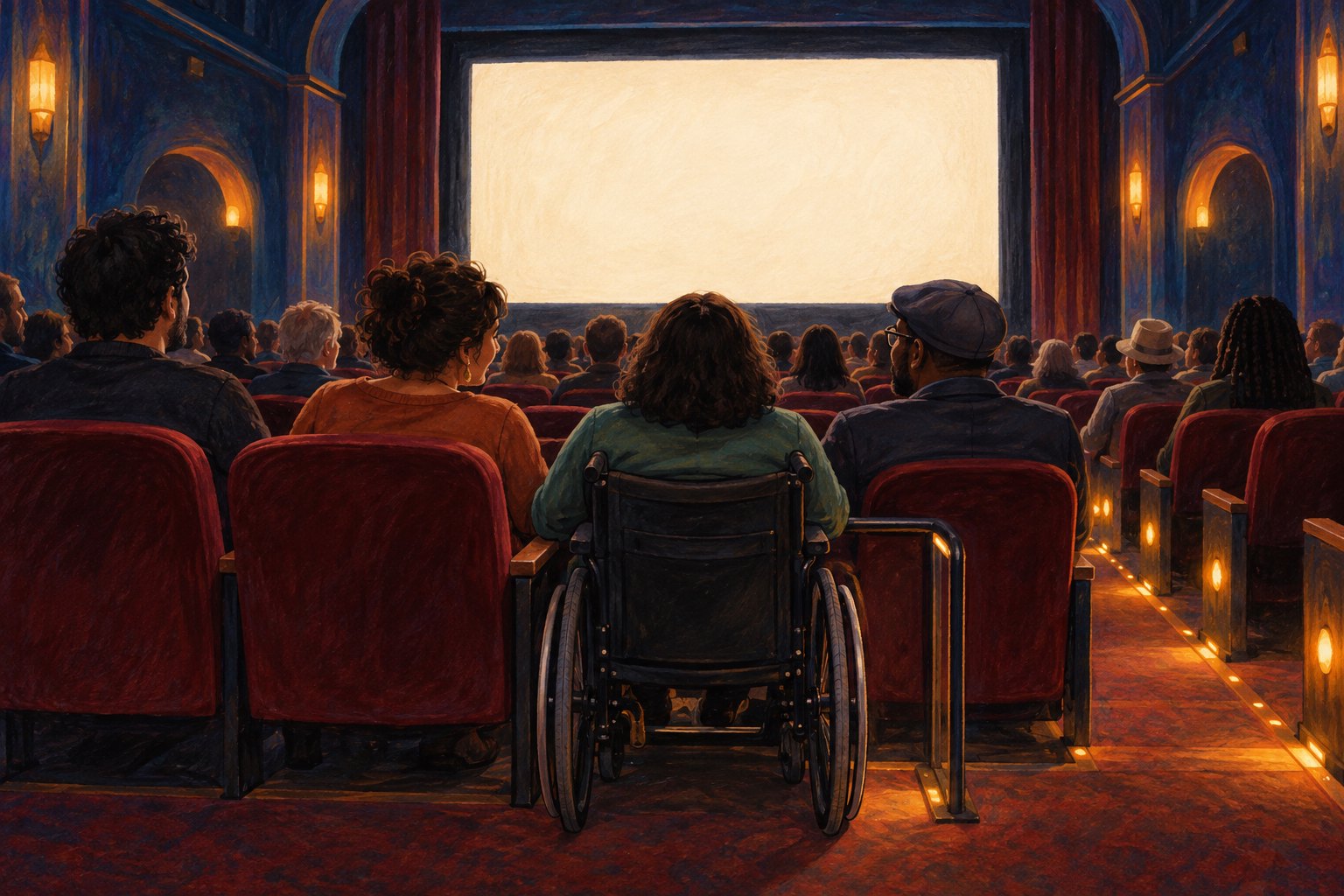
The empty seats in this conceptual illustration represent that interpretive question; they do not reproduce a scene from Artificial. Who occupies the space around a central figure matters. So does whether the story allows those people an independent perspective.
Our discussion of reporting and dramatization in The Social Reckoning approaches a related problem: a compelling exchange can clarify a conflict without becoming documentary evidence of exactly what happened.
An Origin Is a Choice of Where to Begin
The phrase “origin story” sounds straightforward. In practice, every beginning excludes an earlier beginning. A film can start with an idea, a relationship, a decision, or a crisis. Each option implies a different answer to the question of what caused the story that follows.
That matters for Artificial because a company’s origins and a public figure’s emergence are not necessarily the same narrative. Their overlap can be dramatically productive, but treating them as interchangeable risks making collective work disappear into biography.
Viewers can watch for a simple distinction: does success appear inevitable because the audience already recognizes the names, or does the storytelling preserve the uncertainty of the choices being made? Hindsight can make any ascent look destined. Drama becomes more interesting when alternatives remain imaginable.
This is also where an ending carries unusual weight. The point at which a film stops can suggest resolution even when the underlying subject remains unsettled. A satisfying final image is a formal achievement; it is not, by itself, a complete explanation of an institution.
Dialogue Can Reveal Character Without Proving History
A memorable line often becomes the part of a biographical film audiences carry away. That gives dialogue considerable interpretive power. A concise speech can make a character’s worldview feel settled, even when a more searching reading would notice hesitation, contradiction, or self-interest around it.
No dialogue is quoted here because no authenticated film lines are available for this commentary. Inventing a plausible declaration would misrepresent both the screenplay and the person being portrayed. When assessing the film, the better question will be what a line accomplishes between characters, not simply whether it sounds quotable.
That distinction also separates this discussion from our examination of Artificial’s early reception. Enthusiasm describes a response. Character analysis must explain the dramatic choices that produce it.
The Deeper Question: Who Owns the Explanation?
The most productive interpretation of Artificial’s premise is that a technological origin story is also a struggle over authorship. Who gets to describe what an institution means? Whose motives become legible? Whose labor becomes background? These questions reach beyond whether the central figure comes across sympathetically.
My critical position is that an incisive portrait should help audiences understand the attraction of personal authority while retaining the ability to look beyond it. Garfield’s presence gives Artificial a human focus. The deeper measure of the film will be whether that focus opens up the institution around Altman—or makes one man seem large enough to explain it all.
Original content by this site's editorial team. Published: October 5, 2026 at 22:43:39 PDT (Los Angeles time)