
A politically charged movie production has become the subject of a dispute that reaches beyond its intended audience. The Daily Beast reports that Pawn Shop, associated with The Daily Wire, faced a temporary filming suspension in Livingston, Montana, following community backlash. The immediate distinction matters: a reported interruption to local filming does not establish that the movie has been permanently canceled.
For moviegoers, the controversy raises two separate questions. What happened around the production? And what kind of film might emerge from its confrontational subject? The first requires careful reporting. The second invites criticism, but a responsible judgment must stop short of pretending that a reported premise amounts to a completed screening.
This is production commentary and premise analysis, not a review of a finished film. The discussion below includes reported story setup, but no verified ending or dialogue.
What the reported shutdown actually means
ComingSoon’s account describes Livingston officials temporarily suspending the production’s permit while seeking a city attorney’s assessment. That is a narrower development than the sweeping impression created by the word “shutdown.” It concerns permission to continue filming under particular local circumstances; it does not, by itself, answer whether the project can resume, relocate, or eventually reach audiences.
That distinction should guide any reading of the backlash. A temporary pause is consequential, but it is not a box-office result, a distribution decision, or a verdict on the finished movie. Nor does the existence of opposition demonstrate that every complaint has been independently established.
The clearest way to follow this story is to keep three developments separate: the status of the filming permit, the response to residents’ concerns, and the future of the film itself. An announcement about one may leave the others unresolved. Claims that the project has been definitively defeated—or vindicated—would require more evidence.
The community concerns deserve their own attention
Local reporting adds context that a political label alone cannot provide. KTVH reported concerns from the Livingston Food Resource Center about road closures and access to its services. Its executive director also described clients being questioned by security while trying to reach the center. Those are attributed accounts of practical disruption, and they deserve consideration on their own terms.
A resident should not have to agree with a movie’s politics to expect a usable sidewalk. Equally, disliking its politics does not automatically establish misconduct by its crew. Keeping these propositions together makes the controversy easier to understand without reducing everyone involved to a partisan role.
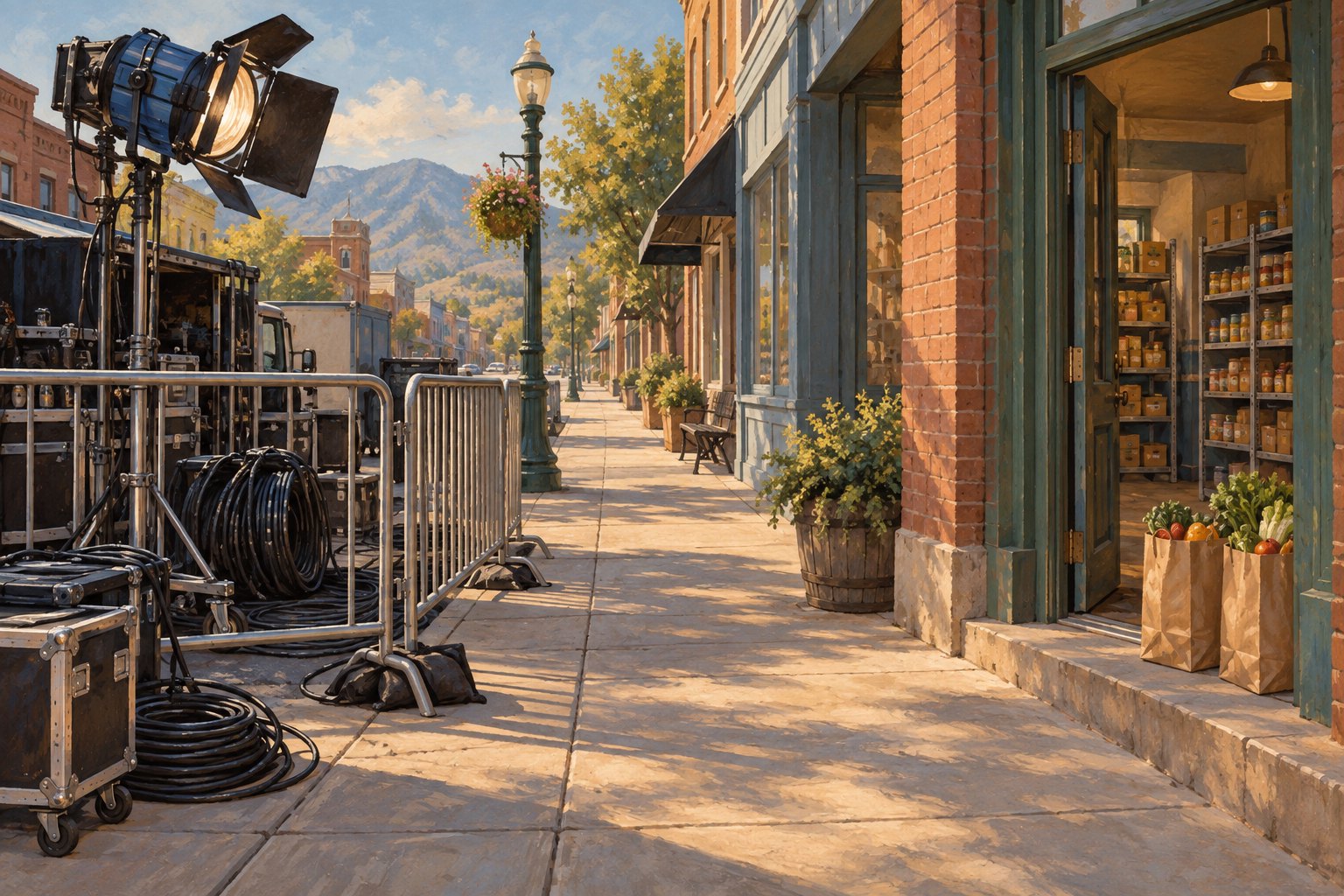
My view is that location filmmaking earns goodwill through the arrangements people actually experience: clear notice, reliable access, and someone accountable when plans go wrong. A production’s artistic ambitions cannot answer a question about getting groceries through a blocked route. These are different responsibilities, and neither disappears because the other is politically contentious.
The broader question also connects with our discussion of what communities need from a film production boom. Bringing cameras into a town creates obligations as well as opportunities. The people living there remain residents, customers, workers, and neighbors even when their streets become a backdrop.
The reported premise puts conflicting loyalties in one room
In its coverage, VEJA, citing Deadline, describes a setup involving a federal officer who becomes trapped during street unrest in a pawn shop with a Latino owner and the owner’s progressive son. Their conflicting beliefs become part of the encounter. That remains a reported premise, rather than a verified account of the finished film’s scenes or character arcs.
As a dramatic proposition, the setup has potential. A confined location can make ideological disagreement unusually personal: people who might dismiss one another in public must negotiate immediate needs together. The important question is whether the screenplay allows those needs to complicate their positions.
The officer: authority under pressure
From the officer’s perspective, confinement could test the distance between possessing authority and earning another person’s trust. A persuasive character would need more than competence during danger. The drama could explore what the officer notices, what he misreads, and whether relying on strangers changes his understanding of them.
These are standards for evaluating the eventual performance and writing, not claims about scenes that have been shown. If every disagreement simply confirms the officer’s original assumptions, the situation may generate action without generating much discovery.
The owner: a person with something to protect
The shop owner offers a different possible center of gravity. In this setup, political conflict enters a space connected to someone’s livelihood. His choices could therefore involve competing responsibilities: protecting his son, preserving his business, and deciding what he owes a stranger.
A character becomes less convincing when his identity serves mainly to endorse someone else’s argument. What would matter here is whether the owner has motives that remain intelligible even when they inconvenience the film’s preferred position. His relationship with his son could supply emotional stakes that no speech about national politics can replace.
The son: disagreement needs an inner life
The progressive son presents a corresponding test. Does disagreement arise from experience, fear, loyalty, or moral conviction? Or does the character exist primarily to misunderstand danger until another person corrects him?
Neither a change of mind nor a refusal to change is inherently sophisticated storytelling. What matters is the path between a belief and a decision. An argument becomes drama when acting on it costs a character something. Without that cost, even heated dialogue can feel like alternating statements prepared for an audience already keeping score.
Political conviction does not settle artistic quality
A movie can take a firm political position and still contain interesting people. It does not need to distribute sympathy evenly. It does need enough observation to make its conflicts feel discovered rather than mechanically arranged.
That is why this controversy cannot substitute for an eventual film review. Supporters may regard opposition as evidence of the project’s importance; detractors may regard it as confirmation of its faults. Neither response tells us how a scene is paced, whether a performance conveys contradiction, or whether the camera notices something the dialogue overlooks.
Our analysis of the distance between reporting and screen drama addresses a related concern: dramatic force and factual authority require separate judgments. Here, the additional challenge is separating the controversy surrounding a production from evidence about its eventual artistic execution.
The deeper question is who gets to be more than an obstacle
The most useful interpretive question surrounding Pawn Shop is who receives a fully developed point of view. Within its reported setup, an officer, a business owner, and a son could each have competing claims on the audience’s attention. Outside the fiction, residents have concerns that cannot fairly be reduced to their usefulness in a political argument.
That parallel does not prove anything about the finished movie. It does establish a worthwhile critical standard. A film about divided people becomes more revealing when it can recognize the difference between an opponent and a person whose life exceeds the disagreement. If Pawn Shop eventually reaches audiences, that capacity will tell us more about its value than the volume of the controversy preceding it.
Original content by this site's editorial team. Published: October 5, 2026 at 23:22:11 PDT (Los Angeles time)