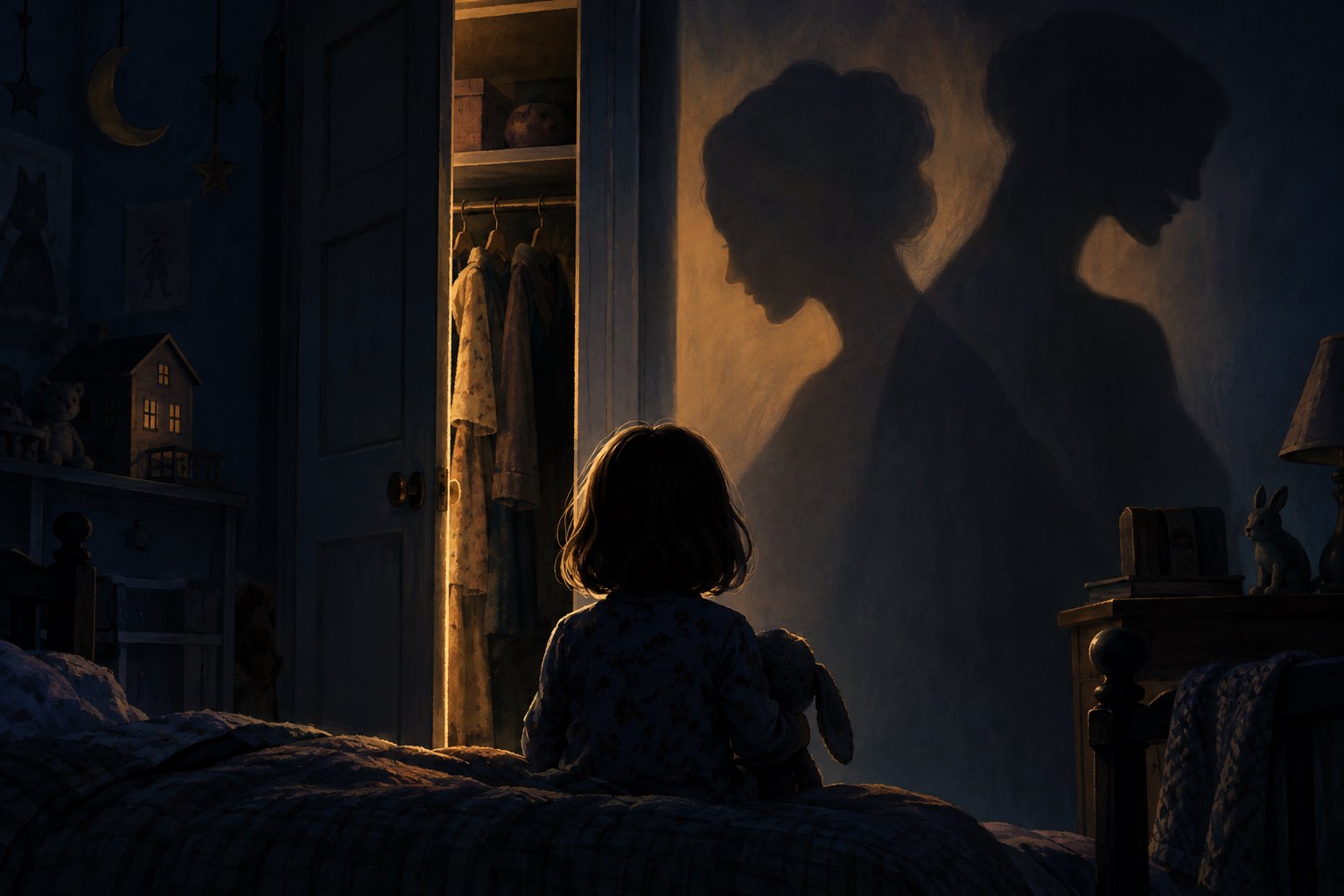
Other Mommy places a disturbing demand at the center of its supernatural story: a child must decide what an adult-shaped presence is allowed to take from her. The frightening proposition is bigger than a monster impersonating a mother. It is the possibility that affection can become an obligation—and that a little girl might feel responsible for satisfying it.
Spoiler note: This critical reading discusses the established premise, a central line, and reported horror sequences. It does not reveal the ending or offer an unverified explanation of the creature’s origins.
Bela’s problem begins before the monster becomes threatening
Directed by Rob Savage, Other Mommy follows Bela, played by Arabella Olivia Clark, whose parents’ troubled relationship forms the background to an increasingly dangerous supernatural attachment. Jessica Chastain plays both her mother, Ursula, and the entity’s maternal manifestation; Jay Duplass plays her father. The story adapts Josh Malerman’s Incidents Around the House. These essentials are documented in the film’s publicity and the Indonesian Film Censorship Institution’s synopsis. [Film synopsis and credits](https://lsf.go.id/en/film/other-mommy/1585)
From Bela’s perspective, the meaningful distinction is initially between attention and its absence. An adult audience can recognize an ominous proposition immediately. A lonely child has another question to answer first: does this person want to be with me? That difference gives the premise its emotional force. Bela’s attachment need not be read as foolishness. It makes sense within a world where she has limited power over the people she depends on.
My reading is that the entity exploits an imbalance already built into childhood. Adults determine where children live, how households function, and which explanations they receive. Bela must interpret the consequences without possessing the same information. A presence that seems interested in her can therefore acquire significance before she understands its intentions.
The request that turns tenderness into pressure
“Can I go inside your heart?” is the creature’s defining question, reproduced in the film’s promotional material. Its effectiveness comes from the collision between an affectionate expression and a literal invasion. Nothing in the sentence sounds like the usual vocabulary of an attack. That is precisely what makes it useful to the attacker. [Trailer quotation and official publicity](https://dailydead.com/can-i-go-inside-your-heart-watch-the-trailer-for-other-mommy/)
The opening words, “Can I,” seem to acknowledge Bela’s authority. Yet asking permission does not make a relationship respectful when the question keeps returning and resistance brings intimidation. Read this way, the entity stages a counterfeit version of consent: Bela appears to have a choice, while the circumstances increasingly punish her for withholding the desired answer.
The final word matters just as much. A heart represents feeling, attachment, and the private self. The request blurs loving someone with making room for that person to occupy you. For a child, those ideas can be difficult to separate. Being kind can begin to feel indistinguishable from surrendering a boundary.
This is the story’s strongest conceptual hook. It invites viewers to notice the moment an expression of need becomes a demand. The monster’s apparent vulnerability is part of its power; Bela is placed in the position of someone who might feel cruel simply for refusing it.
Ursula deserves more than a comparison with her double
Chastain’s dual casting establishes a pointed dramatic problem. The same recognizable face belongs to a parent and to something that uses parenthood as camouflage. Official publicity explicitly identifies the two roles. [Official film information](https://www.othermommymovie.ca/)
That arrangement invites comparison, but comparison can become a trap for the viewer as well as for Bela. A real parent has competing responsibilities, frustrations, and limits. A manipulative presence can initially present attention as its entire purpose. Evaluating them only by who seems most available risks accepting the creature’s own sales pitch.
Ursula’s perspective therefore matters independently of how Bela experiences her. A child can feel rejected without the film having established that her mother is incapable of love. Likewise, acknowledging a mother’s complexity does not erase a child’s hurt. The richer interpretation holds both possibilities together.
For me, this is where the premise carries its greatest critical risk. If maternal imperfection becomes an all-purpose explanation for supernatural catastrophe, the story can reduce a woman to the damage others associate with her. The more searching question concerns what this family cannot communicate, and why a child becomes the place where those failures converge.
A reassuring father still belongs inside the family problem
Bela’s father also warrants scrutiny. Common Sense Media describes him as an engaged caregiver, while documenting a scene in which he lets Bela taste a cocktail she is carrying to her mother. That small incident complicates the easy division between a comforting parent and a difficult one. [Character and scene details](https://www.commonsensemedia.org/movie-reviews/other-mommy)
Warmth and sound judgment are separate qualities. From a child’s perspective, permissiveness may feel like understanding; from outside the relationship, it can reveal an adult’s failure to maintain a useful boundary. This does not make the father equivalent to the entity. It does mean that likability should not exempt him from interpretation.
A character-centered reading should ask what each adult expects Bela to absorb. Who explains uncomfortable truths? Who makes her feel responsible for keeping the atmosphere pleasant? These questions are more revealing than assigning the family one innocent parent and one guilty parent.
When places built for children become traps
The film’s reported body horror extends beyond the bedroom. Common Sense Media describes a children’s play structure becoming a threatening maze, including a dangerous ball-pit sequence, alongside the creature’s unnatural bodily transformations. These are substantial horror elements, despite the story’s young central character. [Violence and set-piece descriptions](https://www.commonsensemedia.org/movie-reviews/other-mommy)
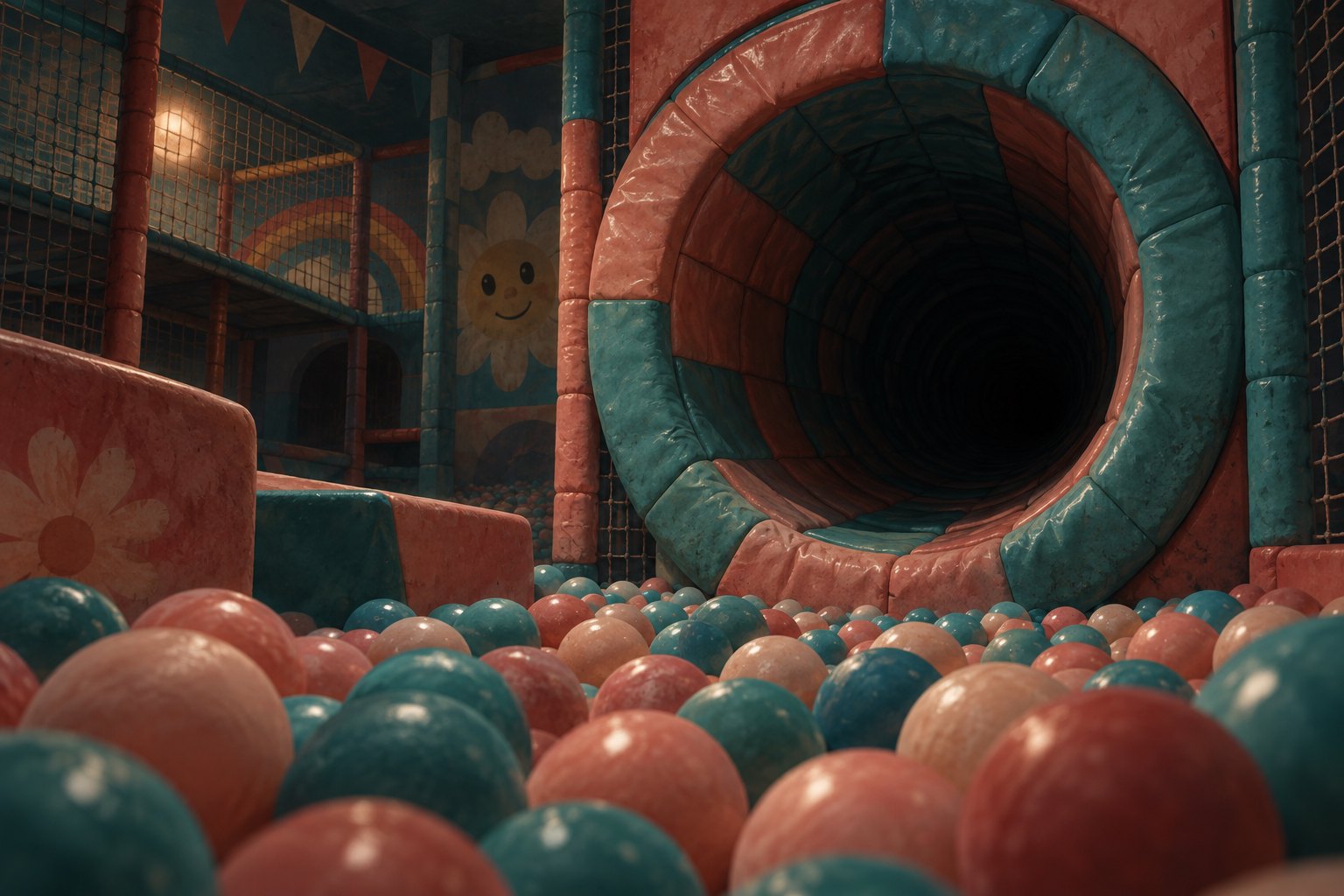
A play area offers an especially apt visual extension of Bela’s predicament. Its design announces safety through softness, enclosure, and bright color. Turn those features against a child and the promise becomes the threat: padded walls still confine, while an inviting opening can lead somewhere she cannot understand.
Our exploration of how familiar locations become frightening on screen considers a related principle. Horror changes how a character can use a place. A room stops functioning as shelter when its occupant can no longer rely on its boundaries.
There is also an important distinction between disturbing imagery and sustained emotional impact. As discussed in our commentary on the challenge of making horror last beyond the immediate scare, proximity to danger is only part of the experience. For Bela’s story, spectacle gains meaning when it deepens our understanding of her predicament.
The deeper horror is an impossible responsibility
The most productive interpretation of Other Mommy centers on the burden of being needed. Bela is vulnerable because she wants connection, but wanting connection is not her mistake. The violation occurs when another presence treats that desire as permission to claim her.
Return to the question about entering her heart, and its emotional cruelty becomes clearer. It asks a child to solve someone else’s hunger by offering her own interior life. In that sense, the supernatural proposition exaggerates an ordinary and damaging expectation: that children should repair adult unhappiness through sufficient love.
That is the idea worth carrying beyond the creature’s appearance. A child’s affection cannot repair every fracture in a household, and her refusal cannot make her responsible for another being’s violence. Bela’s right to remain herself is the story’s most compelling stake.
Original content by this site's editorial team. Published: October 12, 2026 at 22:38:50 PDT (Los Angeles time)