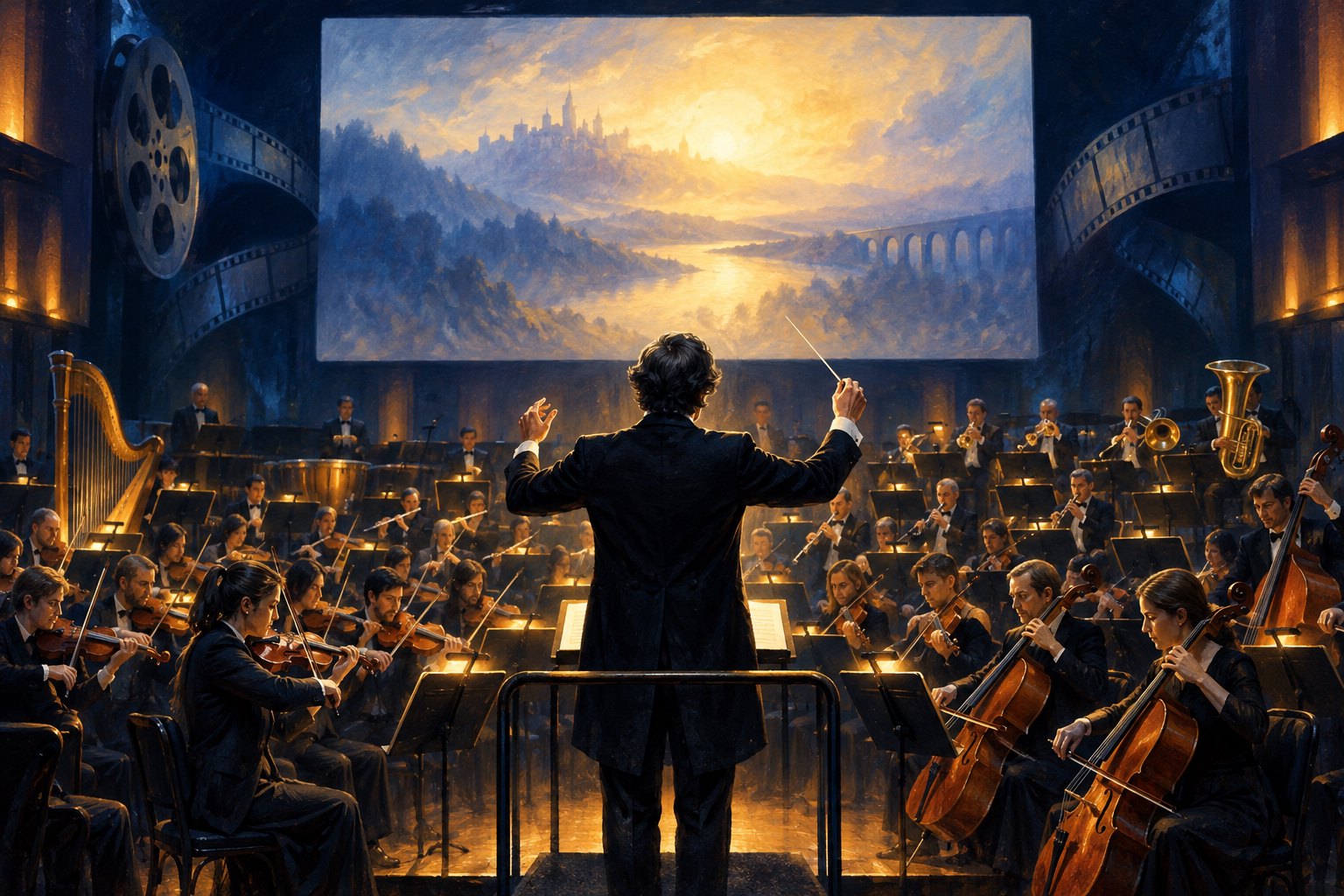
An Iowa-trained musician is leading an orchestra dedicated to film scores, according to Iowa Alumni Magazine. For movie lovers, the appeal extends beyond hearing familiar melodies played live. An ensemble built around screen music brings attention to a part of filmmaking that can shape our understanding of a character before that character has explained a thing.
The central idea deserves attention on its own: music created to work alongside images becomes the reason an audience gathers. That shift raises an intriguing critical question. When the orchestra takes the spotlight, do we simply remember the movie, or do we understand something new about how it made us feel?
This is a spoiler-free critical commentary on that artistic premise, not a review of a specific concert. The report’s central announcement establishes the musician’s Iowa training and the orchestra’s film-score focus. It does not, by itself, establish a repertoire, performance format, or basis for judging the ensemble’s playing.
Why an Orchestra Devoted to Film Scores Matters
In a movie, attention moves between faces, dialogue, locations, movement, and sound. Music participates in that mixture without always announcing its contribution. A scene may feel uncertain because of the harmony beneath it, intimate because the orchestration becomes sparse, or urgent because a repeating figure refuses to settle.
A dedicated orchestra offers the possibility of bringing those decisions into the foreground. Instead of treating the score as a pleasant accompaniment, listeners can follow its construction: which instrument introduces an idea, how the accompaniment changes, and what happens when an expected resolution is delayed.
My view is that this is the strongest artistic case for the project described by Iowa Alumni Magazine. Recognition can get an audience through the door. Sustained attention to musical storytelling gives that audience something to take back to the movies.
The Iowa connection supplies the human starting point, but it should not become a shortcut to assumptions about the musician’s background. Training location alone cannot explain an artistic philosophy. The meaningful question is how the ensemble’s stated dedication to film scores translates into interpretation and programming.
Listen for the Character Behind the Melody
A useful way to approach film music is to ask whose experience it seems to express. Does a passage share a character’s confidence? Does it reveal anxiety beneath a composed exterior? Or does it seem to know something the character has not yet discovered?
These are different dramatic functions. Music aligned with a protagonist can invite identification; music that contradicts the protagonist can introduce distance or doubt. A triumphant sound does not automatically mean that a film endorses the person on screen. Its meaning depends on placement, development, and the surrounding action.
Recurring musical ideas are especially useful to follow. A melody returning in a thinner texture may feel more exposed. The same outline supported by a different harmony may suggest that an earlier certainty has become unstable. Those interpretations need the film’s context to become claims about a particular character, but listeners can begin by noticing the audible changes.
For an orchestra devoted to this repertoire, that creates a demanding interpretive task. Playing a recognizable tune cleanly is only the beginning. The musicians must make its changes of weight, pace, and color feel consequential.
What Changes When Film Music Moves to the Stage
There is an important distinction between performing music alongside a projected film and presenting a score as a standalone concert work. The announcement alone does not tell us which approach this orchestra uses, and the two should not be treated as interchangeable.
With a film playing, musical timing remains connected to the unfolding image. Without it, the performance must establish continuity through sound. A passage designed to lead into a cut or sit beneath dialogue may register differently when listeners give it their full attention.
A concert suite also involves selection. Choosing which passages to include, where to join them, and how to end can change the emotional proportions of the material. An arrangement that emphasizes spectacular climaxes may leave a different impression from one that preserves quieter transitions.
This is closely related to the question explored in our commentary on judging adaptations across different forms: carrying recognizable material into a new setting does not automatically preserve its original effect. The receiving form has demands of its own.
How to Judge the Performance Beyond Familiarity
For this Iowa-connected orchestra, the most useful eventual criticism would explain what the performance reveals. Applause for a beloved melody tells us that recognition happened. It does not tell us whether the interpretation clarified the music.
Three listening questions can make that distinction easier:
- Can you hear the relationships between sections? A melody may be prominent, but a countermelody or repeating accompaniment can supply the tension that gives it meaning.
- Do the quieter passages retain direction? Soft playing should still have shape. Listen for phrases that gather energy, hesitate, or release it.
- Does a climax feel prepared? Volume alone cannot explain why an arrival matters. Its force depends partly on the pacing and restraint that precede it.
Watching the players can enrich that listening. A phrase passed between instruments becomes a visible exchange; a collective entrance makes coordination tangible. Our discussion of watching musical collaboration in live performance approaches a related pleasure: seeing the relationships that help produce what we hear.
The Programming Opportunity: Leave Room for Uncertainty
My strongest hope for an orchestra with this focus would be a willingness to program emotional contrasts. Film music encompasses more than grandeur. A concert can make room for unease, restraint, awkwardness, tenderness, and unresolved feeling alongside the sweeping material that readily fills a hall.
That is an editorial preference, not a description of this ensemble’s announced selections. It matters because a program made entirely of emphatic moments could give an incomplete account of what scores contribute to movies.
The subtle passages can be particularly revealing. Music that stops short of a resolution may preserve a character’s uncertainty. A brief instrumental exchange may convey a relationship more delicately than a full statement of a theme. Giving such material space would let a film-score orchestra demonstrate breadth as well as power.
A Different Way to Carry the Movie Home
The deeper promise of the Iowa-trained musician’s undertaking is a change in how audiences listen afterward. A concert might send someone back to a favorite film newly attentive to the moment music enters, the instrument that takes over, or the silence that follows.
That attention can sharpen character analysis. Instead of assuming a scene’s emotion comes entirely from dialogue or acting, viewers can consider how sound supports, complicates, or questions the visible performance.
An orchestra devoted to film scores is most compelling to me when it opens that door. The familiar melody remains a pleasure, but the greater discovery is hearing how much storytelling was happening around it all along.
Original content by this site's editorial team. Published: October 12, 2026 at 20:10:27 PDT (Los Angeles time)