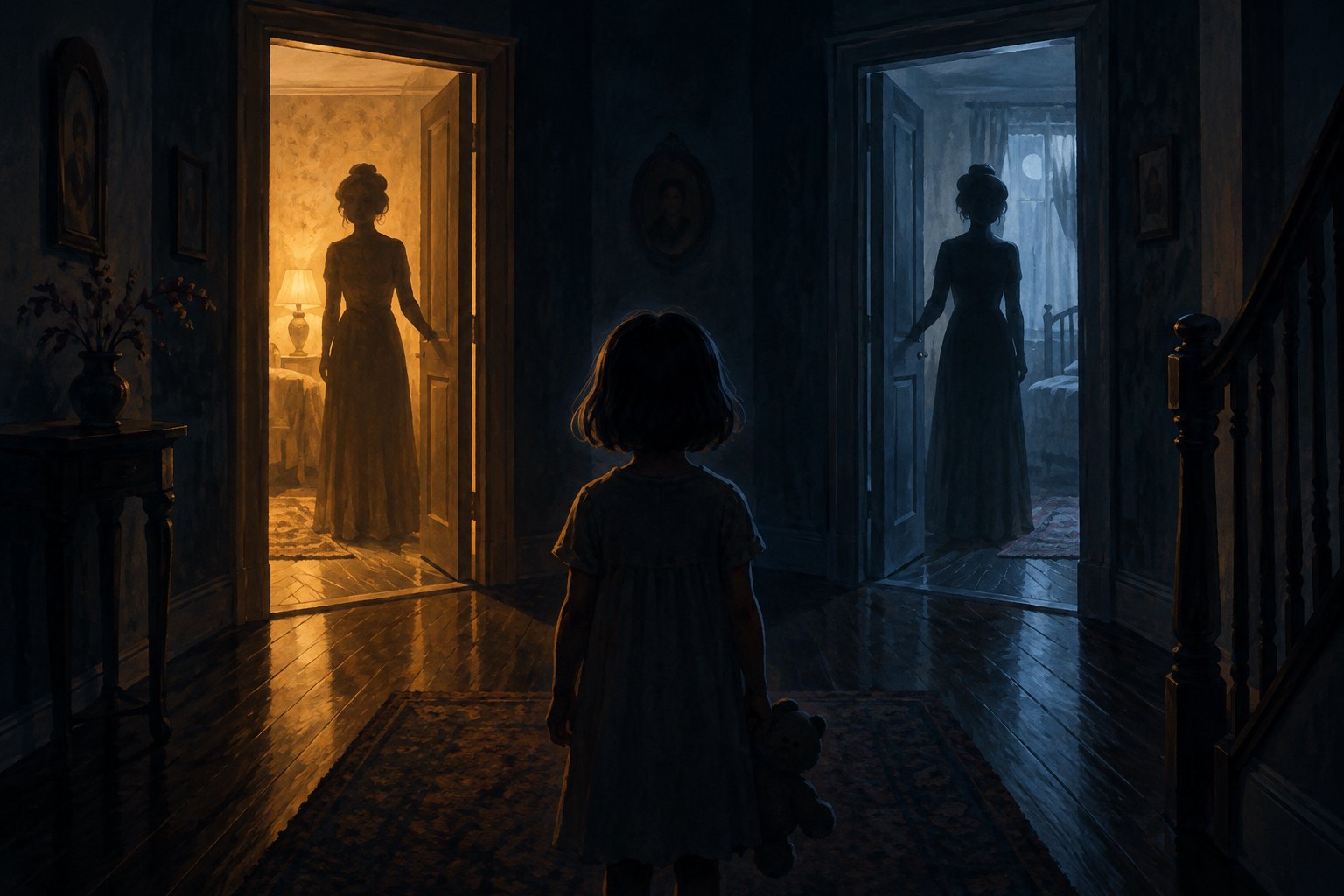
Other Mommy has the stronger opening in Deadline’s box-office reporting, while The Social Reckoning is struggling to attract moviegoers. That contrast supplies the weekend’s immediate business story. The more interesting critical question is what audiences are being invited to fear: a recognizable face that no longer guarantees a recognizable person.
Jessica Chastain’s horror vehicle places a child’s relationship with a threatening maternal double at its center. Read through that child’s experience, the premise becomes more disturbing than a simple contest between a good mother and an evil replacement. It asks how someone still learning what love means can recognize its counterfeit.
Spoiler note: This character-focused commentary discusses the premise and early family dynamics, drawing on official film information and published accounts. It does not reveal the ending or offer a firsthand assessment of every scene.
The opening contrast is clear; its explanation is not
The reported advantage for Other Mommy establishes an opening comparison with The Social Reckoning. It does not establish why individual viewers chose one film, whether they enjoyed it, or which release will ultimately justify its costs. Without verified figures and matching reporting periods, attaching precise totals would make that comparison look more settled than it is.
There is nevertheless a useful distinction between commercial accessibility and dramatic complexity. A sinister version of your own mother is an immediately legible horror idea. Understanding its basic threat requires little explanation. Understanding what that threat means to a particular child should require considerably more.
That distinction also keeps The Social Reckoning from becoming a convenient punch line. Its weaker reported opening is a business outcome, not evidence that its characters, performances, or ideas are inferior. Readers looking for the broader commercial context can revisit our discussion of what Other Mommy’s opening can and cannot establish. Here, the useful next step is to move inside its central relationship.
Bela has to judge something adults usually define for her
The official synopsis identifies Bela, played by Arabella Olivia Clark, as a girl who develops a relationship with a sinister presence resembling her mother. Chastain plays both the mother and the entity’s maternal manifestation; Jay Duplass plays Bela’s father. Those relationships are confirmed in [Universal’s film synopsis](https://www.universalpictures.com/movies/other-mommy/synopsis/).
For an adult, resemblance and identity are separate concepts. For a child, familiar appearance is often part of the evidence that someone is safe. The premise attacks that everyday method of recognition. Bela cannot rely on a face carrying the same meaning every time she encounters it.
My reading is that this makes her uncertainty more important than her innocence. Innocence can become a decorative quality in horror: a reason the audience should worry about someone. Uncertainty gives that person an active problem. Bela must interpret attention, weigh reassurance, and decide what another being wants from her.
That is an unusually demanding burden to place on a child. Adults teach children to accept care and listen to authority, then expect them to identify the moment those signals become dangerous. A monster wearing a parental appearance exposes how difficult that distinction can be.
Ursula deserves to be understood beyond her double
Published accounts describe Ursula as a working mother and Russell as a father who spends more time at home. William Bibbiani’s review also describes the parents becoming aware of the entity and trying to escape it. These are reported story details, rather than assumptions drawn from the advertising. See [TheWrap’s account of the film](https://www.thewrap.com/creative-content/movies/other-mommy-review-jessica-chastain/).
The working-parent distinction deserves careful handling. A child can experience a parent’s absence as rejection without that interpretation being the complete truth. Employment, fatigue, and emotional distraction do not mean the same thing, even when they feel similar to someone waiting for attention.
A sympathetic reading should therefore hold two perspectives together. Bela’s loneliness matters because she experiences it. Ursula’s personhood matters because she exists beyond her daughter’s immediate needs. Reducing either perspective to a moral verdict would flatten the family before the supernatural threat even enters the discussion.
Chastain’s dual casting makes that tension especially pointed. The same performer embodies a human relationship and its threatening imitation. Conceptually, the arrangement challenges viewers to look past recognition and toward conduct: what does each figure ask of Bela, and how much room does each leave for her independence?
A question about love becomes a question about permission
“Can I go inside your heart?” is the question foregrounded in the official publicity. Its power lies in how closely its wording approaches a harmless expression of affection. Someone asking for a place in your heart might ordinarily be asking to be loved.
In this context, the language also suggests entry into a private space. That ambiguity provides a stronger interpretive anchor than a catalogue of startling appearances. The question concerns access, and access is different from companionship.

Read as a metaphor, the heart becomes the part of Bela that should remain hers even when she loves somebody. Affection need not require unlimited availability. Trust need not erase privacy. A child should be able to care about another person without surrendering the right to feel uncomfortable around them.
The unsettling word is therefore “inside.” It turns emotional closeness into a spatial demand. The entity’s maternal appearance supplies familiarity; the question asks whether familiarity will be enough to cross a boundary.
This is an interpretation of the premise and its promotional language, not a claim about an undisclosed final revelation. It also explains why inventing additional dialogue would be unnecessary: the verified question already contains a substantial conflict.
What happens when parents believe the child?
The reported development in which the parents recognize the threat shifts the family’s problem. Bela’s experience can no longer be dismissed solely as something adults do not understand or cannot see. Recognition, however, is only the beginning of responsibility.
From a child’s perspective, parental belief promises protection. From a parent’s perspective, belief may reveal how little control they actually possess. That gap offers fertile dramatic territory: being taken seriously can bring comfort while also exposing the limits of the people you depend on.
It is the same distinction between vulnerability and responsibility that informs our character-centered discussion of Carrie and maternal control. The stories are different, but both invite scrutiny of what parental authority feels like to the person living beneath it.
The deeper horror is affection with conditions attached
The strongest interpretation available here is that Other Mommy makes care difficult to identify by separating its appearance from its purpose. A familiar face may be reassuring. Attention may feel wonderful. Neither necessarily tells Bela whether her wishes matter to the being providing it.
“Can I go inside your heart?” consequently carries two competing possibilities: an invitation to intimacy and a demand for possession. The ethical difference depends on whether the person being asked remains free to refuse.
That is where this box-office leader becomes more interesting than its opening comparison. Its premise puts a child in the position of evaluating the terms of an apparently loving relationship. My judgment is that this question deserves to remain central to any assessment of the film: does Bela matter as a person with boundaries, or merely as someone the adults and the monster want to claim? The most troubling maternal horror begins when those two things become difficult to tell apart.
Original content by this site's editorial team. Published: October 10, 2026 at 17:58:52 PDT (Los Angeles time)