Mike Flanagan wants to make a Jaws movie and has expressed interest in a Jurassic film, too. Deadline’s report captures the appeal in the phrase “could be a blast.” The essential distinction is that this is an expression of creative interest: it does not, by itself, establish a directing deal, an approved screenplay, or a release date. His interest in both properties is also covered in [GamesRadar’s report](https://www.gamesradar.com/entertainment/adventure-movies/mike-flanagan-dreams-of-directing-a-new-jaws-or-jurassic-world-movie/).
The interesting question is what either opportunity would ask of him. My view is that the strongest starting point would be the people who discover that their knowledge, authority, and carefully maintained confidence cannot keep them safe. Steven Spielberg’s originals already offer remarkably different versions of that experience.
Spoiler warning: The analysis below discusses major character developments and sequences in Jaws (1975) and Jurassic Park (1993). It evaluates those existing films and the creative possibilities they suggest, not an unannounced Flanagan production.
Jaws makes responsibility more frightening than ignorance
Police chief Martin Brody recognizes the danger facing Amity, but the town’s economic dependence on beach tourism helps undermine his attempt to close the beaches. Later, aboard the Orca with shark hunter Quint and oceanographer Matt Hooper, he confronts a threat far beyond his experience. His famous response, “You’re going to need a bigger boat,” gives that realization its simplest expression. These events and the line are documented in [AFI’s account of Jaws](https://catalog.afi.com/Film/55193-JAWS).
Brody is compelling because recognizing a problem does not automatically make him capable of solving it. His position carries responsibility without granting him command over everyone whose cooperation he needs. That gap gives the film an emotional pressure that a larger shark could never supply on its own.
The boat line works as both a joke and an admission. Brody finally says aloud what the audience feels: the available protection is inadequate. His reaction makes fear seem sensible. In my reading, this is one of the film’s great strengths. Courage becomes possible precisely because the character understands how frightened he should be.
A hypothetical Flanagan entry could find considerable material in that distinction. Who has the authority to acknowledge danger? Who bears the cost of waiting? Who must live with a decision made under pressure? Those questions could sustain a fresh story without requiring another character to repeat Brody’s exact journey.
Quint shows why a painful history cannot explain everything away
Quint’s account of surviving the sinking of the USS Indianapolis changes the atmosphere aboard the Orca. His later destruction of the radio, preventing Brody from calling for help, makes his determination actively dangerous. The same film gives us access to his suffering and evidence of the harm his behavior causes.
For me, that combination is more unsettling than a simple revelation that the abrasive expert has a tragic past. Understanding Quint does not make his judgment reliable. The audience can feel compassion while recognizing that the other men should not have to surrender their lives to his private reckoning.
This would be a useful discipline for any new interpretation: a revealing speech should complicate a character rather than settle the argument about him. The shark remains a physical threat, while the human drama turns on whose interpretation of that threat governs everyone else’s choices.
It is related to the question raised in our analysis of character perspective in Flanagan’s Carrie: entering someone’s emotional experience requires care about what that access asks an audience to accept.
Jurassic Park turns expertise into an obligation to care
In Jurassic Park, Alan Grant’s encounter with living dinosaurs becomes a responsibility for Hammond’s grandchildren, Lex and Tim. Ellie Sattler takes action to restore power, while the children later face velociraptors in the visitors’ center kitchen. These character movements are recorded in [AFI’s Jurassic Park synopsis](https://catalog.afi.com/Film/67200-JURASSIC-PARK).
Grant’s expertise matters, but the film gives it a new purpose. Knowing something about animals becomes valuable because frightened children need someone who can make a decision. Scientific understanding acquires an immediate human consequence.
That is why I find the film’s movement between wonder and terror so effective. The extraordinary discovery remains extraordinary even when it becomes dangerous. An encounter can be intellectually thrilling and emotionally unbearable at the same time. Preserving both responses would give a new Jurassic movie greater range than treating every dinosaur appearance as another attack cue.
Ellie supplies a different form of judgment. She is willing to act within a collapsing situation without confusing action with mastery. Her competence feels persuasive because it involves exposure to danger. She cannot solve the crisis from a position of perfect safety.
Hammond’s repeated assurance, “Spared no expense,” expresses the opposite temptation: treating expenditure as proof of care. The phrase becomes increasingly hollow because money spent and responsibility fulfilled are different measures. That distinction gives the spectacle an ethical dimension without requiring every scene to stop for a debate.
The kitchen sequence offers a better model than a bigger body count
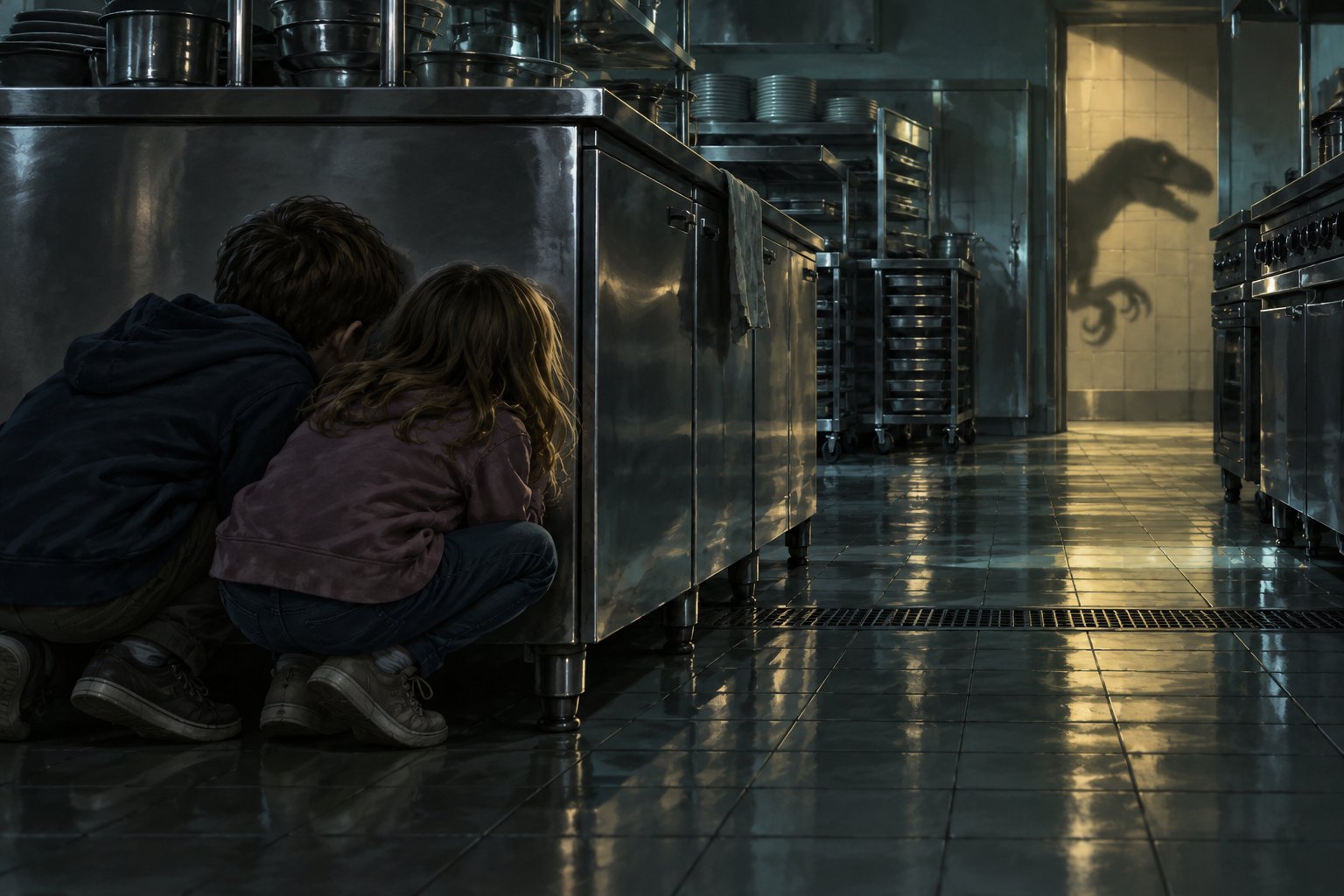
The kitchen sequence narrows an enormous premise to a child's immediate concerns: where to hide, when to move, and whether a sound will reveal a position. Its force comes from giving viewers a comprehensible space and making movement through that space feel consequential.
From Lex and Tim’s perspective, ordinary surfaces become unreliable protection. A room designed for practical human work suddenly belongs to animals that do not recognize its intended uses. The scene makes the familiar strange while keeping the immediate problem easy to understand.
That is an especially promising principle for a hypothetical Flanagan dinosaur film. Sustained attention to vulnerable people could make a relatively contained encounter feel enormous. The necessary creative choice would be whose fear organizes the scene, how much that person understands, and what they must risk to help someone else.
Our discussion of what jump-scare counts can actually tell viewers addresses a similar distinction. A count describes frequency; it cannot measure how deeply a sequence involves us in a character’s predicament.
What would make either Flanagan movie worth seeing?
My preference would be a film that establishes a specific human conflict before asking familiar creatures to carry the excitement. A new Jaws story would need people whose relationship to the sea and to one another makes this encounter matter. A new Jurassic story would need a convincing relationship between fascination, responsibility, and survival.
Both would also need room for pleasure. Humor, curiosity, and moments of trust give danger something to interrupt. Unbroken misery can flatten suspense because every scene begins at the same emotional temperature. Spielberg’s originals remain useful reference points because their characters experience more than fear.
The deeper connection between these films is the collapse of reassuring authority. A public office, a lifetime of experience, scientific expertise, or immense wealth can offer protection, but none guarantees wise decisions. Their most affecting moments ask what people do after those guarantees fail.
That is what makes Flanagan’s interest worth considering. The creative opportunity lies in finding another group of people who must decide whom to believe, whom to protect, and when to admit that they are overwhelmed. Give those decisions weight, and the next glimpse of a fin or a moving shadow could mean something again.
Original content by this site's editorial team. Published: October 10, 2026 at 17:23:36 PDT (Los Angeles time)