Lost Treasure: Handel’s Messiah in Bethlehem brings a concert for peace back into view, with conductor Francisco de Araujo’s determination at the center of its story. The documentary connects a musical performance with the effort required to assemble people who might otherwise remain apart. Its most compelling question is also its hardest: what can a film preserve about an encounter once the encounter itself is over?
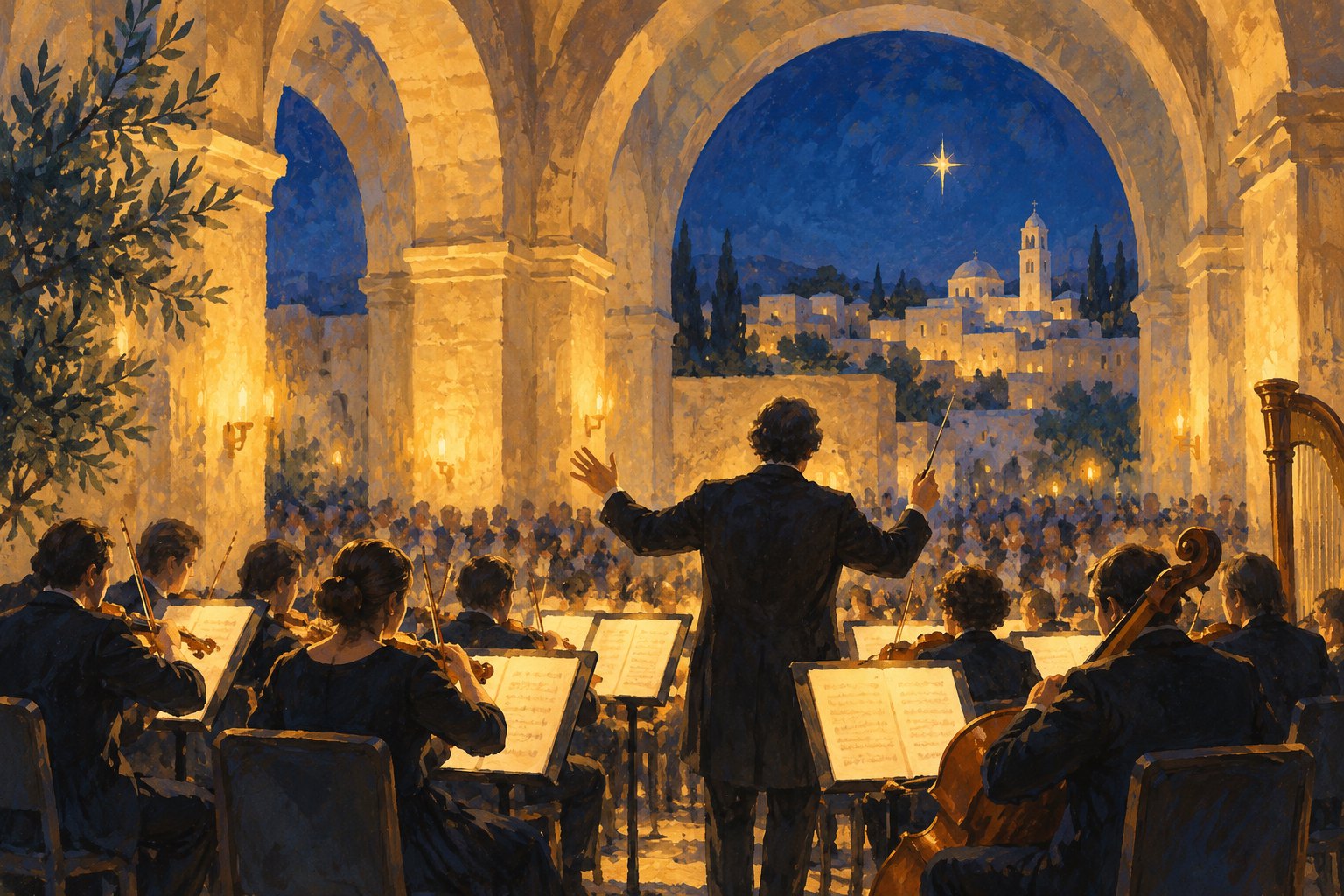
Vatican News reports that the concert took place on November 14, 1994, at the Church of St. Catherine in Bethlehem’s Nativity complex, before an audience that included Israelis and Palestinians, Christians, Jews, and Muslims. That setting gives the project significance, but significance alone does not establish a film’s artistic achievement.
This is a critical preview based on verified reporting and published production information, rather than a review of a completed screening. It examines the documentary’s established subject and structure without assigning unverified reactions, dialogue, or private motives to its participants.
The conductor’s story makes the concert personal
De Araujo offers a concrete way into a subject that could otherwise disappear into general statements about harmony. According to Vatican News, arranging the performance required ten years of negotiations. That duration changes how we understand the event: the concert was the culmination of sustained practical effort, not simply an inspired idea followed by applause.
Viewed through the conductor’s role, the central tension lies between artistic intention and institutional permission. A musician can imagine how an ensemble should sound. Bringing that ensemble into a contested public setting involves decisions beyond the rehearsal room. Persistence becomes meaningful because it must operate through other people, procedures, and concerns.
That distinction matters for character-focused documentary criticism. It would be easy to reduce de Araujo to an inspirational figure whose conviction makes everything happen. A more useful reading asks how individual commitment depends on collective participation. Performers must prepare; organizers must coordinate; people must agree to attend. The conductor can provide direction, but the achievement belongs to more than one person.
For viewers, the interviews offer an opportunity to look for those relationships. Which obstacles receive specific explanation? Whose work becomes visible? Does the account allow uncertainty to remain part of the achievement? These questions help distinguish an involving portrait of perseverance from a retrospective story in which success feels inevitable.
A shared audience does not mean a shared belief
The concert’s interfaith dimension is especially important because Messiah retains its Christian identity. The gathering’s interest lies in people being present for a particular religious and artistic expression. Attendance need not imply agreement with every belief expressed by the music.
My reading of that premise is that listening can carry an ethical value of its own. An audience member may encounter something meaningful to a neighbor without adopting it. Shared attention leaves room for difference; it does not require a film to pretend that difference has disappeared.
This also places a responsibility on how a documentary interprets its audience. An attentive face cannot, by itself, establish reconciliation. Applause cannot tell us everything about a listener’s politics, grief, or hopes. Those limits do not diminish the gathering. They keep its human meaning specific.
The distinction resembles the question raised in our analysis of documentary access and what images can prove: being allowed to observe something is valuable, but interpretation still requires care. Here, the strongest defensible claim concerns people sharing an occasion. Any larger claim needs evidence beyond the occasion itself.
How the film connects performance and explanation
Director and writer Harvey Warren’s published account describes interviews placed between the three parts of the oratorio. The distributor lists a running time of 122 minutes and describes additional Holy Land imagery and biblical paintings. These elements establish a format that combines concert presentation with historical explanation and religious imagery.
That structure creates a clear artistic challenge. Music develops through duration: expectation, repetition, changes in intensity, and the relationship between individual voices and the ensemble. Interviews develop understanding through information and reflection. A successful balance would let each form contribute something the other cannot.
For someone approaching the film primarily as a concert experience, the key question is how much space the performance receives to establish its own momentum. For someone drawn to de Araujo’s story, the question is whether the interviews explain the difficult work behind the gathering with enough specificity. Neither interest is secondary; the documentary’s premise invites both.
Supplementary landscapes and paintings introduce another interpretive layer. They can connect music with geography and religious imagination. They also direct attention away from the performing bodies and the assembled audience. Without a screening, it would be premature to judge the editing, but the distinction gives viewers something concrete to notice: when does an accompanying image deepen the music, and when would remaining with a performer reveal more?
The surviving tape gives the title its weight
The production’s account identifies a surviving VHS copy as the basis for the recovery of the concert footage. It also describes restoration assisted by artificial intelligence. Those details make preservation part of the film’s subject, not merely a technical step before release.

An aging recording introduces a second kind of vulnerability. First, the gathering had to happen. Later, its record had to survive. A performance can matter intensely to the people present and still become difficult for anyone else to encounter.
Restoration should be assessed with that purpose in mind. Improved visibility and intelligibility can help audiences attend to gestures, expressions, and musical relationships. Yet a restoration claim alone cannot establish fidelity. The relevant question is how clearly the finished film preserves the distinction between archival material and later additions.
Our discussion of why preserving and revisiting movies matters considers a related concern: cultural memory depends on continued access. Here, access allows a temporary gathering to become available for fresh attention and disagreement, rather than remaining only a remembered success.
A deeper reading: peace as an experience worth remembering
The most persuasive interpretation of Lost Treasure begins by keeping its promise proportionate. A concert can create an encounter. A recording can preserve aspects of that encounter. A documentary can explain why it mattered. None of those accomplishments requires the claim that a performance resolved the conflicts around it.
From de Araujo’s perspective, the years of preparation make the eventual gathering an achievement in its own right. From the audience’s perspective, its meaning may have been varied and personal. From the perspective of preservation, the surviving images allow later viewers to consider both the aspiration and its limits.
The title therefore suggests more than recovered footage. As an interpretation, its treasure may be the memory of people making room for one another’s presence. That memory cannot guarantee another such moment. It can keep one from vanishing. The documentary’s ultimate artistic test is whether it allows that modest, difficult achievement to carry its full weight.
Original content by this site's editorial team. Published: October 20, 2026 at 13:56:40 PDT (Los Angeles time)