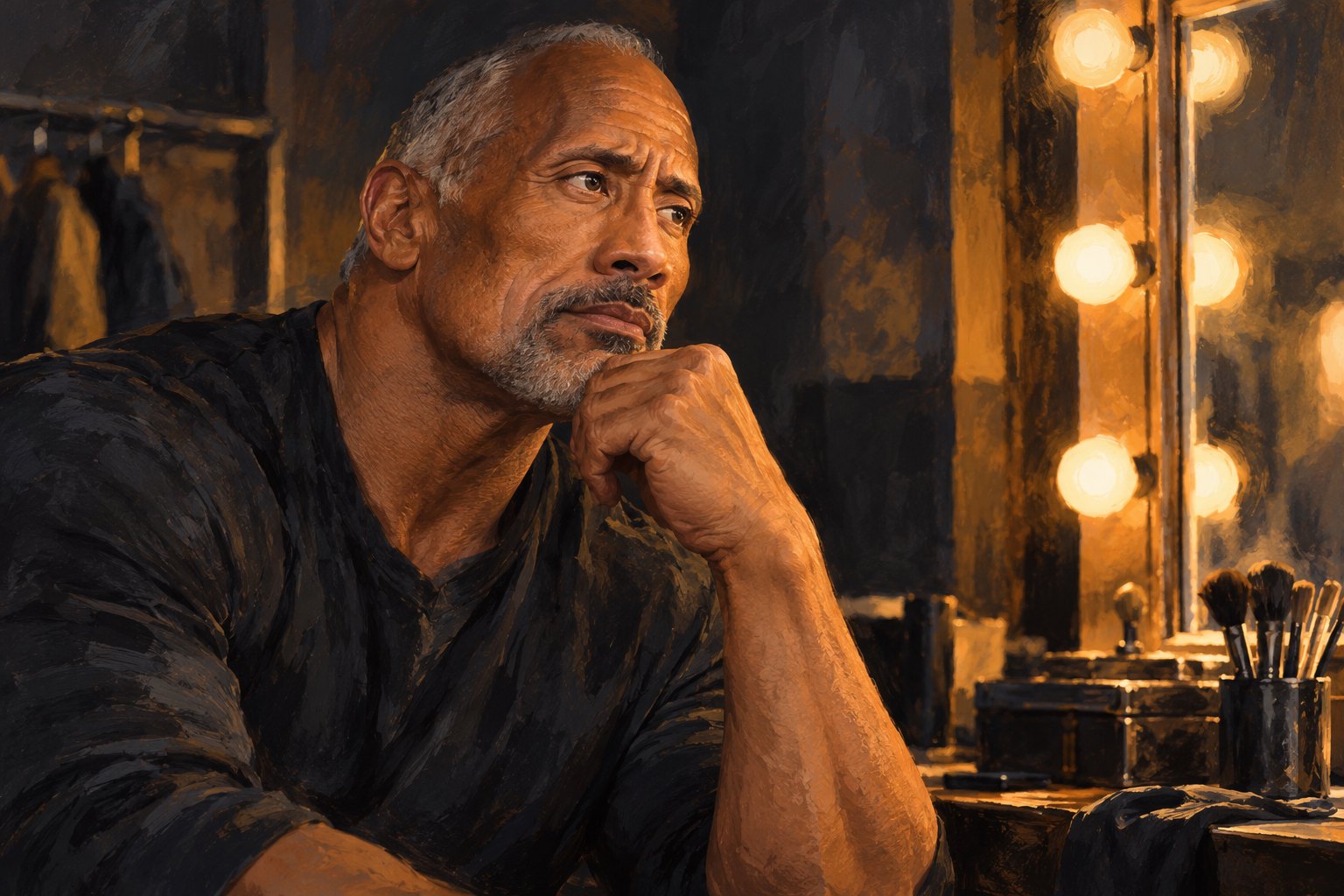
Dwayne Johnson’s transformation into a 70-year-old man for Lizard Music is the focus of new set-photo coverage from Variety. The immediate attraction is obvious: a familiar movie star appears substantially older for a role. The more interesting question concerns what that altered appearance will let him communicate once the character starts speaking, listening, and making choices.
A striking transformation can open a door for an actor. It can disrupt an audience’s expectations before a scene has even begun. But the difference between an impressive disguise and a memorable character emerges over time. For Johnson, the meaningful test will be whether viewers move beyond studying his appearance and become absorbed in the person underneath it.
This is a spoiler-free critical preview of the transformation, not a review of the completed film. Set photographs cannot establish the quality of a performance, the emotional direction of a story, or the effectiveness of its ending. The illustrations accompanying this article are conceptual artwork, not production photographs.
What the Lizard Music Photos Establish
The central reported development is straightforward: Johnson appears aged to portray a 70-year-old in Lizard Music. That gives audiences an early point of interest, but it leaves the most consequential artistic questions open. Looking older is a visible feature of characterization; how a person experiences being older requires scenes.
It is also worth distinguishing a photograph taken during production from the image that eventually appears onscreen. A finished scene has framing, lighting, movement, sound, and an editorial rhythm. Those elements determine whether we examine a face as an object or read it as part of an unfolding emotional exchange.
That distinction should shape any early judgment. A still photograph may make a transformation the entire subject. In a successful scene, that same transformation might quickly recede into the background because the character wants something urgently enough to hold our attention.
Johnson’s Familiar Presence Creates a Specific Challenge
My interest in this casting begins with the expectations Johnson brings into a frame. His screen persona often suggests physical assurance: someone who can occupy space confidently and command attention without much explanation. Aging his appearance creates an opportunity to reconsider what that authority feels like.
There are several possibilities, none of which should be mistaken for a description of this film’s plot. An older character might possess effortless social confidence, protect a private insecurity, or find other people’s assumptions irritating. He might be energetic, reserved, impatient, playful, or contradictory. The actor’s task is to make those qualities belong to a particular person.
The least interesting approach would be to treat age as a collection of signals that announce themselves repeatedly. A stoop, a rasp, and a slow walk do not automatically add up to a life. They become expressive only when they fit the individual and respond to the situation.
For Johnson, a compelling performance need not erase every familiar quality. His confidence could remain useful if it acquires a different purpose. The question is whether recognizable habits become choices made by this character, rather than comfortable gestures carried over from another role.
A Character’s Age Should Inform Behavior Without Defining Everything
From a character-centered perspective, the essential question is what this man believes about himself. Does he consider his age significant? Does he resent being underestimated? Does he expect people to listen? These are useful questions for evaluating a performance, not claims about the answers Lizard Music will provide.
People rarely move through an ordinary conversation thinking of themselves primarily as an age category. They are trying to be understood, finish a task, avoid embarrassment, or get their way. A persuasive older character needs that immediate, everyday sense of purpose.
This is where physical acting becomes especially revealing. A pause could indicate fatigue, but it could also suggest calculation, amusement, or a refusal to be hurried. The surrounding interaction supplies the meaning. Treating every hesitation as evidence of decline would flatten the person the film is trying to create.
Our character-focused analysis of Guillermo del Toro’s Pinocchio offers a related way of thinking about age and relationships: emotional weight develops through what people expect from one another. For Johnson’s role, that same attention to relationships would be more revealing than an inventory of altered facial features.
The Makeup Must Leave Room for Expression
Without verified production details, it would be premature to describe the materials, application process, or digital techniques behind Johnson’s appearance. The useful critical standard is simpler: can the finished face transmit thought?
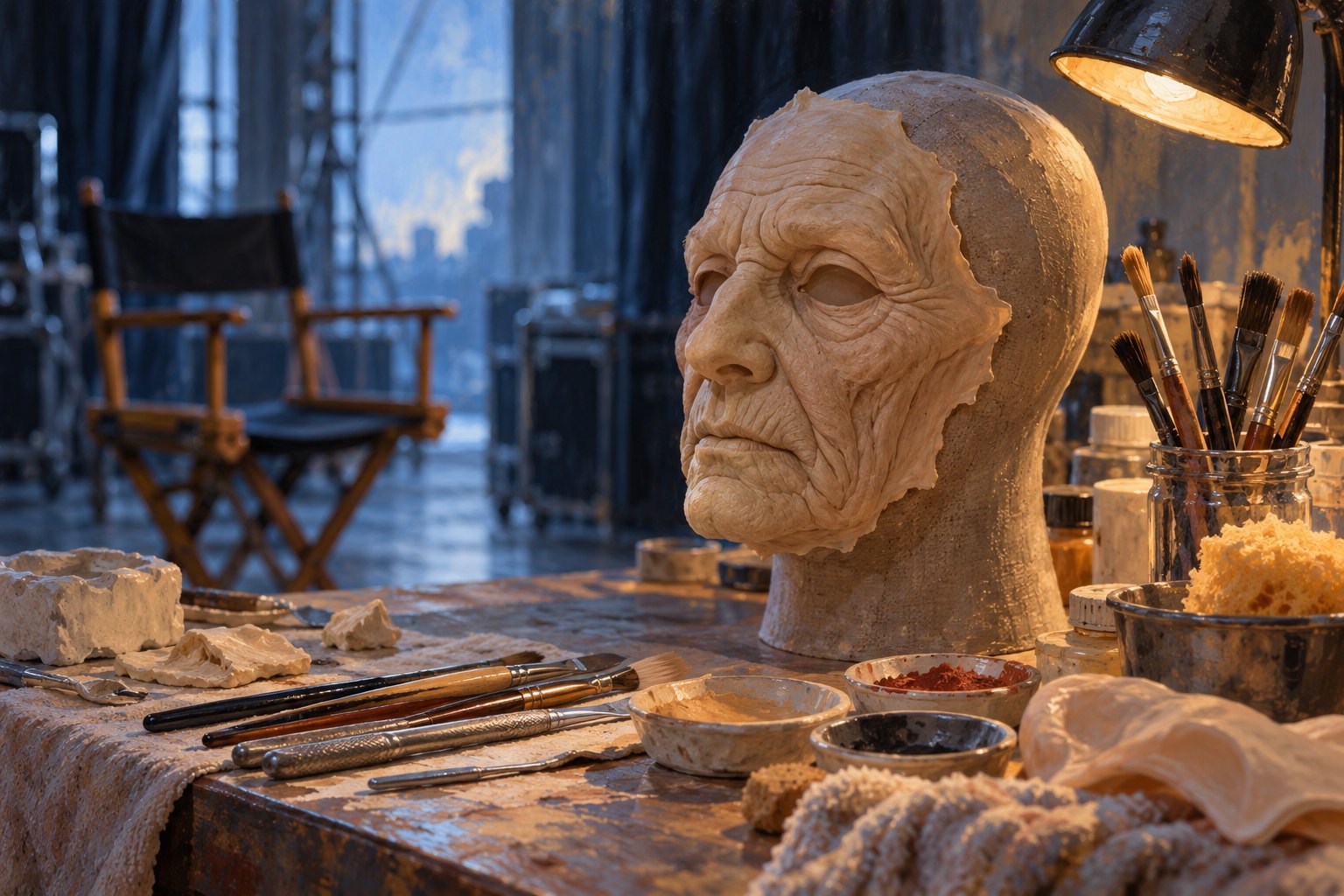
Screen acting often depends on small changes. Eyes settle on someone a moment longer. A mouth begins to smile and stops. An expression holds while its meaning shifts. Whatever techniques a production uses, the final result needs to preserve that communication between actor and audience.
Realistic texture is therefore one consideration among several. Continuity matters, but so does flexibility. A face can look meticulously aged in isolation while offering less dramatic information than a simpler effect that moves naturally through a conversation. Only footage can reveal how these competing demands have been balanced here.
The broader distinction between a convincing surface and an engaging presence also runs through our analysis of performance and audience perception in Ex Machina. Applied to Lizard Music, the question is whether the appearance supports the exchange of attention that makes a character feel alive.
What to Watch for When the Performance Is Revealed
A trailer may offer the next useful evidence, although even a trailer selects moments for impact. The most revealing material would allow Johnson to sustain an interaction rather than simply unveil his appearance.
- Listening: Does his expression change in response to another person, even when he has no dialogue?
- Physical consistency: Do movement and posture feel connected to the individual across different situations?
- Vocal intention: Does the delivery communicate a specific attitude, beyond signaling age?
- Relationships: Do other characters respond to his decisions and personality, giving him a place in their world?
- Emotional range: Can the portrayal accommodate conflicting feelings without returning to the same conspicuous mannerism?
These are more useful measures than how difficult Johnson is to recognize. Recognition is not a failure of acting, just as concealment is not proof of achievement. An audience can remain aware of the star and still believe completely in the character’s immediate predicament.
The Deeper Promise of the Transformation
The most interesting possibility raised by Johnson’s older appearance is a change in how audiences look at him. Familiarity encourages fast judgments. An altered face can interrupt that process and create space for a different kind of attention.
For that opportunity to matter, Lizard Music will need to give the man behind the transformation an inner life: preferences, contradictions, attachments, and reasons for acting. Age can contribute to that life without supplying a ready-made personality or an automatic claim to wisdom.
My provisional judgment is that the transformation provides a compelling invitation to look closer. Whether it becomes meaningful depends on the performance and the film around it. The lasting achievement would be the moment viewers stop measuring how much Johnson has changed and start caring about what his character will do next.
Original content by this site's editorial team. Published: October 20, 2026 at 14:30:49 PDT (Los Angeles time)