
Los Angeles City Council has passed new motions aimed at making the city more welcoming to film production, according to The Hollywood Reporter. The immediate significance is a commitment to changing the conditions under which filmmaking happens. Whether that commitment becomes a meaningful improvement depends on what productions and communities experience afterward.
For moviegoers, municipal reform can sound remote from the pleasures of a great performance or a beautifully staged scene. Yet the practical ability to secure a location, organize a working day, and move a crew through a neighborhood can shape the creative choices available to a filmmaker. A film-friendly city helps make those choices possible.
Our assessment: the council’s direction deserves attention, but passage alone does not establish successful implementation, new employment, or a production revival. The most useful way to judge this development is to ask what would make the promise tangible—and who should benefit.
What the Council’s Action Establishes
The central reported development is straightforward: the council has approved new motions intended to support a film-friendly overhaul. That establishes political action and a stated direction. It does not, by itself, tell a filmmaker which arrangements are available for a particular shoot or establish that every intended change is already operational.
That distinction matters because a motion’s passage and a production’s experience are different stages of the story. Before changing a budget or committing to a location, filmmakers would need applicable requirements, eligibility details, operating procedures, and effective dates. Those practical answers should determine planning decisions.
The broader analysis here concerns what effective reform should accomplish. It is not a claim that the council has already delivered every improvement discussed below. Keeping those categories separate allows the announcement to be taken seriously without awarding it results in advance.
For Filmmakers, Predictability Is a Creative Resource
Cost is an obvious consideration in choosing where to shoot. Predictability deserves equal attention. A production needs to know whether a location is workable early enough to coordinate performers, equipment, transportation, and the people responsible for putting everything on screen.
Consider a hypothetical independent drama built around an evening conversation outside an apartment building. If access remains uncertain, the filmmakers may need a backup location, a different shooting schedule, or a rewritten scene. Each option could work artistically, but each also consumes attention that might otherwise go toward rehearsal, blocking, or finding the right emotional rhythm.
Useful reform would make requirements understandable and answers dependable. It would help a filmmaker distinguish a feasible plan from an unrealistic one before money and labor are committed. That benefit is less photogenic than a celebratory announcement, but it is much closer to the everyday work of making a movie.
Location policy also sits alongside other production considerations. Our examination of what would make film tax credits matter for movies raises a related question: how does a policy’s promise become something a production can actually use? Different measures require different evidence, even when they share an ambition to encourage filmmaking.
Why Location Access Can Change What We See
A location does more than establish geography. It gives characters a physical relationship to their world. A narrow entrance can make an arrival awkward. A long sidewalk can stretch the silence after an argument. The distance between a workplace and a home can suggest something about a character’s routine without anyone explaining it.
These are possibilities of cinematic storytelling, not descriptions of a particular film. Their relevance to the council’s initiative is that access can influence which possibilities remain available. If a production can realistically work in a setting that serves its story, it has another expressive tool.
My view is that the strongest artistic argument for a film-friendly Los Angeles reaches beyond recognizable landmarks. The city’s ordinary spaces can support specific, believable lives on screen. Making production workable should help filmmakers explore that specificity, whether a scene calls for visual spectacle or simply two people standing somewhere that feels right.
Access does not guarantee an insightful screenplay or a convincing performance. It expands the conditions in which those achievements might happen. That is a worthwhile ambition, provided it remains distinct from claims about the quality of movies that have yet to be made.
A Film-Friendly City Must Work for Its Residents
The neighborhood is part of the filmmaking equation. Residents and local businesses experience a shoot through its practical effects: access to a doorway, activity near a workplace, equipment on a sidewalk, or changes to a familiar routine. Their cooperation should never be treated as an unlimited resource.
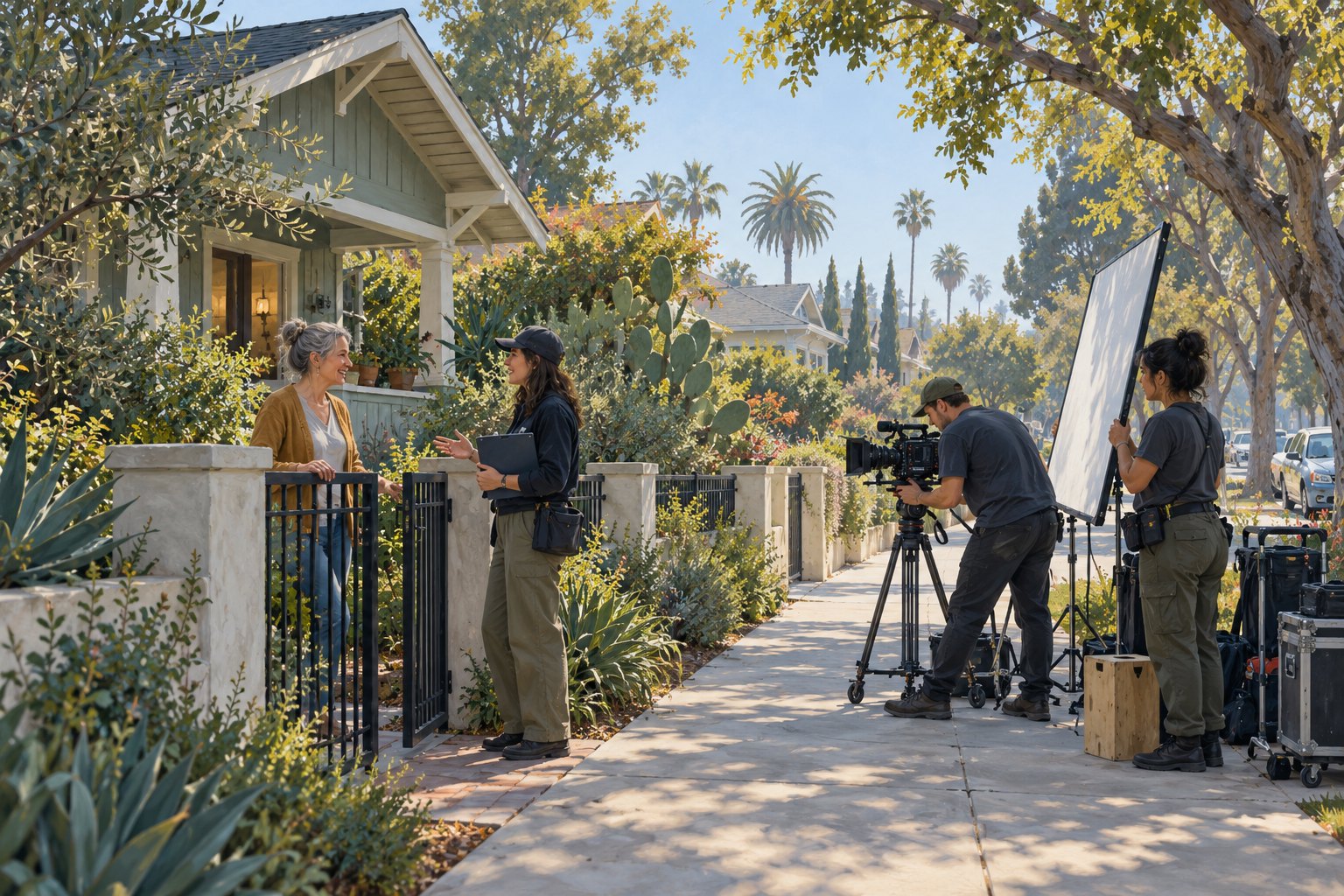
In evaluating reform, I would look for clear communication, proportionate requirements, and a reliable way to resolve problems. A production benefits when it understands its responsibilities. A resident benefits when there is a clear explanation of what is happening and someone accountable for addressing an issue.
That is a practical basis for lasting cooperation. If filming becomes easier to arrange while its effects become harder for neighbors to manage, the policy risks creating resistance to future shoots. A successful approach should make the relationship more dependable on both sides.
Smaller Productions Belong in the Test of Success
A reform effort should be assessed partly through the experience of filmmakers with limited administrative capacity. A large production may have personnel devoted to coordinating locations and logistics. A small team may ask one person to handle several of those responsibilities while also doing creative work.
This makes clarity particularly valuable. Instructions that are technically available can still be difficult to navigate. A useful process should allow a first-time applicant to understand what is required without relying on personal connections or guessing which question to ask next.
There is a wider editorial principle here: the conditions that allow a project to exist deserve scrutiny alongside its eventual reception. Our commentary on the creative cost of an unrealized Cleopatra film approaches that issue through a very different case. Municipal reform brings the question down to everyday access: which filmmakers can move from an idea to a workable production?
What Evidence Would Justify Calling the Overhaul Successful?
A credible assessment should follow the experience of people using the system. Several questions would help distinguish an appealing announcement from an effective change:
- Clarity: Can applicants understand the requirements and identify the responsible contact?
- Reliability: Do productions receive answers in time to make realistic plans?
- Access: Can smaller teams use the process without disproportionate administrative effort?
- Working conditions: Does smoother coordination support safe, properly organized shoots?
- Community experience: Can residents obtain information and resolve disruptions?
These are proposed standards for evaluation, not reported outcomes of the newly passed motions. Evidence on them would be more persuasive than treating every later production announcement as proof that the overhaul caused it.
The Deeper Stakes: Keeping a City Available to Storytelling
The council’s action matters because filmmaking depends on relationships between creative ambition and ordinary civic life. Cameras require space. Scenes require time. Crews require workable arrangements. Neighborhoods require consideration.
For Fun Movie Reviews, the strongest version of a film-friendly overhaul would make those relationships easier to sustain. Its eventual value would appear in concrete opportunities: a manageable shoot, a neighborhood willing to welcome another crew, or a filmmaker able to preserve a meaningful location in the story.
The motions establish a direction. The next judgment should rest on whether that direction produces dependable access—and gives more stories a practical chance to reach the screen.
Original content by this site's editorial team. Published: October 30, 2026 at 23:34:29 PDT (Los Angeles time)