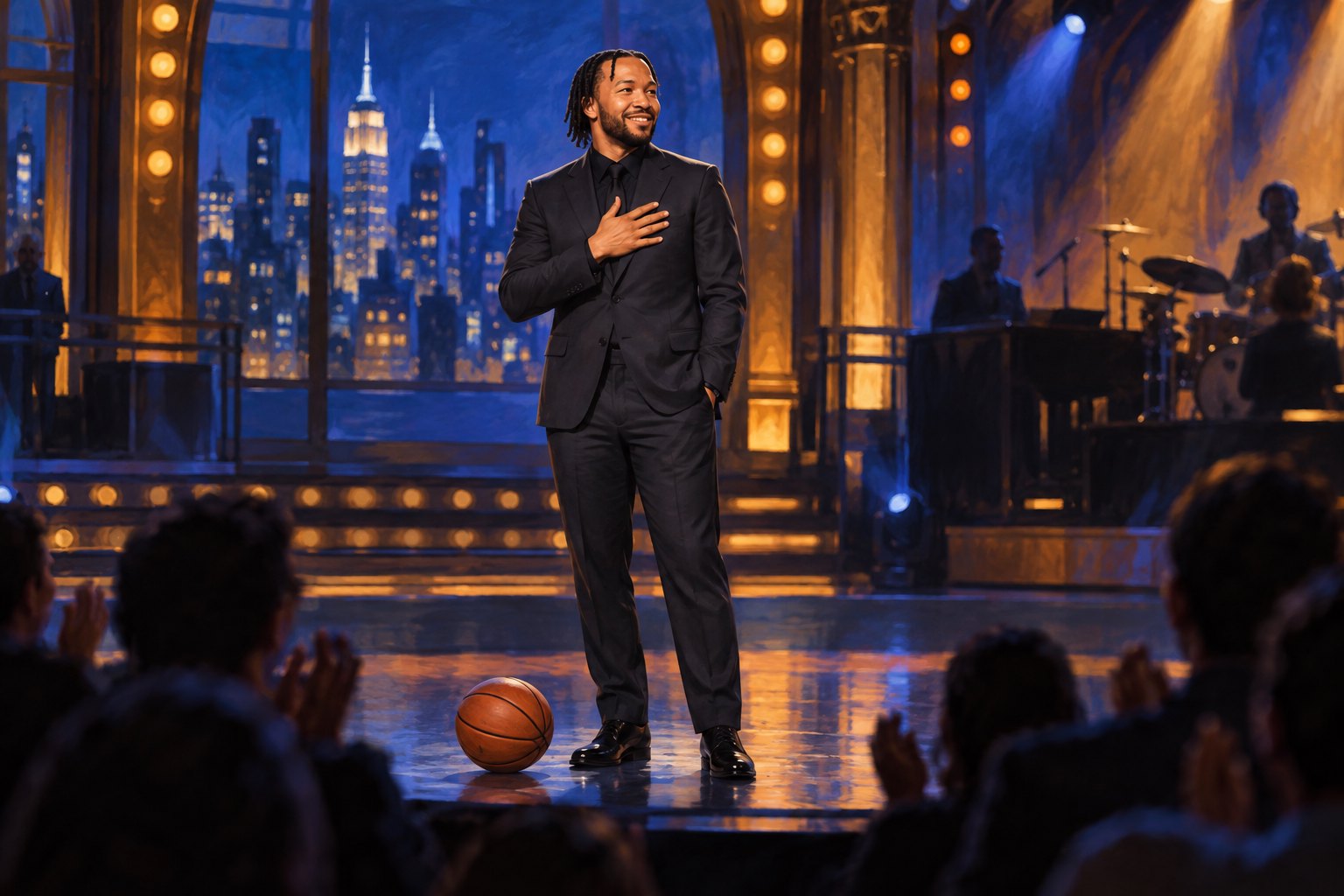
Jalen Brunson’s Saturday Night Live season premiere offers an appealing proposition: put a Knicks star in a setting where competitive authority is less useful than a willingness to look ridiculous. The New York Times characterized the opener favorably and emphasized Brunson’s readiness to participate. That response points toward the most interesting question surrounding his appearance: what does an athlete bring to comedy when being impressive is no longer the main objective?
The distinction matters for anyone deciding what to expect. A receptive guest can make an episode enjoyable without transforming every sketch into a classic. Brunson’s reported reception suggests an evening worth approaching for the pleasure of a familiar public figure entering unfamiliar territory. It does not, by itself, establish that every premise worked or that professional comic timing comes naturally.
This is commentary on the premiere’s reported reception and hosting premise, rather than a sketch-by-sketch review. A reported joke topic is discussed below, but no punchlines are reproduced.
What the Premiere’s Reception Actually Tells Us
Three details establish the scope of the conversation. Brunson hosted the season opener. NBC’s advance coverage identified both the host and musical guest as debutants. USA Today highlighted a joke involving a Taylor Swift–Travis Kelce wedding. Together with the Times’ favorable assessment, those details describe a first hosting appearance that drew attention for both the guest’s attitude and a recognizable pop-culture reference.
They leave plenty open. A headline about a willing host cannot tell us how well individual scenes escalated, whether their endings landed, or how effectively supporting performers shaped the action. Nor should a headline about a wedding joke be read as independent confirmation of wedding arrangements. It identifies material used in comedy.
My view is that the emphasis on Brunson’s willingness identifies a meaningful strength, but only one part of the job. Comedy needs cooperation; it also needs a reason for that cooperation to become funny. The interesting critical task is separating the audience’s affection for the guest from the scene’s ability to earn a laugh.
The Athlete Arrives Before the Character Does
Celebrity hosts bring a preexisting story onto the stage. With Brunson, the audience knows it is watching a basketball player take on a different kind of public performance. Even viewers with little interest in the Knicks can understand the basic tension: someone recognized for expertise has agreed to become a beginner in front of an audience.
That tension creates an advantage. A small departure from an athlete’s expected image can register immediately. It also creates a limitation. If recognition does all the work, the scene has little room to grow. The surprise of seeing a sports star in an unexpected situation is a beginning, not a complete comic structure.
A useful character question is therefore simple: what does this person want inside the scene? Approval, authority, attention, or a way out of embarrassment can each give a performer something playable. Those are examples of comic motivations, not descriptions of unverified Brunson sketches. They explain what would allow a celebrity appearance to develop beyond the initial reveal.
The broader problem resembles the distinction explored in our discussion of how a filmmaker’s public story can shape expectations of the work. Context can enrich a performance, but it can also occupy space that belongs to the characters. Brunson’s fame gets viewers interested; the scene still has to hold them.
Why Willingness Helps an Ensemble
Being willing to participate means more than agreeing to a costume or an embarrassing premise. In ensemble comedy, it can mean allowing another performer to have the strongest reaction, accepting a temporary loss of status, or remaining committed while the situation becomes increasingly unreasonable. A host who protects an image of effortless competence can restrict those possibilities.
This is why the reported emphasis on Brunson’s attitude is worth taking seriously. A guest’s openness can give the surrounding performers room to establish relationships instead of repeatedly reassuring the audience that the celebrity is in on the joke. The humor becomes more interesting when people within the scene respond to one another, rather than merely pointing toward the famous visitor.

There is also a productive difference between participation and polish. An inexperienced performer may be appealing without possessing an experienced actor’s control. That should neither disqualify the appearance nor exempt it from criticism. The writing must provide a clear task, and the ensemble must turn the guest’s presence into a relationship the audience can follow.
For Brunson, the relevant standard is whether the comedy makes use of his participation. Simply asking a recognizable athlete to endure silliness can become repetitive. Giving that athlete a character who earnestly believes something absurd offers a more substantial possibility.
The Swift–Kelce Joke and the Shortcut of Recognition
USA Today’s attention to Brunson’s Taylor Swift–Travis Kelce wedding joke identifies one concrete point of interest. Without a verified transcript, however, its wording, target, and delivery should remain separate from any judgment about its success. Knowing the subject of a joke is not the same as knowing how it works.
As a comic choice, the reference makes sense at a general level. It connects an athlete host with a celebrity story involving sports and entertainment. Such references can establish common ground quickly: the audience recognizes the names before the performer has to explain much.
The artistic test comes after recognition. Does the joke expose an unexpected perspective? Does it reveal something about the speaker’s persona? Does it complicate an assumption? A topical reference becomes more satisfying when familiarity leads somewhere, instead of functioning as the entire payoff.
There is a useful parallel with our examination of why recognizable characters still need meaningful storytelling. Recognition creates access. What happens after that determines whether the entertainment has substance.
How to Judge Brunson Beyond the Highlight
For viewers approaching the premiere, three questions offer a more useful framework than asking whether a basketball player can be funny.
- Does the character have a clear objective? A performance becomes easier to assess when the person in the scene wants something specific.
- Does the situation develop? Repeating the surprise of Brunson’s presence is less rewarding than changing the circumstances around him.
- Do the other performers matter? Strong ensemble comedy gives the guest relationships, resistance, and opportunities to react.
These questions also help distinguish a memorable clip from a satisfying episode. A highlight can preserve an entrance or a single reference. Sustained comedy depends on what surrounds it: setup, reaction, variation, and an ending that arrives before the premise wears out.
The Deeper Appeal: Competence Meets Vulnerability
The most compelling interpretation of Brunson’s hosting premise is that it puts established competence beside visible uncertainty. Audiences are accustomed to encountering athletes through achievement and judgment. Comedy offers another relationship: the pleasure of watching someone accept a situation in which looking foolish can be part of doing the job well.
That does not require inventing a private motive for Brunson or declaring his debut an acting breakthrough. It simply explains why a willingness to participate can feel like more than good manners. For a performer whose public identity rests on expertise, temporarily surrendering that advantage gives the audience something different to watch.
The favorable reception makes Brunson’s premiere an inviting prospect. The lasting question is whether the scenes turn that openness into character and surprise. His celebrity supplies the occasion; the richest comedy would come from the moments when a person inside the scene becomes more interesting than the star visiting it.
Original content by this site's editorial team. Published: September 27, 2026 at 08:56:59 PDT (Los Angeles time)