
Howl’s Moving Castle makes its strongest argument through the people who learn to inhabit its impossible house. Its spells can be elusive, and its ending resolves a devastating war with surprising ease. Yet Sophie’s movement from self-erasure toward confidence gives the fantasy a recognizable emotional shape. This is a movie for the heart, certainly, but its feelings reward close attention.
Hayao Miyazaki’s 2004 Studio Ghibli film follows a hat maker whose encounter with Howl brings the Witch of the Waste’s curse upon her. Transformed into an elderly woman, Sophie leaves home and enters the wizard’s wandering castle. The premise makes physical transformation the doorway to an adventure about identity and attachment. [Film details and synopsis](https://gkids.com/films/howls-moving-castle/).
Full spoilers follow, including the ending. Quoted dialogue refers to the English dub.
Sophie’s curse gives her room to speak
Before the curse, Sophie treats her own desires as matters that can wait indefinitely. Work provides both responsibility and cover. She knows how to be useful, but being wanted seems beyond the future she has allowed herself to imagine.
Her elderly appearance changes that arrangement. She becomes more willing to complain, negotiate, and enter spaces without waiting for an invitation. The pleasure of these scenes lies in the mismatch between her apparent frailty and her increasing forcefulness. Losing the appearance of youth loosens some of the expectations that had kept her quiet.
That does not make the curse a blessing. Her exhaustion and difficulty moving remain real. The film allows liberation and discomfort to coexist, which makes its treatment of age more interesting than a simple lesson about inner beauty.
Sophie’s fluctuating appearance is especially expressive. I read those changes as a visual accompaniment to her unstable sense of worth, rather than a precise system in which confidence subtracts a predictable number of years. Her face can communicate a feeling before she has language for it. Animation makes an inward uncertainty visible without requiring her to explain herself.
Howl’s beauty conceals a frightened person
Howl initially seems to possess everything Sophie lacks: confidence, glamour, mobility, and the ability to make an entrance. Getting to know him means discovering how little security those advantages provide. His distress over his altered hair color is funny because its scale is absurd. It is revealing because appearance matters so desperately to him.
The scene also tests the romance. Sophie has to encounter someone childish beneath the enchanting surface. Attraction becomes more credible when the film lets irritation interrupt it. Howl can be generous and exhausting within the same relationship.
To me, their strongest connection comes from a shared mistake. Both have allowed appearance to dictate what they believe they deserve. Sophie assumes she cannot attract love; Howl behaves as though losing beauty would make him unworthy of it. Their romance becomes meaningful when each begins to see the other beyond that bargain.
This is where the film puts pressure on the familiar idea of an enchanted beloved. As in the questions raised by our commentary on the unsettling possibilities inside Sleeping Beauty, a magical transformation becomes interesting when it changes how people recognize one another.
The kitchen makes the fantasy worth protecting
The castle’s exterior promises spectacle; its interior offers work. Cooking, cleaning, and negotiating with Calcifer give the household texture. Sophie’s presence changes the rhythm of the place, while Markl helps make its domestic life feel like something larger than a private romance.
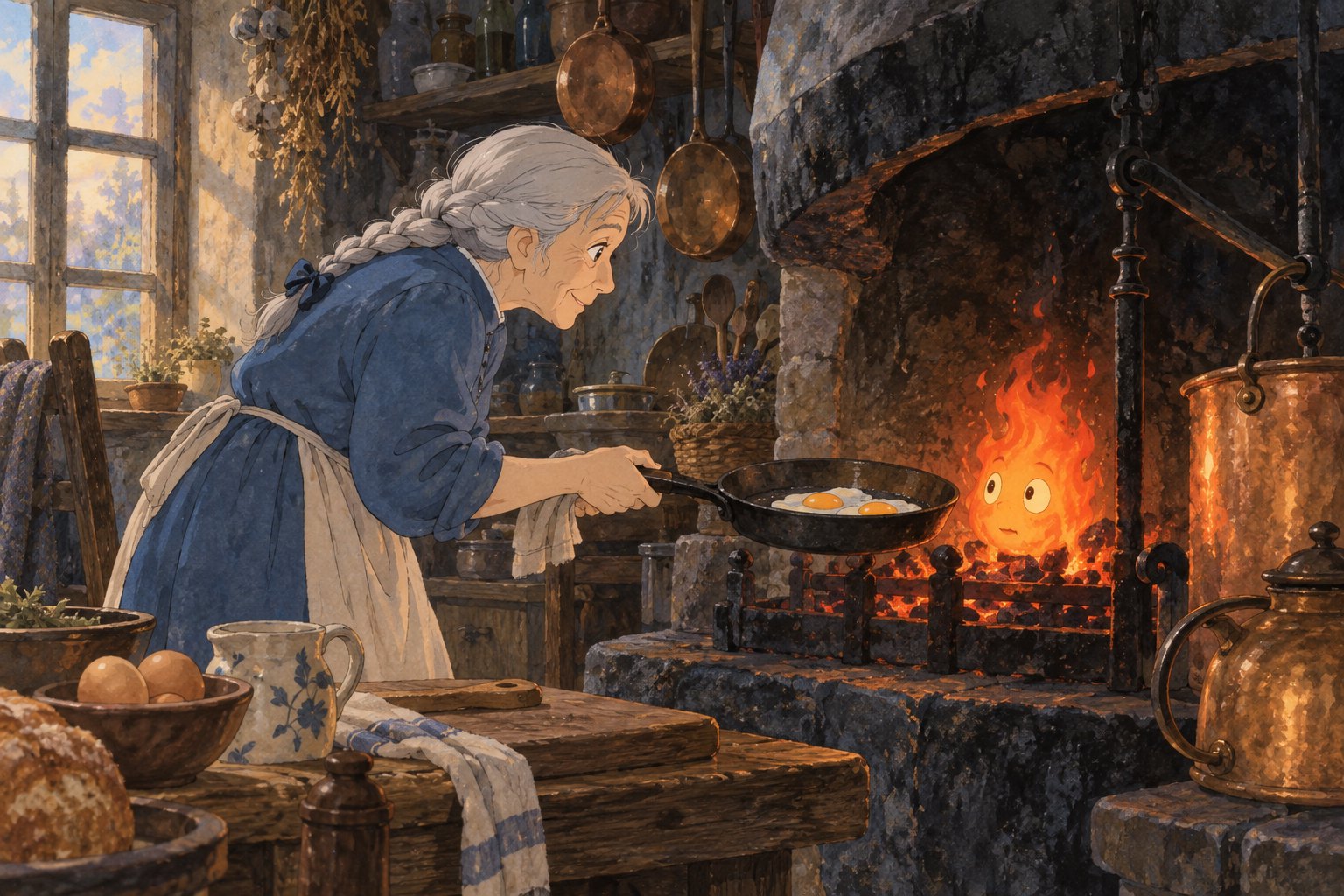
These routines establish what danger might take away. A breakfast matters because it is repeatable: the promise that people might gather again tomorrow. The film makes ordinary comfort desirable before asking us to fear its destruction.
Calcifer is essential to that effect. His complaints give the castle a personality as well as a power source. A marvelous building becomes more intimate when its continued operation depends on a grumbling participant. Magic acquires the friction of shared living.
There is a potential imbalance here: Sophie’s usefulness could become the price of her admission. The film is most convincing when her place in the household grows beyond the chores she performs. She needs to belong even when she cannot keep everything orderly or everyone safe.
The Witch tests the limits of Sophie’s compassion
After Suliman strips the Witch of the Waste of her powers, Sophie helps the person responsible for her curse. The reversal is uncomfortable in a productive way. The Witch’s helplessness does not erase what she did, but it changes what Sophie chooses to do next.
Compassion here is more demanding than liking someone. Sophie responds to an immediate need without receiving a satisfying moral accounting first. That decision enlarges the household’s meaning: refuge cannot depend entirely on whether its occupants are charming.
The Witch’s continued possessiveness also keeps this kindness from becoming a tidy cure. Receiving care does not instantly make someone considerate. For me, that unresolved difficulty gives these scenes more weight than a conventional villain’s apology would have supplied.
War gives Howl’s transformations a terrible cost
Howl’s increasingly monstrous bird form makes his involvement in the fighting physically frightening. Sophie wants him to survive, while he insists on protecting her. Their disagreement places romantic devotion under pressure: an act intended as protection can threaten to destroy the protector. The film’s dialogue makes that conflict explicit. [Translated dialogue transcript](https://thescriptsavant.com/movies/Howls_Moving_Castle.pdf).
From Sophie’s perspective, heroic sacrifice is hardly reassuring. The person she loves may disappear inside it. This gives the combat an emotional consequence beyond the question of who wins an encounter.
The ending is less persuasive as political storytelling. Turnip Head’s revelation as the missing prince and Suliman’s decision to end the war arrive with a speed that the preceding destruction makes difficult to accept. My reservation is not that the film owes us a diplomatic procedural. It is that the ease of stopping the violence briefly reduces the weight of what we have witnessed.
The intimate resolution has been prepared more carefully. We understand why these people might choose one another, even if peace comes too readily.
The ending asks what it means to carry a heart
During her glimpse of Howl’s childhood, Sophie calls, “Find me in the future!” Later, when his heart has been restored, she answers his discomfort with “A heart’s a heavy burden.” Both lines appear in the English dialogue. [English dialogue reference](https://www.subtitlecat.com/subs/953/H%20Moving%20Castle%20%282004%29%20-%20English.html).
The first line turns understanding into a promise. Sophie has seen something fundamental about Howl, and that knowledge gives her a direction. The second refuses the idea that emotional wholeness should feel effortless. Getting a heart back means becoming available to fear, responsibility, and loss.
As our essay on how brief dialogue can change an entire movie explores, a short line gains force from the relationship surrounding it. Sophie’s observation matters because she has already accepted the difficulty she names.
Calcifer’s voluntary return completes that thought. The household can continue after the binding arrangement ends. Belonging becomes a choice.
That is the film’s deepest emotional achievement. Sophie does not simply receive confirmation that she is lovable, and Howl does not simply recover something missing. They move toward a life in which affection carries obligations without becoming ownership. The castle remains improbable; the desire to stay together feels earned.
Original content by this site's editorial team. Published: September 29, 2026 at 04:19:38 PDT (Los Angeles time)