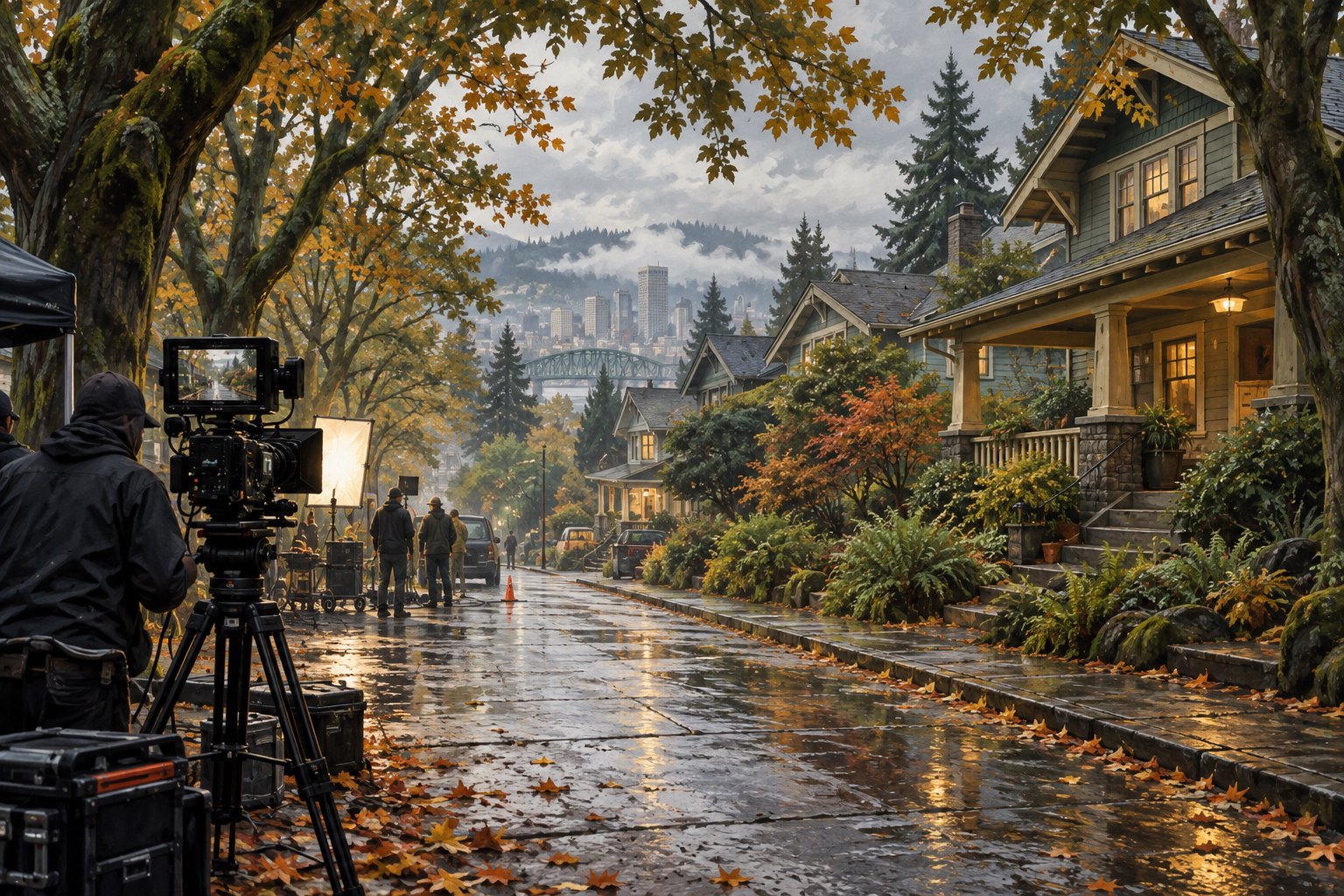
Portland residents have a fresh reason to notice the activity on their block: The Oregonian has reported that two major stars could be filming in local neighborhoods. The attraction is immediate. A place you associate with walking the dog or finding parking might become the backdrop for a scene watched by people who have never visited the city.
The crucial word, however, is could. That possibility does not establish that either performer will appear on a particular street, that a visible crew belongs to the production being discussed, or that residents can expect a public encounter. For anyone wondering whether their neighborhood is involved, the report’s central premise is a reason to follow developments, not a confirmed schedule.
There is also a worthwhile movie question beneath the celebrity curiosity: what happens when an ordinary neighborhood becomes part of a character’s world? That is where this Portland story becomes interesting beyond the prospect of recognizing a famous face.
What the Portland filming news does—and does not—tell us
The narrow, supportable takeaway is that two prominent performers may be filming in Portland neighborhoods. A specific location, an appearance time, a character description, and a release date each require their own confirmation. None follows automatically from that central claim.
That distinction matters because local filming stories easily acquire extra details as they circulate. Someone sees equipment; someone else mentions a familiar actor; a third person connects the two. The resulting account can sound more definite than any of the observations that produced it.
For readers, the most useful approach is to separate three questions: Is filming happening? Which production is involved? Is a particular performer actually present? Evidence for one does not necessarily answer the others. Even seeing a recognizable actor would not, by itself, explain the scene or establish the film’s story.
This is therefore an early film commentary, not a review of a completed movie. Assigning motives to characters or quoting supposedly memorable dialogue would promise knowledge that the available reporting does not establish.
How to interpret activity on your block
If filming does reach your neighborhood, start with information intended for residents. Read any posted notices carefully for dates, affected areas, and contact details. A notice addressing access or parking answers a practical question; it should not be treated as an invitation to watch a star perform.
- Separate observation from identification. Equipment and work vehicles may indicate production activity, but they do not independently identify the cast or project.
- Check the scope of an announcement. A citywide filming report is different from confirmation about your street.
- Keep access clear. Follow posted directions and crew requests, and avoid standing in driveways or equipment routes.
- Describe uncertainty accurately. If sharing an observation, distinguish what you saw from what you think it means.
Watching from an appropriate public area may also be less revealing than expected. Waiting, repositioning equipment, or repeating a small movement can look uneventful from the sidewalk. Those fragments do not provide a reliable basis for judging an actor’s performance. The finished scene will supply framing, sound, surrounding action, and an editorial rhythm that an onlooker cannot see.
A familiar street can become unfamiliar through a character’s eyes
For a Portland viewer, recognizing a location creates one kind of pleasure. Understanding why a character feels comfortable or threatened there creates another. In my view, the second is what makes a location dramatically valuable.
Consider a hypothetical scene involving someone arriving at a house. A camera that stays near the visitor may emphasize hesitation: a slowed step, a hand that almost reaches the bell. A camera watching from inside may make the same arrival feel like an intrusion. The architecture has not changed, but the audience’s relationship to it has.
This example is not a description of the project mentioned in the Portland report. It illustrates the creative possibility behind neighborhood filming. A porch, doorway, or stretch of sidewalk can help express who belongs, who is being watched, and who needs permission to enter.
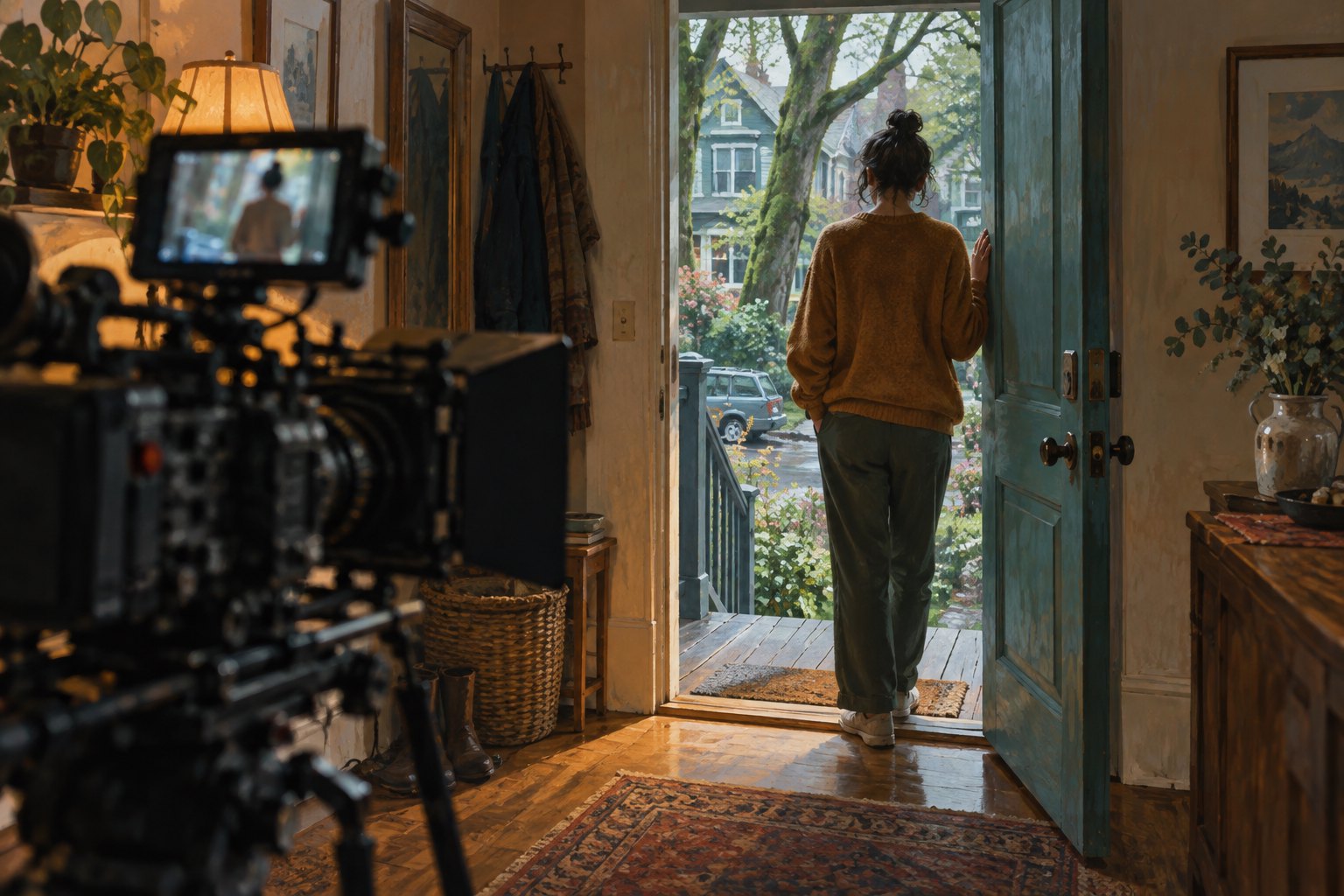
Once a finished film becomes available, useful character analysis can begin with physical choices. Does someone move through a space confidently? Do they wait outside despite being welcome? Does another person control the doorway? These details can communicate the balance of a relationship before anyone explains it aloud.
Our discussion of how brief dialogue gains emotional force explores a related principle: meaning depends on the relationship surrounding a line. A location can help establish that relationship before the line arrives.
Two stars create anticipation, but the scene still needs a purpose
The possibility of two major stars filming nearby makes this an appealing local story. Familiar performers bring expectations with them, and viewers naturally wonder how those screen personalities will fit into an everyday setting.
Still, two names connected to a filming story do not establish an on-screen partnership. Without verified character and scene information, it would be premature to describe a rivalry, friendship, romance, or shared dramatic arc. Even the assumption that both performers will work at the same neighborhood location needs support.
My critical interest would be in how the eventual film uses recognition. Does a familiar face make a character seem trustworthy before the story complicates that impression? Does the performance gradually replace our expectations with something more specific? Those are questions to bring to the finished work, rather than conclusions to draw from production excitement.
The same distinction informs our look at the performance demands behind an upcoming starring role: casting can invite an interesting discussion without supplying a verdict on a movie nobody has evaluated here.
What Portland viewers can look for when the film arrives
If local filming is confirmed and the resulting work reaches audiences, resist stopping at “I know that corner.” Ask what the corner does for the scene. Does it give someone an escape route? Keep two people visible to each other? Make a private disagreement uncomfortable because strangers can pass?
Also distinguish a filming location from a story setting. Recognizing Portland would not automatically mean the characters are meant to be in Portland. The relevant question is whether the spaces form a convincing world for the people inhabiting the story.
That is the deeper promise of this neighborhood buzz. Celebrity presence briefly changes how residents look at a familiar place; a strong film can make that change last by attaching a character’s decision to it. For now, the possibility of two stars working nearby is the news. Whether those streets become emotionally meaningful is the question worth saving for the screen.
Original content by this site's editorial team. Published: September 29, 2026 at 03:07:23 PDT (Los Angeles time)