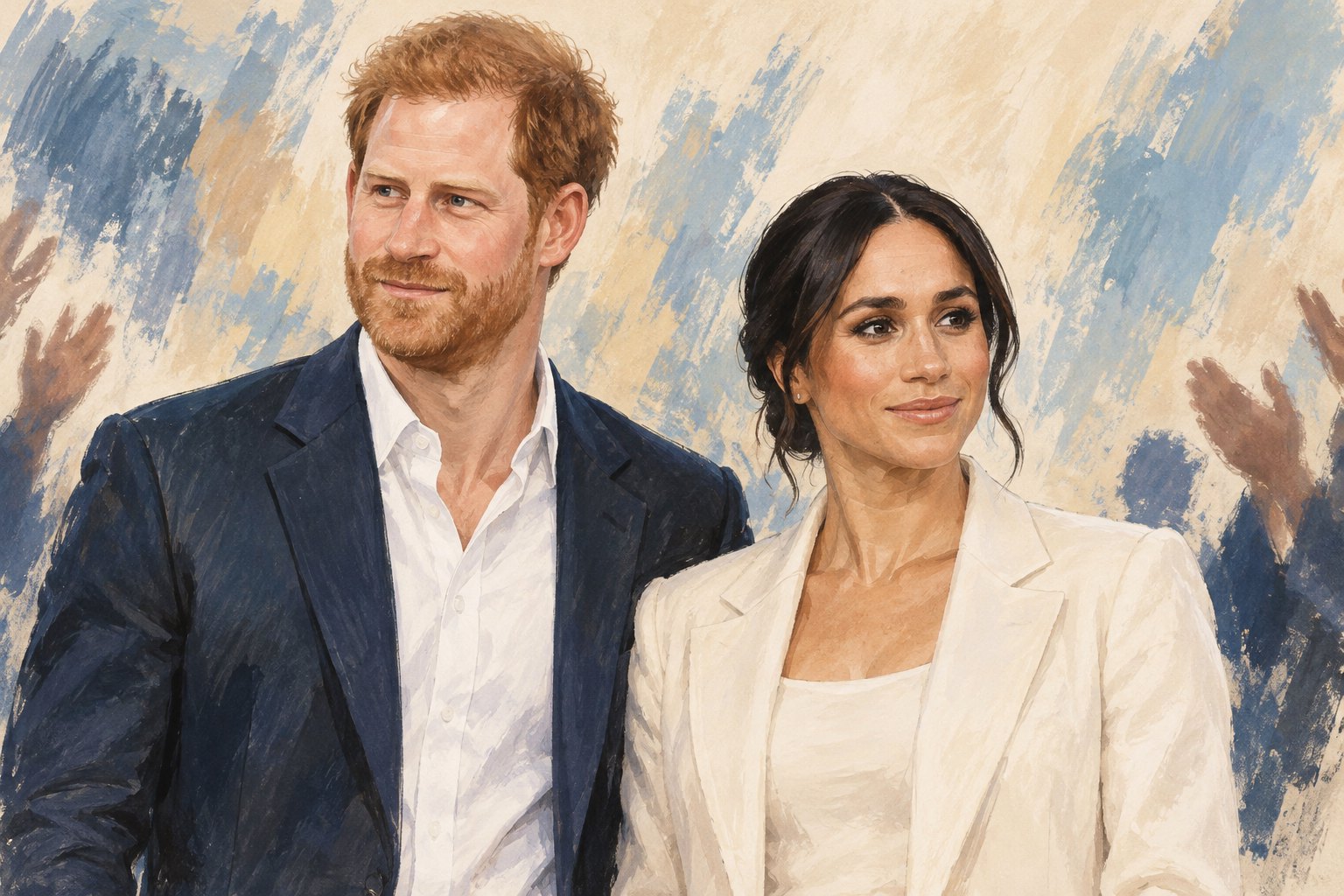
Harry and Meghan received cheers at their first joint appearance since returning to the U.K., according to NBC News. That gives the occasion an immediate, understandable significance: the couple encountered a welcoming response. What that reception means for their wider public standing, their relationships, or their future requires a separate discussion.
The coverage already contains several competing storylines. NBC News emphasizes the cheers. CNN emphasizes the first joint appearance after their return. People highlights Meghan’s reported words, “It’s great to be back.” Fox News foregrounds an expert’s accusation of “royal theatre.” Each emphasis invites readers to interpret the same occasion differently.
For a publication interested in screen storytelling, the revealing question is how those interpretations take shape. This is media commentary about a real public appearance. The people involved have private experiences that no headline, photograph, or crowd reaction can fully explain.
A warm reception has a specific meaning
The cheers matter because public encounters are experiences in their own right. A welcoming response can make an appearance feel less distant and more conversational. Readers do not need to dismiss that warmth simply because the people receiving it are famous or because cameras are present.
Its evidentiary reach, however, has boundaries. A crowd at an appearance represents the people gathered there. Without broader evidence, its response cannot establish a national consensus. Enthusiasm at one event also cannot resolve questions about private family relationships or future institutional arrangements.
This distinction makes the story more useful. Saying that Harry and Meghan were cheered describes a reported response. Saying that Britain has collectively embraced them would turn that response into a much larger claim. The latter would need evidence beyond the occasion itself.
My reading is that the strongest angle begins with the encounter’s human scale. People offered a welcome; the couple appeared together. Those details deserve attention without being made responsible for explaining every unresolved question surrounding them.
Why “first appearance” creates a new-chapter feeling
The phrase “first joint appearance” supplies a clear narrative threshold. It divides events into before and after, encouraging readers to look for a change in direction. The additional phrase “since returning” gives that threshold an emotional geography: departure, distance, and arrival.
Film audiences recognize that structure. A return often prepares us for a confrontation, a reconciliation, or an altered understanding of home. A filmmaker can build toward one of those outcomes through dialogue, performance, and carefully arranged scenes. News coverage has a different responsibility: the outcome may remain unknown.
With Harry and Meghan, it is easy to let the language of a new chapter imply that a larger resolution has already begun. Yet the designation “first” establishes sequence. It does not, by itself, establish a change in anyone’s intentions.
That is where a film critic’s habits can help, provided they remain disciplined. We can notice the story structure a headline encourages while resisting the temptation to assign the participants predetermined roles. Our discussion of the rush to assign heroes and villains in celebrity coverage explores a related problem: a satisfying narrative can arrive before a sufficiently complete account.
Meghan’s greeting expresses a welcome-back sentiment
People’s coverage attributes a brief, positive greeting to Meghan: “It’s great to be back.” The sentence is memorable because it is direct. It conveys pleasure about being back without supplying a detailed explanation of what the return means.
The word “back” is especially open to interpretation. Readers may connect it with familiarity, belonging, relief, or renewed opportunity. Those associations belong to the audience’s response unless Meghan explicitly develops them herself.
In a scripted film, a short line can acquire a precise second meaning through earlier scenes or a later revelation. Applying that expectation to an isolated public remark can produce unwarranted certainty. The line supports a straightforward reading of expressed positivity; it cannot independently explain a relocation decision, a family negotiation, or a long-term plan.
Harry’s presence alongside Meghan likewise establishes their participation in the appearance. It gives us no reliable access to his internal monologue. Character analysis works in fiction because a work offers evidence through its construction. Real people retain a private interior beyond what coverage makes visible.
What the “royal theatre” accusation asks readers to believe
The accusation highlighted by Fox News deserves careful classification. It is an expert’s characterization of the appearance. Calling something theatrical can suggest calculated presentation, borrowed ceremonial authority, or a gap between outward behavior and private feeling. Those are distinct claims, and the phrase can blur them together.
Public presentation is a useful subject for criticism. We can examine what an occasion communicates, which images receive attention, and how language establishes importance. An allegation of insincerity demands something more: evidence connecting the presentation to a deceptive intention.

The camera offers a helpful analogy. Every frame selects a portion of a scene. Selection influences meaning, but the existence of a frame does not make everything inside it false. An organized public occasion can contain sincere exchanges; an enthusiastic exchange can also become useful publicity. Neither possibility settles the other.
For Harry and Meghan’s appearance, the productive critical question is what the available reporting establishes about the encounter. Treating “theatre” as a verdict would bypass that work. Equally, treating applause as proof that all criticism has been answered would give a visible reaction more authority than it possesses.
How to read the coverage more closely
Readers can get more from this story by separating three kinds of information:
- Reported events: The couple appeared together after returning to the U.K., and NBC News reported cheers.
- Attributed speech: Meghan’s greeting is presented as her statement; the theatricality accusation is presented as an expert’s opinion.
- Interpretation: Claims about a comeback, reconciliation, or reputational transformation require an argument and supporting evidence.
When considering photographs or video, ask what is actually visible and what the accompanying language adds. A frame may show proximity, expression, or an interaction. Descriptions such as “triumphant,” “defiant,” or “calculated” introduce judgments that deserve to be examined separately.
Context also matters. Who is speaking? Is a quotation complete enough to interpret? Does a report distinguish the response at the appearance from attitudes elsewhere? These questions preserve the interest of the event while improving the accuracy of the conclusions drawn from it.
The same attention to framing informs our examination of how screen portrayals gain meaning beyond an attractive image. In both settings, the most striking visual detail is a starting point for understanding.
The deeper story is the appeal of a homecoming
Harry and Meghan’s appearance has narrative force because returning is an experience audiences readily understand. A return raises questions about acceptance and change: how familiar a place feels, how others respond, and whether an earlier relationship can take a different form.
Those questions explain the emotional appeal of the coverage. They also explain why a brief appearance can attract interpretations far larger than the event. Viewers bring their own expectations about homecoming and read the available images through them.
My judgment is that the warm reception deserves to stand as a meaningful public moment. Its significance will become clearer through subsequent actions and fuller reporting. For now, the cheers establish a welcome at this appearance, while the larger story remains open.
Original content by this site's editorial team. Published: October 15, 2026 at 05:56:45 PDT (Los Angeles time)