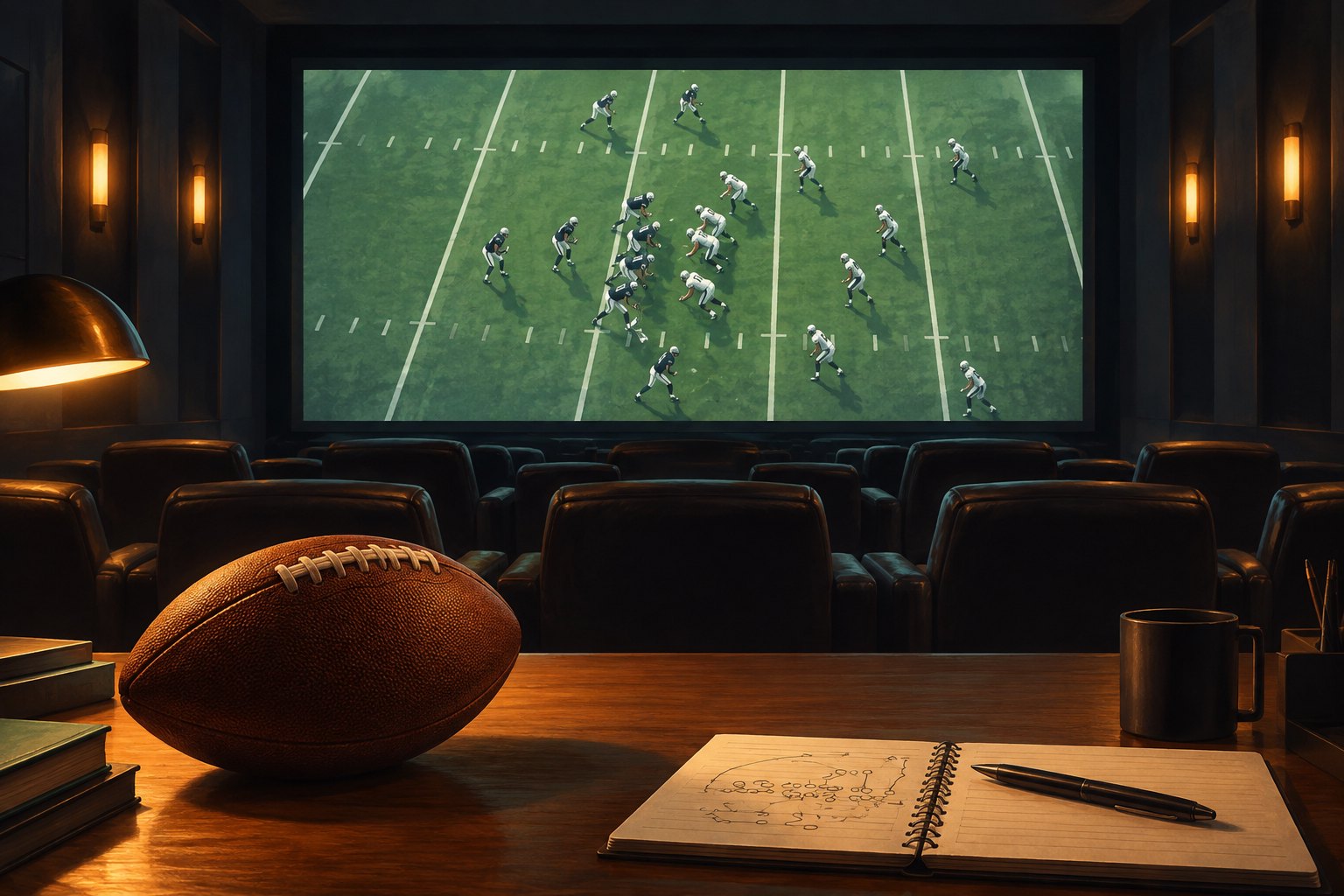
Greg Cosell’s Film Study Week 5 calls for a particular kind of attention: looking past the football to understand the decisions around it. The Cleveland Browns presentation belongs to the world of sports analysis, where studying film means examining game footage. For readers accustomed to movie criticism, the interesting connection is perspective—how an image distributes information, directs attention, and invites judgments about the people inside it.
This is a critical viewing guide, not a firsthand review or a play-by-play recap of the Week 5 installment. It does not attribute specific observations, quotations, or conclusions to Cosell. Its purpose is to explain what to look for when watching this kind of breakdown, and how to separate an illuminating interpretation from a story the images cannot establish.
Start With the Decision, Not the Result
A completed pass gives viewers an immediate ending. The ball arrives, the receiver secures it, and the play appears successful. An incompletion produces the opposite impression. Neither result, by itself, explains the quality of the decisions that preceded it.
Consider a hypothetical throw that reaches its target despite a defender nearly intercepting it. The outcome is positive, but the decision may still deserve scrutiny. Conversely, a well-timed pass can fail because the catch is not completed. These examples are not descriptions of plays in Cosell’s Week 5 presentation; they illustrate the distinction a useful breakdown should preserve.
For a viewer, the practical question is simple: what was available when the choice had to be made? That question slows the rush toward praise or blame. It also makes analysis more interesting, because it replaces a familiar verdict with a sequence of observable actions.
Read the Players’ Perspectives Without Inventing Their Thoughts
Character-focused movie criticism asks what a person knows, wants, and can do within a scene. Some of that discipline transfers to football footage, provided we remember that athletes are real people whose internal thoughts are not supplied by a screenplay.
The quarterback: seeing less than the replay reveals
A viewer can pause an image and inspect several areas of the field. A quarterback must act while bodies move, passing lanes change, and pressure develops. An apparently available receiver in a still image may not have been an available target at the moment the throw needed to begin.
When watching a breakdown, keep the timing of the decision attached to the timing of the opportunity. Notice whether the explanation identifies when a receiver becomes available, whether the passer has room to deliver the ball, and what the camera actually reveals. An overhead view can clarify spacing without reproducing the quarterback’s sightline.

The receiver: contributing without receiving the ball
Following only the eventual target can make everyone else disappear from the explanation. Yet a receiver’s movement can matter even when no pass comes their way. The useful viewing habit is to follow one player through the whole action and observe how nearby defenders respond.
Be precise about the conclusion. A defender visibly moving with a receiver is an observation. Claiming that the route was specifically designed to remove that defender requires additional support. The distinction protects the analysis from turning a plausible explanation into an assumed assignment.
The defender: an opponent with choices
Offensive highlights can reduce defenders to obstacles waiting to be beaten. A stronger reading gives them agency. Watch their initial position, the direction of their movement, and the point at which they react. Then ask whether the explanation accounts for those actions instead of describing only what the offense hoped to accomplish.
This attention to spatial knowledge has a cinematic counterpart in our analysis of space and uncertainty in Verity. In both kinds of viewing, understanding where someone stands helps clarify what they can perceive. The comparison concerns perspective, not an equivalence between fictional motives and real players’ intentions.
Replay Should Test an Explanation
Replay is persuasive because it gives the audience time to notice something it initially missed. That power also creates a responsibility: the explanation should remain convincing when the action returns to full speed.
A freeze-frame can establish relative positions at one instant. It cannot, on its own, establish how long an opening lasted. Slow motion can make a brief opportunity feel comfortable. A tight crop can reveal technique while removing the surrounding action needed to interpret it.
My critical standard is that a useful breakdown should make the viewer more capable of checking its claim. After hearing the explanation, you should know where to look and what sequence matters. If the argument depends entirely on the narrator’s confidence, the audience has received a verdict without gaining much understanding.
A Four-Pass Method for Watching the Week 5 Study
You do not need to identify every formation to watch more carefully. When footage is available to replay, use a manageable sequence:
- Watch the whole action. Establish the basic sequence before concentrating on an individual mistake or achievement.
- Follow someone away from the ball. Choose a receiver, blocker, or defender and stay with that player. Notice which actions your first viewing missed.
- Locate the decision point. Identify when the meaningful choice occurs. Examine the positions at that moment rather than relying on the final arrangement.
- Return to normal speed. Check whether the explanation still respects the pace of the action and the time available to respond.
Keep a separate mental category for uncertainty. If an assignment is unknown, leave it unknown. If the angle hides a relevant player, acknowledge the missing view. Those limits are part of an accurate account, not defects that confident language should conceal.
What Film Criticism Can Contribute
The strongest connection between movie analysis and game-film study is attention to relationships within the frame. In a movie, staging can reveal who has power, who is excluded, and whose reaction changes a scene. In football footage, looking beyond the central action can reveal contributions that the result alone does not explain.
Our discussion of why background performers matter to a movie’s world approaches a related viewing habit: noticing people outside the apparent center. Their roles are fundamentally different, but both subjects reward an audience willing to distribute its attention.
The boundary matters just as much as the connection. A fictional scene may deliberately establish a motive through dialogue or editing. Game footage does not give us that access. Facial expressions, a failed play, or a late reaction should not become unsupported claims about courage, commitment, or personality.
The Deeper Value of Looking Again
Greg Cosell’s Film Study Week 5 is a useful occasion to reconsider what we want from screen analysis. The most satisfying explanation is not necessarily the most forceful one. It is the one that helps us distinguish what happened, what may explain it, and what remains unresolved.
That distinction makes repeat viewing worthwhile. The first look gives us an outcome; the next can reveal the constraints and relationships behind it. Good analysis expands our attention while keeping its conclusions proportionate to the evidence. For anyone coming to football footage with a movie critic’s curiosity, that is the essential habit to bring: watch closely enough that the image can complicate your first impression.
Original content by this site's editorial team. Published: October 9, 2026 at 00:51:19 PDT (Los Angeles time)