Fujifilm Instax Wide makes an appealing proposition: give a moment enough space to breathe, then give it a physical place in your life. For someone drawn to instant photography, that combination may matter more than another opportunity to adjust an image. The attraction is easy to understand. A photograph becomes something you can hand to another person, leave beside a bed, or encounter again without opening a screen.
For movie lovers, the wider frame offers another pleasure: room to notice how people relate to their surroundings and to one another. This is a critical appreciation of that format and its appeal, rather than a hands-on evaluation of color accuracy, exposure consistency, or camera performance. Its strongest argument concerns how we look at pictures—and what we decide to keep.
What makes Instax Wide worth considering?
The useful starting question is simple: do you want a physical photograph as part of the experience of taking a picture? If the answer is yes, instant photography has an obvious purpose. If you mainly want files to edit, organize, and distribute, its physical output may feel like an extra responsibility.
My view is that Instax Wide is most interesting when the finished photograph has a destination. A portrait intended for a friend already has a reason to exist. A picture made for a small display has a scale and a viewing context. Those intentions can sharpen the decision about what belongs in the frame.
That is a more useful way to evaluate its appeal than treating analog photography as automatically more meaningful. A physical picture can be forgettable. A phone photograph can be irreplaceable. The format creates an opportunity for attention; the photographer still has to do something with it.
A wider frame can make relationships visible
Consider an imagined photograph of two friends at a cafe. A tight portrait might emphasize one person's expression. A wider composition can include the companion, the empty seat between them, and the window drawing someone's gaze away. Each additional element offers information, but it also competes for attention.
This is where a movie viewer's habits become useful. We read posture, distance, and direction of gaze almost instinctively. Two people leaning toward the same object suggest a different relationship from two people facing opposite edges of the picture. Neither arrangement proves an emotion, but each invites an interpretation.
A wide instant photograph can make those relationships the subject. The goal need not be to squeeze more people into the picture. It can be to preserve the space that explains why the people matter to one another.
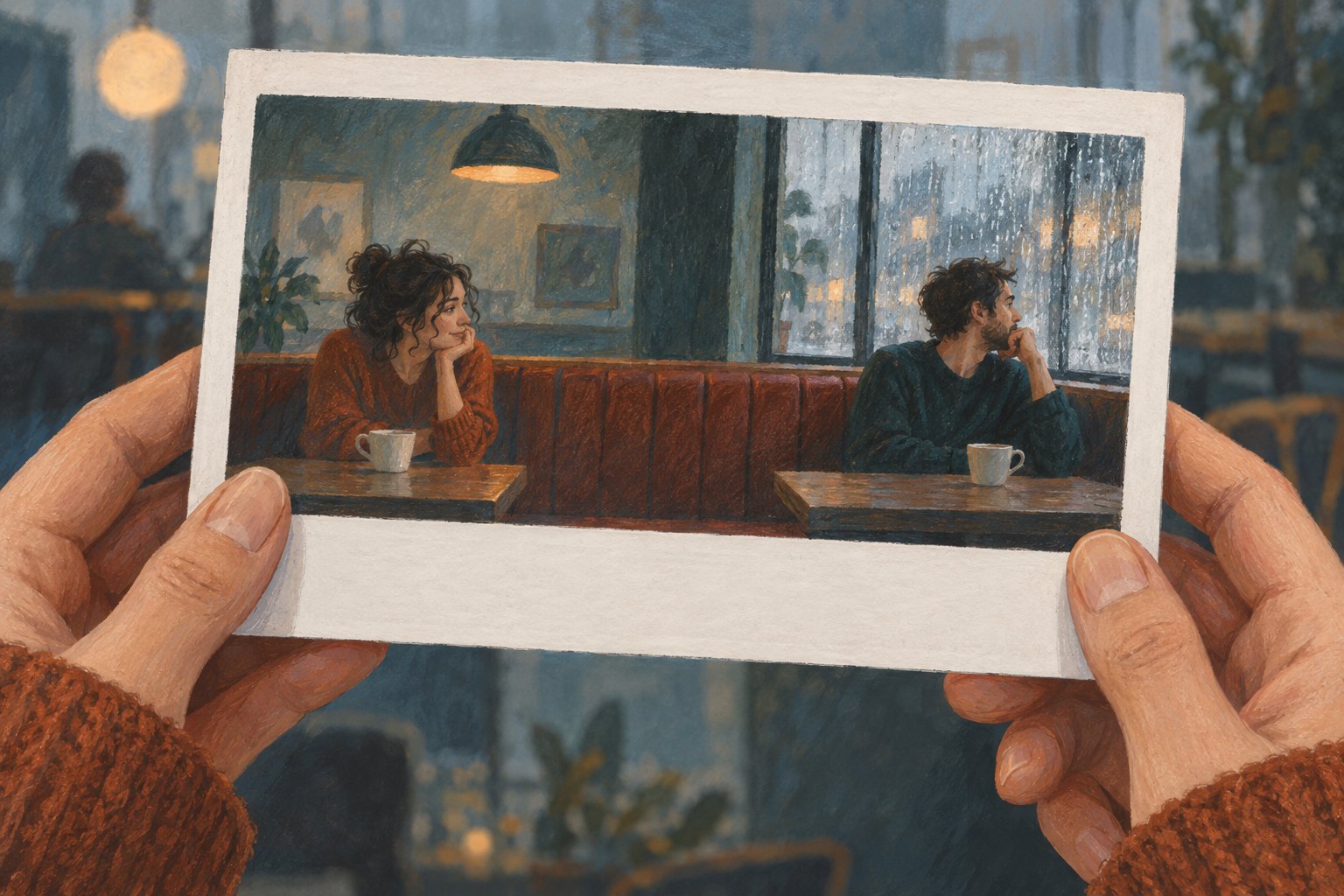
The illustrated scene above demonstrates a compositional idea, not the film's photographic performance. The gap between the figures carries much of its suggested story. Move them together and the emotional reading changes, even if their expressions remain the same.
The same attention to a person within a larger environment informs our discussion of bodies, landscape, and visual rhythm in Mountains of the Moon. For an Instax photographer, the practical lesson is to examine the whole frame before committing to it.
The physical print changes the audience
There is a small but consequential difference between showing someone an image and giving them its physical print. Showing can be momentary: look, react, move on. Giving introduces a decision about ownership and display. The recipient can put the photograph somewhere the photographer never sees.
That possibility changes the picture's purpose. A photograph made for a particular person can prioritize a private association over immediate visual impact. An ordinary doorway might matter because it belongs to a shared memory. The image does not have to explain itself to strangers to succeed.
I find this the most persuasive explanation for instant photography's continuing appeal. It offers a modest, specific form of participation. Someone chooses the moment, someone receives the print, and the picture acquires a life beyond the act of capture. This is an interpretation of its appeal, not a claim about sales or the motives of every buyer.
Charm should not excuse a disappointing photograph
Affection for the medium can make criticism too forgiving. A missed expression, a distracting background, or an unreadable subject does not become successful simply because it appears inside a white border. An accident may produce something interesting, but interest has to be visible in the result.
It also helps to separate three questions: do you like the composition, do you like the rendering, and did the equipment behave as expected? Those questions require different evidence. One attractive photograph cannot establish consistency, and one unsuccessful photograph cannot identify its own technical cause.
Before spending money, check compatibility with the exact camera or printer you intend to use, read its operating guidance, and calculate your ongoing film budget. This article offers no tested cost-per-picture figure or promise about results under particular lighting conditions. Those details deserve verification rather than a romantic guess.
The ongoing expense deserves particular thought. A finite supply of exposures might encourage one person to look carefully and make another hesitate until the moment disappears. Neither response is a personal failing. A satisfying format should suit the way you actually enjoy taking pictures.
Try a character-centered approach to composition
You do not need to imitate a famous movie frame to bring cinematic attention to an instant photograph. Start with the person and ask what the surrounding space contributes. A few deliberate choices can make a picture easier to read:
- Identify the main relationship. Decide whether the picture concerns two people, a person and a place, or a person looking toward something outside the frame.
- Inspect the edges. Notice whether background objects add context or simply distract from the subject.
- Choose your distance intentionally. Moving closer emphasizes expression; stepping back may preserve a gesture or setting that matters.
- Give empty space a purpose. Leave room where someone is looking, or use separation to make the composition feel unsettled.
- Review the result without inventing motives. Describe what the picture shows before deciding what its subject must have felt.
That last distinction matters beyond photography. Our analysis of the limits of a Pretty Woman comparison considers the temptation to impose a satisfying narrative on real people. An evocative photograph deserves the same care: visual suggestion is powerful, but it is not proof.
The deeper appeal is a picture with somewhere to belong
My judgment is that Instax Wide's most compelling promise lies in the combination of a spacious composition and a tangible result. The frame can preserve relationships; the print can become part of one. That makes it especially appealing as a way to create personal objects with a clear recipient or purpose.
There is no need to argue that every photograph should become physical, or that inconvenience guarantees authenticity. The more interesting possibility is smaller: making one picture that receives sustained attention. A face, a gesture, and a little surrounding space may be enough.
A photograph earns its place through what it helps someone remember or notice. Instax Wide offers a format in which that place can be literal—a shelf, a wall, a friend's hand. The lasting attraction is the chance to make an image that someone chooses to live with.
Original content by this site's editorial team. Published: October 13, 2026 at 22:38:41 PDT (Los Angeles time)