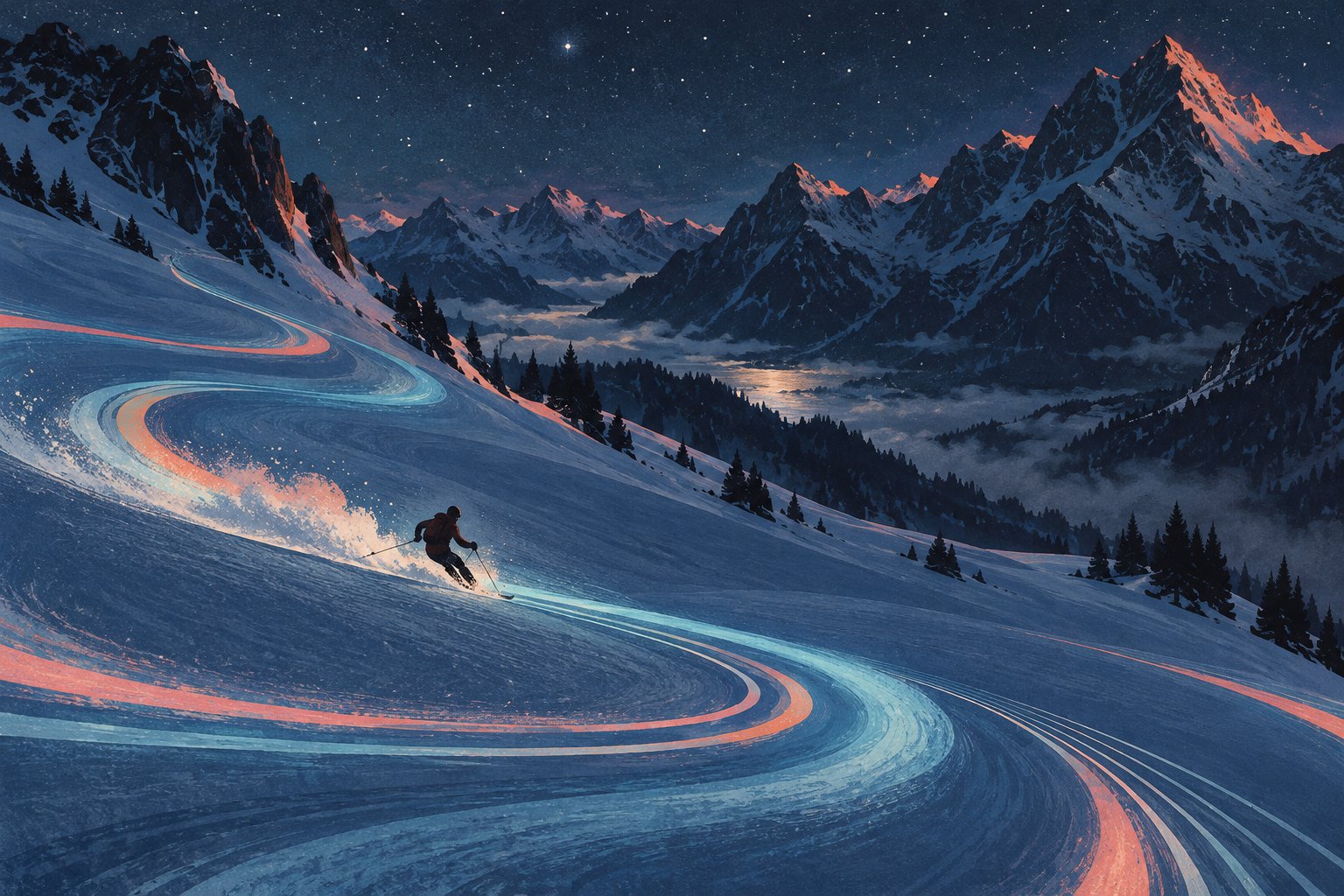
Mountains of the Moon makes an intriguing proposition: a ski turn and a musical phrase can express the same relationship between discipline and freedom. Chris Benchetler’s film brings outdoor athletes into nocturnal landscapes, with the Grateful Dead’s music providing its connective tissue. Its most interesting idea is that extraordinary physical ability can become a way of belonging to a place, rather than simply demonstrating mastery over it.
Scope and spoilers: This critical analysis draws on documented sequences, official film materials, and Benchetler’s account of the production. It discusses imagery and themes rather than offering a firsthand assessment of every sequence or the complete soundtrack.
What kind of movie is Mountains of the Moon?
Benchetler’s film combines action sports, musical tribute, and experimental visual design. The official description identifies a journey through ocean, river, and mountain environments, filmed almost entirely at night using lighting, animation, lasers, and projection mapping. Paul Stamets supplies narration, and Mickey Hart appears among the participants. These are real people performing within a constructed visual world, so character analysis requires attention to their roles and actions rather than invented backstories. [Official film description and credits](https://www.chrisbenchetler.com/mountains-of-the-moon)
That distinction shapes how to approach the movie. A conventional sports documentary might organize its material around preparation, setbacks, and a decisive achievement. Here, the central question is more perceptual: what happens when familiar outdoor movement becomes strange enough that we notice it again?
For a skier, the attraction begins with recognizable technique. For a music listener, it begins with rhythm. For someone interested primarily in cinema, the attraction is the transformation of bodies and landscapes through light. Those entry points overlap without requiring every viewer to share the same expertise.
Benchetler’s perspective: the mountain as a creative partner
Benchetler occupies an unusually revealing position as both filmmaker and athlete. He understands the mountain through repeated physical experience, but his artistic project asks how that familiarity can be renewed. The creative problem is therefore personal: how do you photograph somewhere you know intimately without merely repeating the image you already carry in your head?
In an interview with Mammoth Mountain, he describes deliberately revisiting terrain that helped shape him. He also explains the practical contradiction of nighttime lighting: illuminated snow can reflect glare toward the skier, while darker colors can make surface texture harder to read. The visual transformation changes the conditions of performance. [Benchetler’s production interview](https://www.mammothmountain.com/discover-mammoth/mammoth-blog/mountains-of-the-moon)
That detail gives the aesthetic a useful physical basis. Beautiful color is not an abstract layer sitting harmlessly over athletic movement. It affects what the athlete can perceive. From the performer’s perspective, the image asks for adaptation, judgment, and trust.
My reading is that this makes collaboration the film’s most substantial human theme. The luminous athlete may appear alone in the frame, but that appearance depends on other people’s work. Individual expression emerges from shared preparation. The apparent solitude of the mountain image conceals a social achievement.
The athletes’ bodies carry the argument
Arc’teryx identifies skiing, snowboarding, surfing, freediving, mountain biking, and climbing among the film’s disciplines. Its production materials also describe the illuminated suits built for these different environments. That range matters because each activity gives the body a different relationship to gravity, resistance, and balance. [Official overview of the sports and production](https://events.arcteryx.com/MOTM)
A skier reads a slope through momentum. A climber must negotiate contact and support. A freediver moves through an environment that surrounds and slows the body. Those distinctions provide a more concrete foundation for the film’s theme of connection than a general assertion that everything belongs together.
The skeleton imagery invites a second reading. Stripping the figure down to a luminous bodily outline emphasizes something shared beneath professional identity. Yet it also creates an artistic tension: the more universal the figure becomes, the easier it is to lose the particular person.
That is where movement becomes essential. Posture, timing, hesitation, and commitment can preserve individuality when costume and lighting reduce facial expression. The relevant question is not whether these athletes resemble dramatic characters, but whether their physical choices remain legible within the spectacle. Our discussion of Nureyev and the challenge of filming embodied expression explores a related problem: how cinema can reveal a performer without reducing a body to an impressive image.

Mickey Hart makes the musical connection tangible
One documented set piece brings the film’s two worlds into unusually direct contact: athletes launch above a mammoth-shaped snow feature while Grateful Dead drummer Mickey Hart plays. Backcountry’s account of the premiere describes this meeting of percussion, snow sculpture, and aerial movement. The sequence gives the tribute a physical center. [Backcountry’s account of the sequence](https://backcountrymagazine.com/stories/mountains-of-the-moon/)
Hart’s presence changes the relationship between sport and soundtrack. A recording can accompany almost any montage; a musician sharing the constructed environment becomes part of the event. The athlete’s movement and the drummer’s gesture can be understood as parallel forms of timing.
It would be too simple to equate skiing with unrestricted improvisation. A skier cannot ignore terrain any more than a musician can ignore what the other players are doing. The compelling connection is responsive freedom: knowing a form well enough to make choices within it.
This also offers a useful way in for viewers who do not know the band’s catalog. Musical recognition may enrich the experience, but the underlying relationship is visible. Our analysis of music and belonging in Young Soul Rebels considers a different cinematic setting in which sound helps define a shared world.
Paul Stamets and the risk of explaining the wonder
Benchetler recalls an opening phrase from Stamets as “From mycelium to the galaxies.” His recollection neatly captures the project’s movement between intimate natural structures and immense scales. It is a useful interpretive clue, although an interview recollection should not be mistaken for a checked transcript of the finished narration.
The phrase also exposes a potential weakness in this kind of cinema. Connections that feel persuasive through movement and visual association can become less interesting when narration explains them too insistently. A luminous body crossing darkness already raises questions about vulnerability, perception, and the surrounding world. Words can deepen that image, but they can also close it down.
The film’s official materials use another concise formulation: “Without darkness we cannot see the light.” This is promotional language, not a verified spoken line. As a guide to the visual concept, however, it is productive. Darkness creates the conditions for attention; illumination becomes selective rather than total.
A deeper reading: skill without ownership
The strongest interpretation of Mountains of the Moon begins with a modest proposition: being exceptionally good at moving through nature does not make nature yours. Athletic confidence and human vulnerability can occupy the same image. The glowing skeleton makes that coexistence unusually explicit.
There is a productive contradiction here. Considerable technology transforms the landscape to encourage appreciation of the living world. Whether that feels revelatory or overly designed will depend on how much artificial spectacle a viewer welcomes. The worthwhile question is whether the transformation returns attention to the terrain and the body, or absorbs both into decoration.
For viewers drawn to movement, musical immersion, and experimental sports filmmaking, the documented concept offers a distinctive invitation. Its deepest promise lies in treating skill as participation: a turn, a climb, or a drumbeat becomes meaningful because something beyond the individual makes it possible.
Original content by this site's editorial team. Published: October 13, 2026 at 20:18:07 PDT (Los Angeles time)