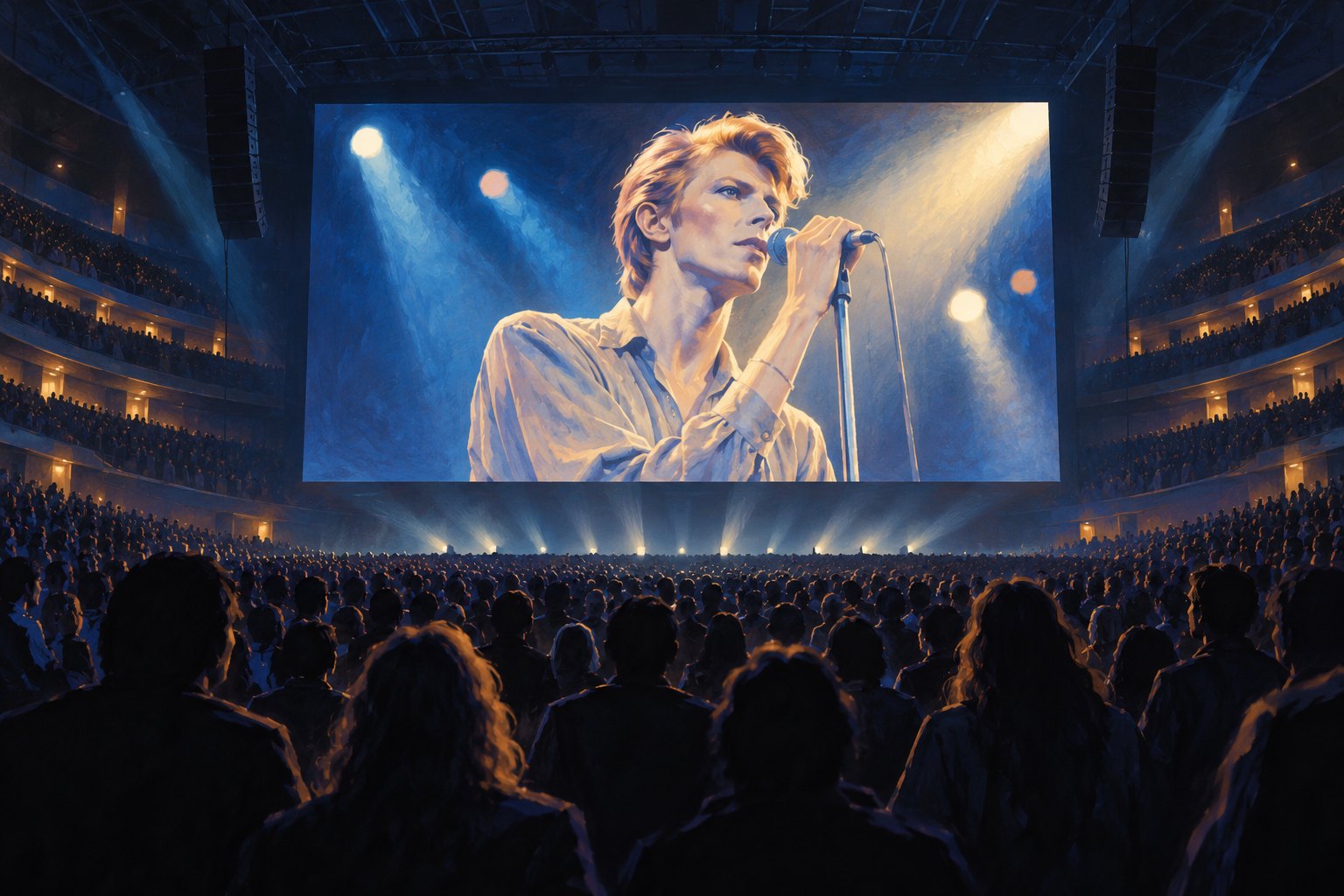
David Bowie’s Stage, an immersive concert experience from Brett Morgen, is set to have its world premiere at the Berlin Film Festival, according to Variety. The announcement places the project at an interesting intersection: a celebration built around a musician and a screen experience entering a setting devoted to evaluating cinema. For viewers, the compelling question is what that meeting will reveal about Bowie as a performer.
This is a critical preview, not a review of the completed experience. The premiere announcement establishes the project’s subject, Morgen’s involvement, its immersive description, and its festival destination. It does not provide a basis for evaluating individual sequences, quoting dialogue, or declaring the presentation a success. Those judgments belong after a viewing.
Why the Berlin Premiere Changes the Conversation
A festival premiere gives a concert experience a particular kind of attention. Alongside excitement about the artist, there is room to ask how the work organizes time, directs the eye, and establishes a relationship between subject and spectator. These are questions of filmmaking even when the central attraction is musical performance.
That distinction matters for Stage. An audience can enjoy hearing a beloved artist without learning anything new about the performance. A film can also make familiar material feel newly legible: a gesture becomes easier to notice, a pause acquires weight, or an exchange between musicians changes the emotional meaning of a passage. Whether Morgen’s project achieves any of this remains to be seen. The festival context makes those questions especially useful.
Selection or presentation at a festival should not be mistaken for a critical verdict. Nor does the word premiere, by itself, establish competition status, awards eligibility, or a wider release plan. The significant development here is the opportunity to encounter Stage as a work with formal choices, rather than treating its subject’s reputation as the entire argument for its value.
Bowie as a Performer, Not a Character to Decode
Approaching a concert experience through character analysis requires care. Bowie is a real person performing for an audience, not a fictional protagonist whose intentions can be read from a screenplay. A glance, smile, or still posture may be expressive without offering direct access to private feeling.
The useful distinction is between describing an action and assigning it a motive. A reviewer might observe that a performer holds a pose while the music continues. Calling that pose lonely, defiant, or exhausted is an interpretation that needs support from its surrounding context. Calling it proof of what the performer privately believed goes further still.
For Stage, the strongest analysis would begin with the relationship Bowie establishes with the viewer. Does a passage invite closeness or sustain distance? Does movement appear to answer the music, complicate it, or pull attention elsewhere? Such questions keep the discussion anchored in observable performance. They also leave space for ambiguity, which can be more revealing than a neat explanation of an artist’s personality.
This is where a concert film can offer something distinct from biography. It need not explain every artistic decision through an episode from someone’s life. Sometimes the most illuminating subject is the decision itself: how a performer occupies a moment and changes the audience’s attention.
Immersion Should Make Room for Interpretation
The description of Stage as immersive sets an expectation of involvement, but it does not, on its own, specify the presentation’s technology or explain its artistic approach. It would be premature to infer particular projection systems, interactive features, or staging arrangements from that label.
As a critical standard, immersion becomes interesting when it means sustained attention. Feeling surrounded by a presentation and feeling engaged by a performance can overlap, but they are different experiences. A viewer may be overwhelmed by sensation while remaining uncertain about what the work wants them to notice.
My preference is for a concert experience that allows attention to move between pleasure and curiosity. There should be room to respond immediately to the music, then notice something less obvious: the relation between a voice and a gesture, the balance between individual presence and collective effort, or the way anticipation changes a moment’s impact. These are expectations for judging Stage, not claims about its contents.
Our earlier discussion of Bowie’s concert imagery and arena presentation considered the challenge of carrying performance across formats. The Berlin premiere raises a further question: what will viewers be able to interpret once that performance has their attention?
The Audience Brings More Than Applause
A Bowie enthusiast and a newcomer will not enter Stage with the same expectations. One may recognize details immediately and supply context from years of listening. The other may depend almost entirely on the work’s internal rhythms and emphasis. Neither response is inherently more legitimate, but a useful review should recognize the difference.
Familiarity can deepen a viewing. It can also conceal gaps: a devoted listener may connect moments that the presentation itself leaves disconnected. Conversely, a newcomer’s uncertainty is not automatically evidence of failure. Art does not have to explain every reference to communicate a coherent experience.
The question is whether Stage creates meaningful relationships within what it presents. Can a viewer follow shifts in energy without needing an external history lesson? Does the work make space for discovery as well as recognition? A festival audience offers an opportunity for those different responses to meet, although the premiere alone cannot tell us what their conclusions will be.
That is also why thoughtful criticism should do more than report the room’s enthusiasm. As our essay on the trust readers develop with a film critic explores, a recognizable critical perspective gives readers someone to think alongside. With Stage, that means explaining what produced an emotional response, not assuming that affection for Bowie makes explanation unnecessary.
What a Useful Stage Review Will Need to Establish
After the premiere, the most valuable reviews should address a few concrete issues:
- Structure: How does the experience develop, and what gives its progression a sense of purpose?
- Perspective: What aspects of Bowie’s performance receive emphasis, and what does that emphasis encourage viewers to conclude?
- Context: What can a newcomer understand from the presentation itself?
- Emotional effect: Which responses arise from the work’s choices, and which depend on the viewer’s existing attachment?
Specific examples will matter more than superlatives. Memorable lines, musical selections, and apparent references should be discussed only when their presence and context can be established. Until then, inventing a representative scene would obscure the very thing a review is supposed to illuminate.
The Deeper Opportunity: Encountering an Artist Anew
The most promising possibility for Stage is a shift from recognition to observation. Recognition says that we know the artist before us. Observation asks us to look again, allowing a familiar presence to become complicated, surprising, or difficult to summarize.
That is the standard I would bring to its Berlin premiere. An immersive experience earns its artistic force when it opens up attention rather than deciding every response in advance. If Stage gives audiences more to notice about Bowie’s performance, its value will extend beyond the excitement of the occasion. The premiere creates the opportunity; the work itself must supply the revelation.
Original content by this site's editorial team. Published: October 27, 2026 at 05:47:42 PDT (Los Angeles time)