Andrzej Wajda’s centennial is an invitation to revisit a filmmaker who made history feel painfully personal. Film Forum’s Andrzej Wajda 100 retrospective provides the occasion; Ashes and Diamonds provides an especially compelling starting point. Released in 1958, it follows a young resistance fighter whose assignment becomes unbearable just as he discovers something he wants to live for.
My judgment is that the film’s enduring power lies in its refusal to let sympathy settle the moral argument. Maciek is magnetic, frightened, funny, and capable of murder. Wajda makes us feel his longing for another life without allowing that longing to erase the lives he takes.
Spoiler warning: This review discusses the assassination plot, major character developments, and the ending. English subtitle wording can vary between editions.
A victory that does not feel like peace
Set around the end of the war in Europe in May 1945, Ashes and Diamonds places Maciek, played by Zbigniew Cybulski, within Poland’s anti-Communist underground. He and his fellow fighter Andrzej are tasked with assassinating Communist official Szczuka. Their initial attack kills the wrong men. The intended target survives, and the assignment remains unfinished.
That mistake matters before any romance or political debate begins. The film establishes a gap between confidence and knowledge: men who believe they understand their duty do not even correctly identify the people they shoot. Violence arrives with certainty, then leaves uncertainty for everyone else.
Much of the subsequent action gathers around a hotel, where private encounters unfold alongside public celebration and professional maneuvering. For a first-time viewer, the essential tension is straightforward: the fighting that shaped Maciek has not ended simply because a victory has been announced. He still belongs to an organization that expects him to kill.
Maciek’s charm is part of the problem
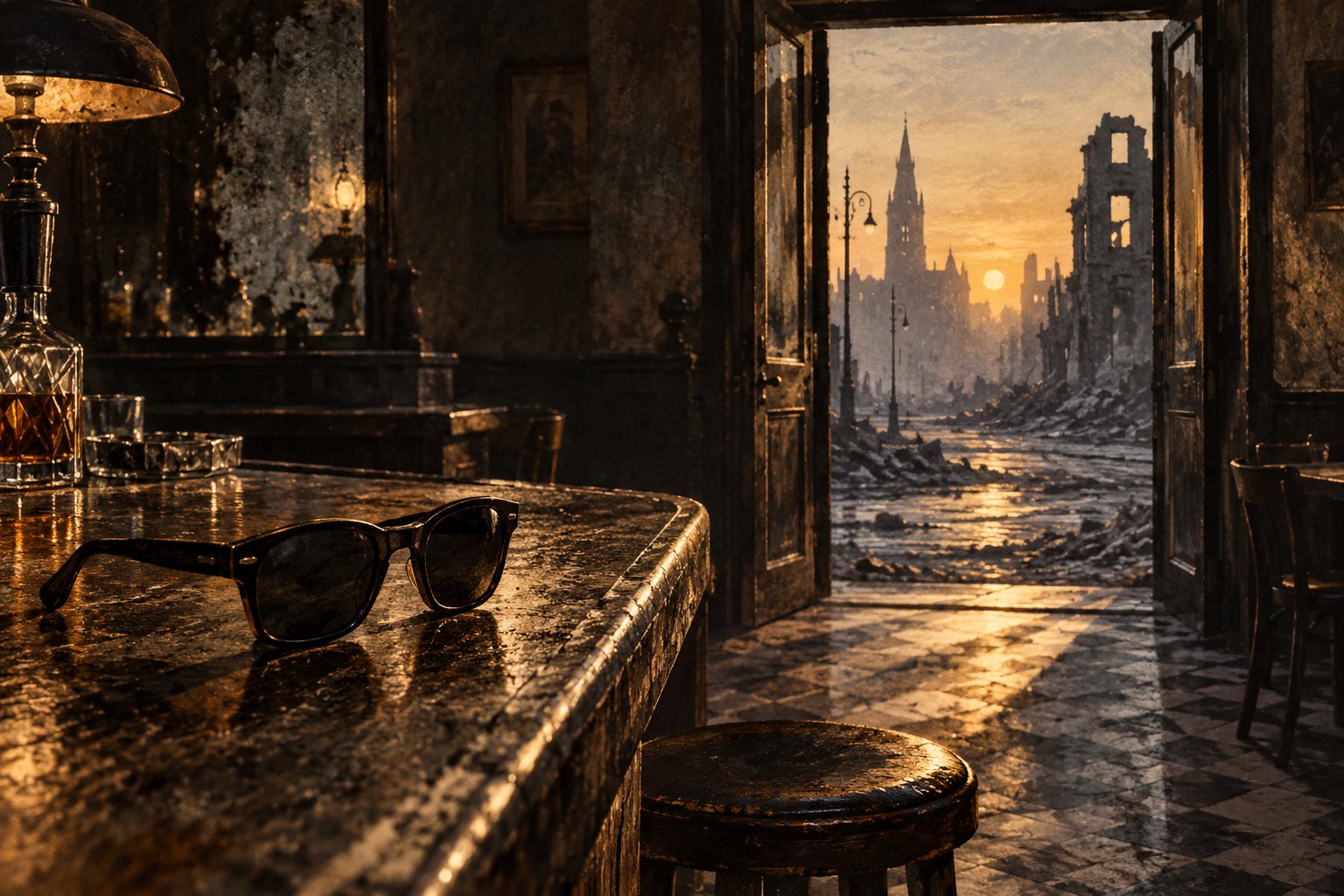
Cybulski makes Maciek difficult to hold at a comfortable distance. His dark glasses, restless movement, and shifting manner create a young man who seems to be improvising his personality from moment to moment. He can appear insolent in one exchange and suddenly exposed in the next.
Asked about his glasses, he calls them a “souvenir of unrequited love for the homeland.” The phrase turns injury into a joke, but its emotional structure is revealing. He describes national devotion as a relationship in which love has not been returned. His flippancy protects a wound that patriotic language cannot heal.
The performance also creates a trap for the viewer. Because Maciek is so watchable, his wish to escape can begin to feel more urgent than the consequences of his actions. Wajda’s achievement is to sustain that attraction while keeping the failed assassination in the film’s moral field. Charisma explains our attachment; it cannot provide an acquittal.
Krystyna makes an ordinary future imaginable
Krystyna, the hotel barmaid played by Ewa Krzyżewska, changes the scale of Maciek’s thinking. Their encounter makes room for desires that military duty has crowded out: intimacy, study, continuity, and the possibility of waking up without another clandestine assignment.
From her perspective, however, his sudden intensity is no guarantee of a future. A stranger can speak sincerely and still leave. Her reserve gives their relationship a necessary imbalance: he experiences the discovery of possibility, while she must consider the vulnerability of believing him.
Maciek eventually protests, “I can’t kill or hide any more!” The force of that declaration comes from its exhaustion. He is not presenting a developed political alternative. He is recognizing that the life he knows has become impossible to endure.
Yet recognition does not automatically produce freedom. Andrzej’s insistence on obligation gives Maciek’s hesitation the shape of betrayal. Walking away would mean confronting the identity that has sustained him and the comrades whose sacrifices helped define it.
This makes an illuminating companion to our discussion of ordinary life and emotional refuge in Perfect Days. Where that film finds meaning in repeated daily actions, Wajda makes the opportunity to establish such a routine feel almost unreachable.
The burning glasses turn memory into pressure
When Maciek and Andrzej light glasses of spirits in remembrance of dead comrades, the bar briefly becomes a place of mourning. The gesture is intimate and visually beautiful. It also helps explain why the living find it so difficult to stop.
For Maciek, remembrance carries an implicit demand. If others died while remaining faithful, what would it mean for him to choose personal happiness? The film allows us to feel the emotional force of that question without agreeing that another killing could answer it.

My reading is that the scene exposes the moment when grief becomes an obligation imposed on survivors. The dead deserve remembrance. Whether they require the living to repeat their fate is a separate question, and Maciek struggles to separate the two.
Szczuka has a private life beyond the assignment
Szczuka, played by Wacław Zastrzeżyński, must be understood as more than the destination of Maciek’s gun. His concern for his son gives him a private vulnerability that the language of assassination excludes. The target is also a father.
That perspective changes how the film’s suspense works. We can fear that Maciek will fail to escape his assignment while also fearing that Szczuka will not survive it. These responses coexist because Wajda gives the men different political commitments without reducing either to a function.
The distinction between understanding a person and endorsing that person also underlies our essay on the trust readers develop through film criticism. A useful critical response must remain open to emotional identification while testing what that identification leaves out.
An ending that strips away the glamorous image
Maciek ultimately shoots Szczuka. Fireworks accompany the killing, bringing public celebration and private destruction into the same terrible moment. The image does not allow the assassination to exist in a separate moral universe from the peace supposedly being celebrated.
Later, Maciek is himself shot while fleeing soldiers and dies on a rubbish heap. The location is brutally important. The young man whose presence has dominated the film does not receive an ending proportionate to his charm. His body becomes vulnerable, awkward, and abandoned.
For me, this is where the film most decisively challenges the romance surrounding its protagonist. We may have wanted his intensity to guarantee significance. Wajda shows that intensity offers no protection against a wasted death.
What survives in the ashes?
The film’s title draws on a poem by Cyprian Norwid encountered during Maciek and Krystyna’s visit to a ruined church. Its question about what remains after destruction belongs to the lovers, but it also addresses the viewer. Can suffering leave something valuable behind without being justified by that value?
The church, the burning glasses, and the fireworks are recurring symbolic structures rather than hidden Easter eggs. Their meanings develop through context: light can commemorate, illuminate, celebrate, or accompany destruction. Beauty itself provides no reliable moral guidance.
That is why Ashes and Diamonds remains such a rewarding film through which to approach Wajda at 100. It does not ask us merely to admire a doomed young man. It asks us to notice how urgently he wants a future, how fully other people possess lives of their own, and how disastrous it becomes when inherited obligations make those truths impossible to act upon together.
Original content by this site's editorial team. Published: October 27, 2026 at 04:40:11 PDT (Los Angeles time)