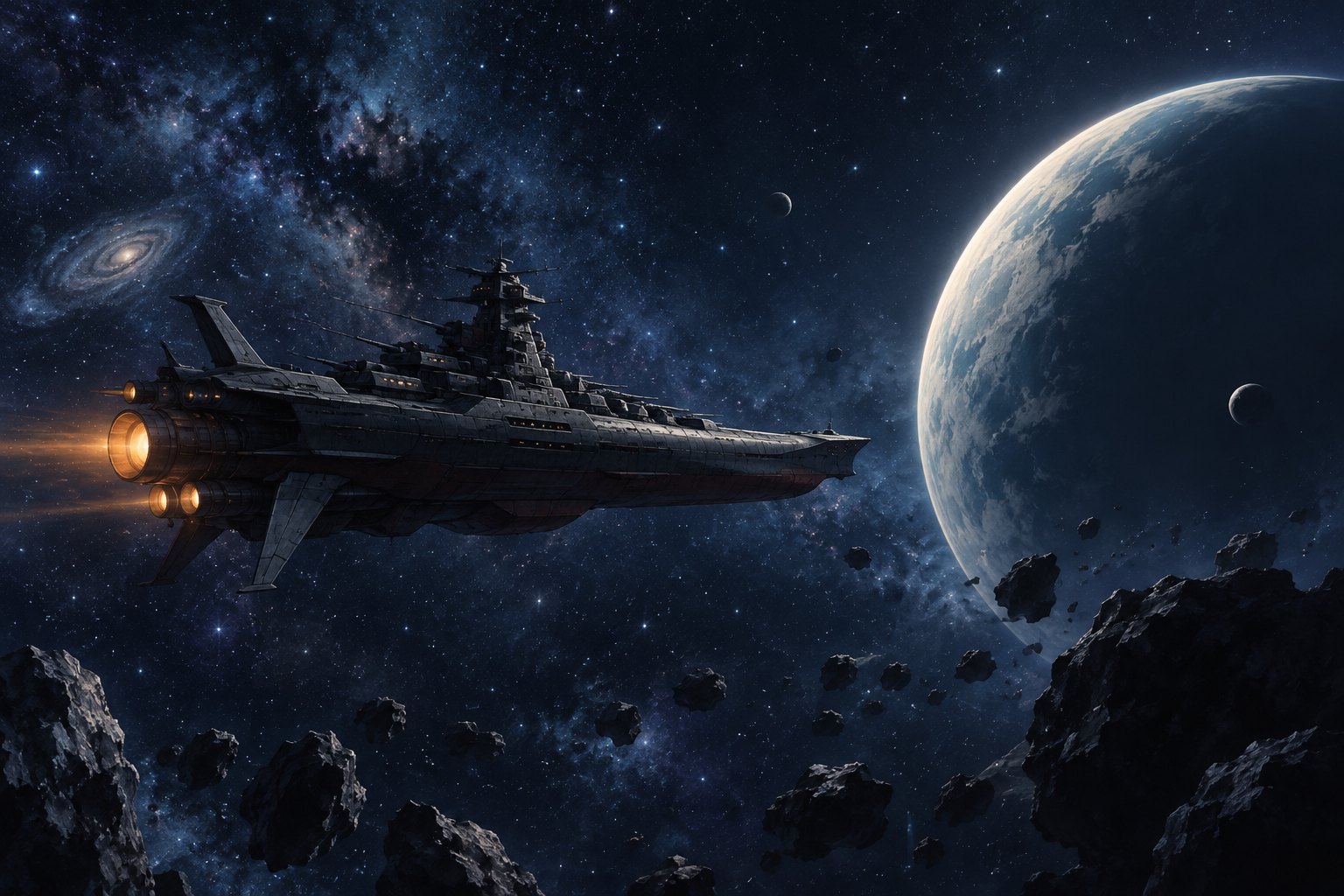
Cosmoship Yamato √2199 has been announced as an anime feature film, according to Crunchyroll. For readers looking for the essential news, that is the starting point: a feature announcement, with a title that immediately invites questions about the story it will tell and the audience it hopes to reach.
The most interesting critical question is how a film carrying that name might make an immense journey feel personal. A spacecraft can establish scale in a single image. Giving the people inside it equally strong identities takes decisions, disagreements, and time. That is the standard I would bring to this project when there is a finished film to assess.
This is spoiler-free announcement commentary, not a review of the completed movie. No scenes, character arcs, or dialogue from the new feature are evaluated here. The distinction matters: anticipation can begin with a name, but criticism needs the work itself.
What the announcement establishes
The central confirmed information is straightforward: the announced project is an anime feature titled Cosmoship Yamato √2199. That identifies its format and gives readers a specific project to follow. It does not, by itself, explain how the film's narrative will be structured or whose experience will organize it.
A feature announcement should also be kept separate from practical viewing information. This article does not establish a release date, an American theatrical engagement, a streaming destination, or a recommended viewing order. Those questions require their own verified answers. The fact that an entertainment publication reports a movie does not establish that publication's associated service as its distributor.
For anyone arriving through a search for a movie review, there is an equally useful distinction: the existence of a project is news; the quality of its storytelling remains something to judge. An announcement cannot show whether an emotional turning point has been earned or whether a conclusion makes sense from a character's perspective.
The title invites interpretation, but does not settle continuity
The unusual √ symbol is the title's most conspicuous feature. In mathematical notation, it is a radical sign commonly used to indicate a square root. Its appearance here makes the name visually distinctive, but that observation should not be stretched into a plot explanation.
It may tempt readers to speculate about origins, alternate paths, or a return to essentials. Those are possible associations a viewer might bring to the typography, not established descriptions of the movie. A symbol cannot confirm a reboot, a sequel, an alternate timeline, or a particular relationship to another production.
The same caution applies to the number 2199. Recognizing a number is different from knowing how a new film will use it. Before prescribing homework to newcomers, coverage should establish what knowledge the movie actually expects. Otherwise, excitement about a title can accidentally become a barrier to entry.
That leaves a productive question for future footage and story information: how quickly can the film make its immediate situation understandable? A newcomer should be able to recognize what someone wants, what stands in the way, and why a decision matters before mastering a larger fictional history.
A character perspective begins with unequal stakes
My strongest hope for Cosmoship Yamato √2199 concerns perspective. In a space epic, sharing a destination need not mean sharing a motive. Dramatic depth emerges when people can agree on what must happen while disagreeing about its cost, its urgency, or the authority of whoever makes the decision.
That is a criterion for the eventual film, not a description of its unconfirmed cast. The useful test would be whether supporting characters have priorities that remain intelligible beyond their immediate function in the plot. A person who supplies information can also resent being ignored. Someone who follows an instruction can still understand its consequences differently from the person giving it.
Character analysis becomes especially revealing when it asks who has meaningful choices. Does an apparent disagreement alter anyone's behavior? Can a subordinate's judgment affect an outcome? Does a relationship change because someone listens, or does the screenplay simply move on after a speech? These questions distinguish an ensemble with agency from a collection of reaction shots.

Our discussion of the character challenge behind a proposed Cars prequel approaches a related problem: a compelling machine or recognizable setting can attract attention, while the people associated with it must sustain the drama. Here, too, visual appeal would be only the beginning of the critical conversation.
What the feature format asks of the storytelling
A feature film needs to establish its own dramatic rhythm. Whatever larger associations the title carries, this particular work will have to decide what deserves emphasis, which relationships need room to develop, and where its emotional center lies.
Compression can be an advantage. A sharply chosen point of view can turn a complicated situation into an immediate experience. But compression can also produce the appearance of depth without its substance: introductions that substitute for relationships, explanations that arrive where a conflict should be, or major decisions whose consequences receive too little attention.
For my eventual review, the important measure would be causality. A character's choice should create pressure that the next scene must address. When events merely accumulate, even impressive sequences can feel interchangeable. When a choice changes what another person is willing to do, spectacle acquires a human dimension.
That distinction also informs our examination of ensemble balance and narrative cohesion in Artificial's early reception. Memorable individual moments and a satisfying whole are related achievements, but one does not guarantee the other.
Why dialogue and Easter eggs must wait
There are no verified lines from the new feature to discuss here. Borrowing a familiar quotation from another work and allowing it to stand in for this movie would blur the distinction between expectation and evidence. A memorable line deserves analysis in the scene where it occurs: who says it, who hears it, and what changes afterward.
Likewise, a visual resemblance or suggestive title element is not enough to establish an Easter egg. Identifying a deliberate reference requires something concrete to examine. Until then, assigning hidden meanings risks turning an interpretation into an invented production fact.
The deeper question: who gives the journey meaning?
The announcement's strongest invitation, for me, is to think about the relationship between a vessel and the lives it contains. An enormous object can become emotionally significant through small acts: responsibility accepted, trust revised, attention paid. Whether this film achieves that remains open.
The eventual test for Cosmoship Yamato √2199 will be whether its scale helps us understand its characters. A distant destination gives a story direction. The people deciding how to reach it give that direction meaning. That is where anticipation can become a useful critical question—and where a future review should begin.
Original content by this site's editorial team. Published: October 6, 2026 at 02:58:12 PDT (Los Angeles time)