Avengers: Endgame has reclaimed the worldwide box-office record seven years after its debut, according to Fortune. Its return invites a tempting conclusion about Hollywood: familiar characters remain its safest investment. But the movie itself offers a more demanding lesson. Familiarity becomes dramatically valuable when characters can outgrow the identities audiences recognize.
Steve Rogers and Nebula make that argument particularly well. Both encounter earlier versions of themselves. Both discover that survival requires a different relationship with the past. Watching their stories now, my strongest impression is that Endgame succeeds because it gives repetition a destination. Hollywood can reproduce a costume indefinitely; completing the person inside it requires harder choices.
Spoilers follow for the full story and ending of Avengers: Endgame.
The time heist makes nostalgia answer to character
The Avengers’ plan sends them into earlier periods to collect the Infinity Stones. This structure gives viewers the pleasures of recognition while placing the heroes in an unusually revealing position: they become visitors to stories they have already lived.
That distinction matters. Revisiting an old location can be an easy applause cue. Revisiting it with someone whose beliefs have changed creates friction. The audience remembers who these people were, while the returning characters carry knowledge their earlier selves lack. Recognition becomes a way to measure experience.
The approach also exposes the movie’s limitations. Its excursions sometimes resemble a guided tour whose attractions require prior admission to several other films. A newcomer can understand the objective without feeling the full weight of every encounter. The storytelling is accessible at the level of action and heavily cumulative at the level of emotion.
For invested viewers, however, the best sequences ask a worthwhile question: what would you find embarrassing, painful, or unfinished if you could stand inside your own greatest hits? Our earlier examination of Endgame’s intimate emotional stakes considers its quieter relationships. Here, the more revealing subject is how its heroes resist becoming permanent exhibits of themselves.
Steve Rogers discovers the limits of endless endurance
Steve’s fight with his 2012 counterpart makes that conflict literal. The younger Captain America announces, “I can do this all day.” The older one answers, “Yeah, I know.” A declaration of moral resolve becomes, briefly, something exhausting to hear.
The joke works because Steve has earned the right to be tired of his own slogan. His courage remains intact, but the exchange creates a little distance between the man and the ideal he performs. Chris Evans lets exasperation interrupt nobility without making either quality feel false.
That is essential groundwork for the ending. After his mission to return the Stones, an elderly Steve gives Sam Wilson the shield. The closing dance with Peggy Carter supplies the private fulfillment that public service has repeatedly postponed. Asked about the life he chose, Steve says, “It was beautiful.”
I find this conclusion moving because retirement becomes an affirmative act. Steve does not need to lose his goodness before he can stop working. Passing responsibility to another person allows his commitment to survive without requiring his permanent availability.
There is an unresolved cost. Peggy receives less interior life here than Steve does; their reunion is presented primarily as the completion of his longing. The sequence also leaves practical questions about his years in the past. Its emotional clarity exceeds its explanatory clarity. Even so, ending on a dance gives this enormous franchise something surprisingly modest to value: a life whose worth does not depend on the next emergency.
Nebula confronts an identity built by someone else
Nebula’s encounter with her 2014 counterpart is harsher. The earlier Nebula remains loyal to Thanos, while the later version has developed attachments beyond his control. Their shared technology exposes the Avengers’ mission, and the earlier Nebula infiltrates the team.
This is a particularly effective use of a returning character because the same recognizable appearance contains radically different possibilities. Karen Gillan makes allegiance feel physical: rigidity, watchfulness, and the expectation of punishment shape the younger Nebula’s presence.
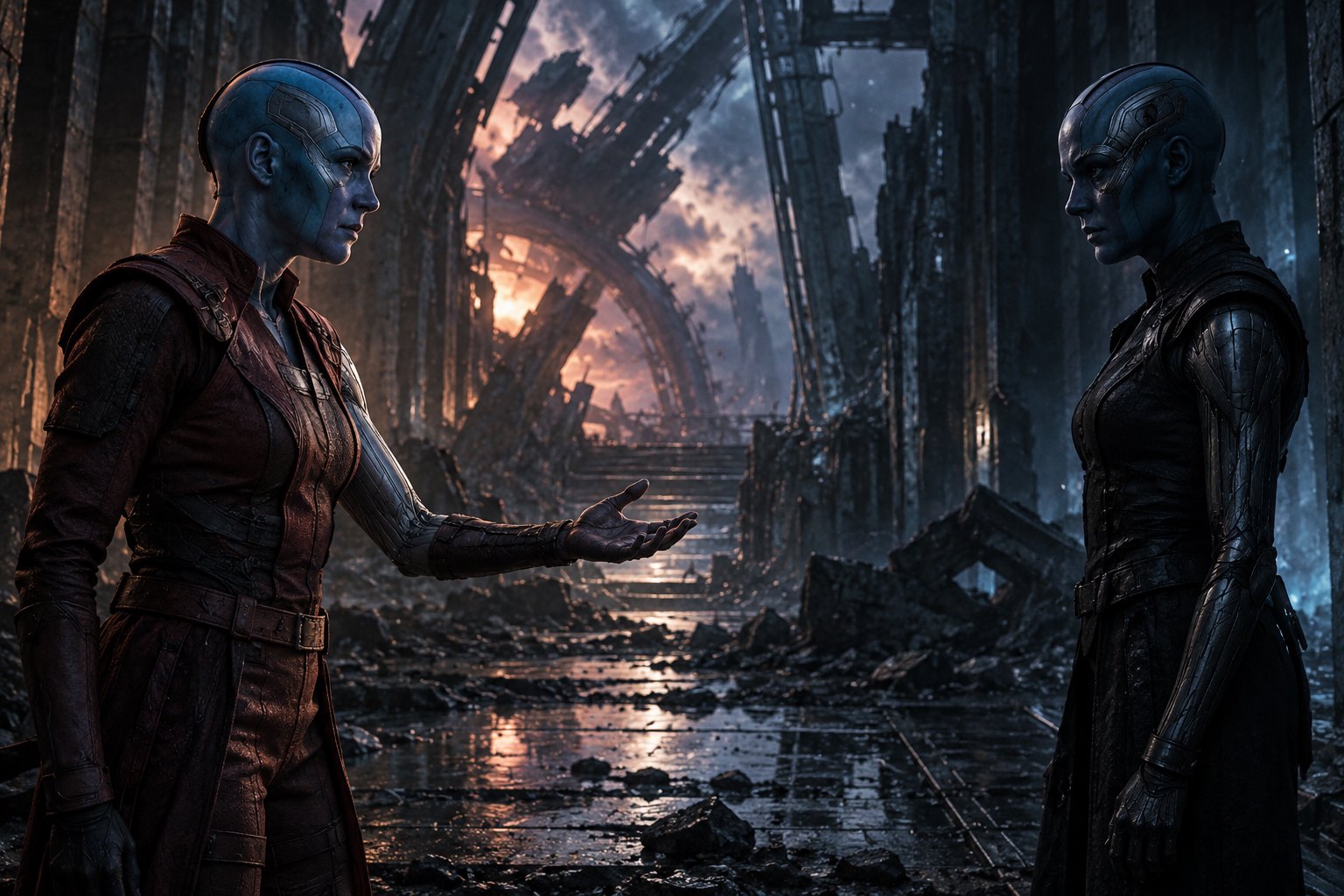
When change is offered to her, the earlier Nebula answers, “He won’t let me.” The line is devastating because she treats another person’s permission as the boundary of her possible future. The woman standing before her proves that a different life exists, yet proof alone cannot undo her conditioning.
The later Nebula ultimately kills her counterpart. As action plotting, this resolves an immediate threat. As character drama, it leaves an uncomfortable implication: the version who has escaped survives by destroying the version who cannot yet imagine escape.
For me, the scene is powerful but abbreviated. The film gives the confrontation enough space to register tragedy, then moves on before fully considering it. Nebula’s development deserves more than a clean division between her redeemed and obedient selves. Still, the conflict reveals something that endless franchise reuse can obscure: meaningful character continuity requires acknowledging how profoundly someone has changed.
Why the final battle needs an aftermath
The climactic assembly supplies the film’s most obvious spectacle. Its effectiveness depends on accumulated recognition, but recognition alone would leave the movie emotionally unfinished. A crowd can demonstrate the scale of a fictional universe without explaining what any individual has gained or surrendered.
The aftermath supplies that explanation. Steve’s departure and Nebula’s survival are different forms of release. One character relinquishes a role he has fulfilled; the other continues beyond a role imposed on her. Together, they suggest that a successful conclusion need not give everyone the same kind of closure.
This is where I think Endgame remains stronger than its most easily imitated features. Its crowded imagery sometimes makes individual action difficult to follow, and its recognition cues can feel insistently arranged. Yet the film understands that a final confrontation should change the terms on which characters can live afterward.
The business lesson is more complicated than familiarity
A box-office result records spending. It cannot, by itself, tell us how much of that spending came from affection for particular characters, the appeal of a communal screening, curiosity, or the desire to revisit a completed story. Treating those motives as interchangeable produces weak criticism and potentially weak creative decisions.
The same distinction informs our discussion of what gives a movie value beyond opening weekend: commercial performance and artistic durability raise connected but different questions.
My reading of Endgame is that its durability depends partly on the confidence of its farewells. Viewers can return to a finished experience and know what emotional journey awaits them. Continuing a franchise may create valuable new stories, but simply reopening an accomplished ending risks weakening the very experience that made people want to return.
Callbacks that reveal the deeper argument
Two callbacks sharpen this interpretation. Steve’s whispered “Hail Hydra” turns the familiar elevator setup from Captain America: The Winter Soldier into a deception rather than another brawl. Sam’s “On your left” transforms an old running joke into the announcement that Steve no longer stands alone.
Both moments reward memory by changing its meaning. Steve can act differently inside a familiar situation; Sam can return an old phrase with new emotional force. These are useful models for franchise storytelling because they make repetition produce development.
The deeper achievement of Endgame is its willingness to imagine that beloved identities have limits. Steve can remain admirable after setting down the shield. Nebula can remain herself after rejecting the authority that shaped her. A fictional universe becomes richer when its people can leave old functions behind. Hollywood’s challenge is to preserve that freedom even when recognition remains profitable.
Original content by this site's editorial team. Published: October 6, 2026 at 18:43:24 PDT (Los Angeles time)