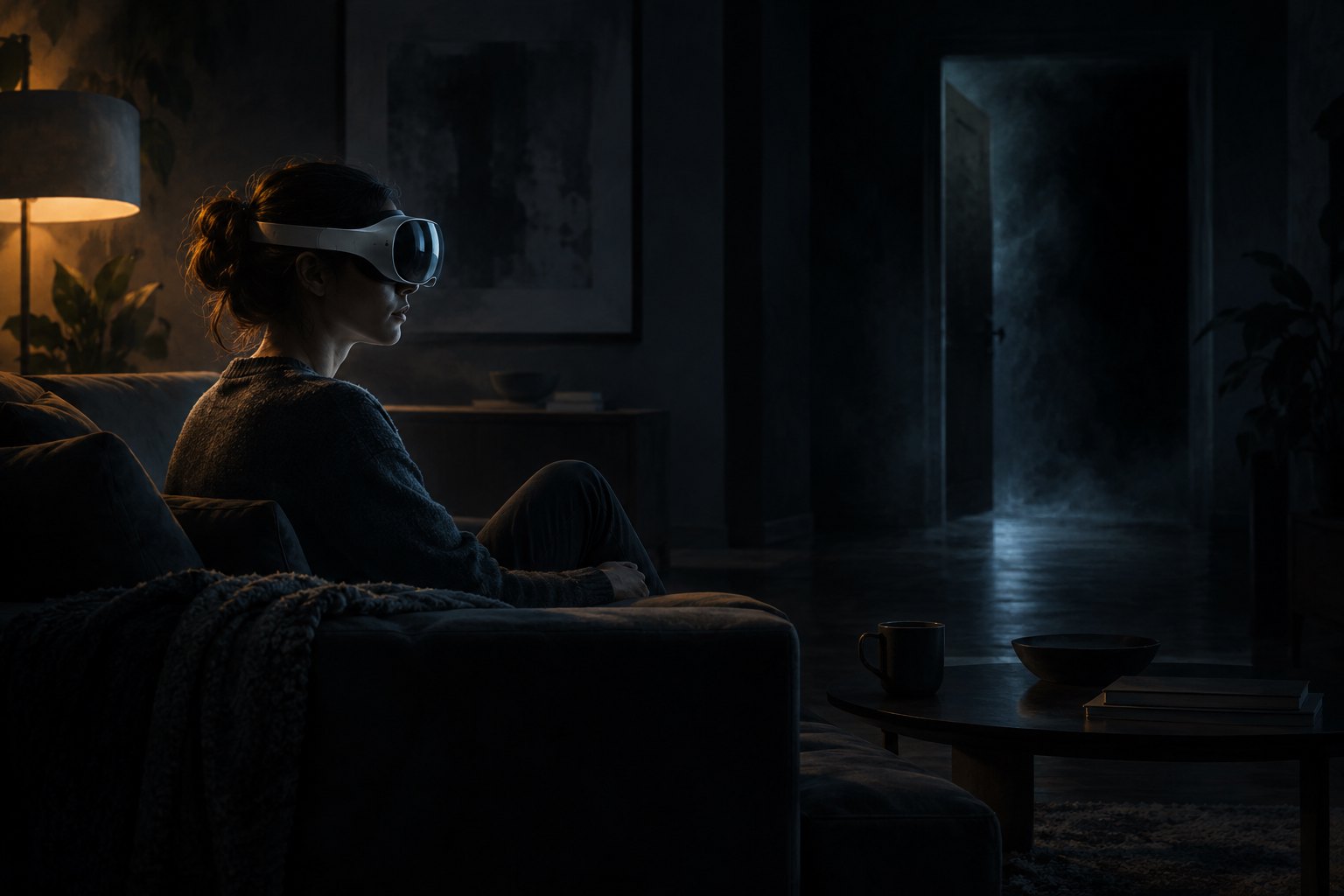
Apple has unveiled an immersive horror film coming to Vision Pro this week, according to 9to5Mac. For horror fans, the announcement offers an intriguing possibility: a viewing experience that makes the distance between the audience and a frightening scene feel smaller. Whether that closeness produces a satisfying movie is the more interesting question.
This is a spoiler-free critical preview, not a review of the completed film. The announcement establishes the immediate news; it does not establish the quality of the performances, the effectiveness of the scares, or the meaning of the ending. Those judgments require seeing the work. For now, the strongest reason to pay attention is the potential relationship between immersive presentation and a character’s experience of fear.
What the announcement promises—and what remains open
The central information is straightforward: Apple has announced an immersive horror film for Vision Pro, with its arrival described as this week. Readers following the release should treat that relative timing as part of the announcement, rather than a permanently current availability notice.
The word immersive describes an ambition for the viewing experience. It cannot tell us whether the story develops its characters, earns its revelations, or sustains tension between shocks. Nor should the word alone be taken to mean that viewers make decisions or control the narrative. A film can draw an audience into its space without becoming an interactive game.
My interest in this release rests on what the presentation might do for dramatic perspective. Horror can make ordinary acts of attention feel dangerous: watching someone hesitate, waiting for them to notice a sound, or realizing that their confidence has become a liability. An immersive film has an opportunity to make those acts unusually immediate.
The crucial distinction: feeling present and understanding a person
Being startled is a physical response. Caring about a frightened character requires something more specific. We need to understand what that person wants, what they believe, and why they make a choice that exposes them to danger. A convincing horror protagonist does not have to behave wisely. Their mistake needs to make sense from where they stand.
That distinction matters when evaluating Apple’s film. A threatening image might feel remarkably close while the person threatened remains emotionally distant. Conversely, a quiet exchange could become the most unnerving moment if it changes our understanding of someone’s intentions. Proximity gives a filmmaker an expressive tool; characterization gives that tool a purpose.
The useful question is whose uncertainty the audience shares. Are we discovering danger with a character, anticipating something they have missed, or watching them conceal knowledge from someone else? These are different dramatic relationships. Each can generate fear, but the film needs to establish which relationship governs a scene.
Our discussion of why character presence needs meaningful story development raises a related standard. Giving someone prominence is only the beginning. Their attention, decisions, and changing relationships must make that prominence matter.
Space becomes frightening when it affects a choice
An impressive environment can hold the eye without advancing a story. Horror gains dramatic force when a space changes what a character can do: where they can retreat, whom they can reach, or what they must pass to get out. These are general possibilities of the genre, not descriptions of scenes in Apple’s film.
For an immersive presentation, spatial clarity deserves particular scrutiny. The audience should have enough information to understand a character’s predicament. Confusion can be effective when it expresses that person’s disorientation. It becomes frustrating when viewers cannot tell what matters or why a movement carries risk.
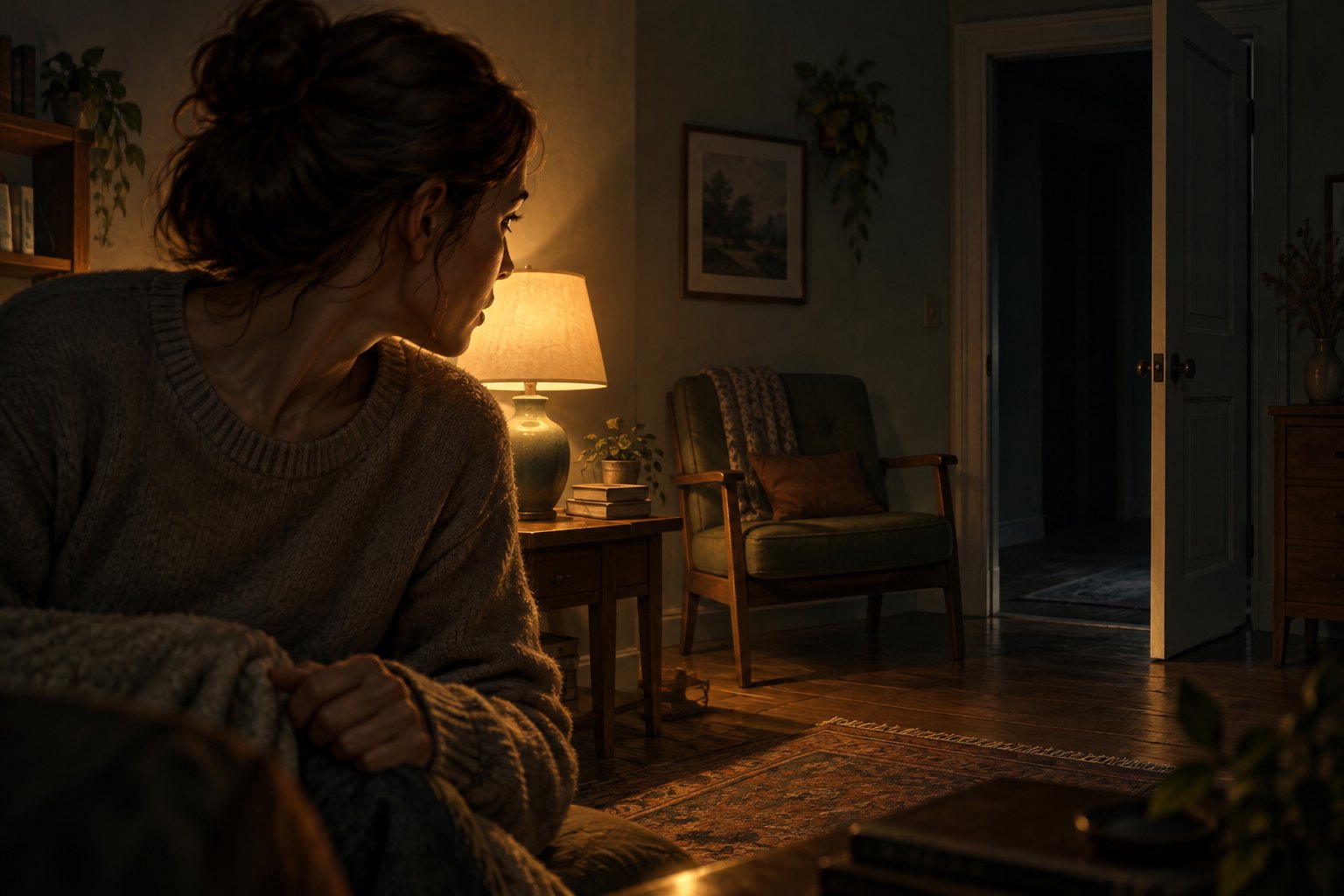
A hypothetical doorway illustrates the difference. A dark opening might initially suggest danger simply because we cannot see beyond it. Give a character a compelling reason to approach, and the same opening becomes a decision. Establish that another person may be waiting there, and it becomes a relationship. The visual feature stays the same while its emotional significance changes.
That connection between place and human vulnerability also runs through our examination of horror locations that make familiar spaces unsettling. For this Vision Pro release, the question will be whether its environments accumulate meaning as the story progresses.
Suspense needs somewhere to go between the shocks
A scare can interrupt a moment; suspense gives that moment a direction. We wait because something remains unresolved. A character may be withholding information, misreading another person, or trying to maintain an appearance of calm. The audience’s anticipation depends on how the film develops that uncertainty.
I would judge this experiment partly by its willingness to ease off. Constant intensity can leave little room for a new threat to register. A calmer passage can restore our attention to a face, a relationship, or a detail whose significance has changed. Restraint is a creative choice worth evaluating alongside spectacle.
Sound belongs in that assessment, too. The important question is what listening reveals. Does a sound alter a character’s behavior? Does silence create an expectation that the scene then develops? A loud interruption may produce a reaction, but its dramatic value depends on what follows.
What to watch for when the film arrives
A useful first viewing does not require counting scares or searching every corner for hidden clues. Follow the people and the film’s handling of your attention. Four questions can help separate the appeal of the presentation from the strength of the storytelling:
- What does the central character want? A clear desire gives danger a specific consequence.
- What changes after a frightening moment? Look for a changed decision, relationship, or understanding.
- How does the film guide attention? Notice whether looking and listening help you follow the emotional action.
- What remains after the surprise? Consider whether the revelation deepens the story or simply ends the uncertainty.
There is no sound basis yet for quoting memorable dialogue, explaining character arcs, or identifying Easter eggs here. Those details should emerge from the actual film. Treating imagined scenes as evidence would obscure the very thing this release deserves: a fair assessment of its particular creative choices.
The deeper possibility: closeness without control
The most compelling possibility for Apple’s immersive horror film is the tension between feeling close to an event and being unable to change it. In my view, that tension could make helplessness unusually expressive. The audience might feel drawn toward a character while remaining unable to warn, comfort, or protect them.
That is a possibility, not a verdict. The film will have to give its closeness emotional meaning through performance, pacing, and believable choices. If it does, the lasting impression could be more complicated than a successful jolt: the unsettling experience of understanding someone’s fear while having to watch them face it.
Original content by this site's editorial team. Published: October 12, 2026 at 19:35:18 PDT (Los Angeles time)