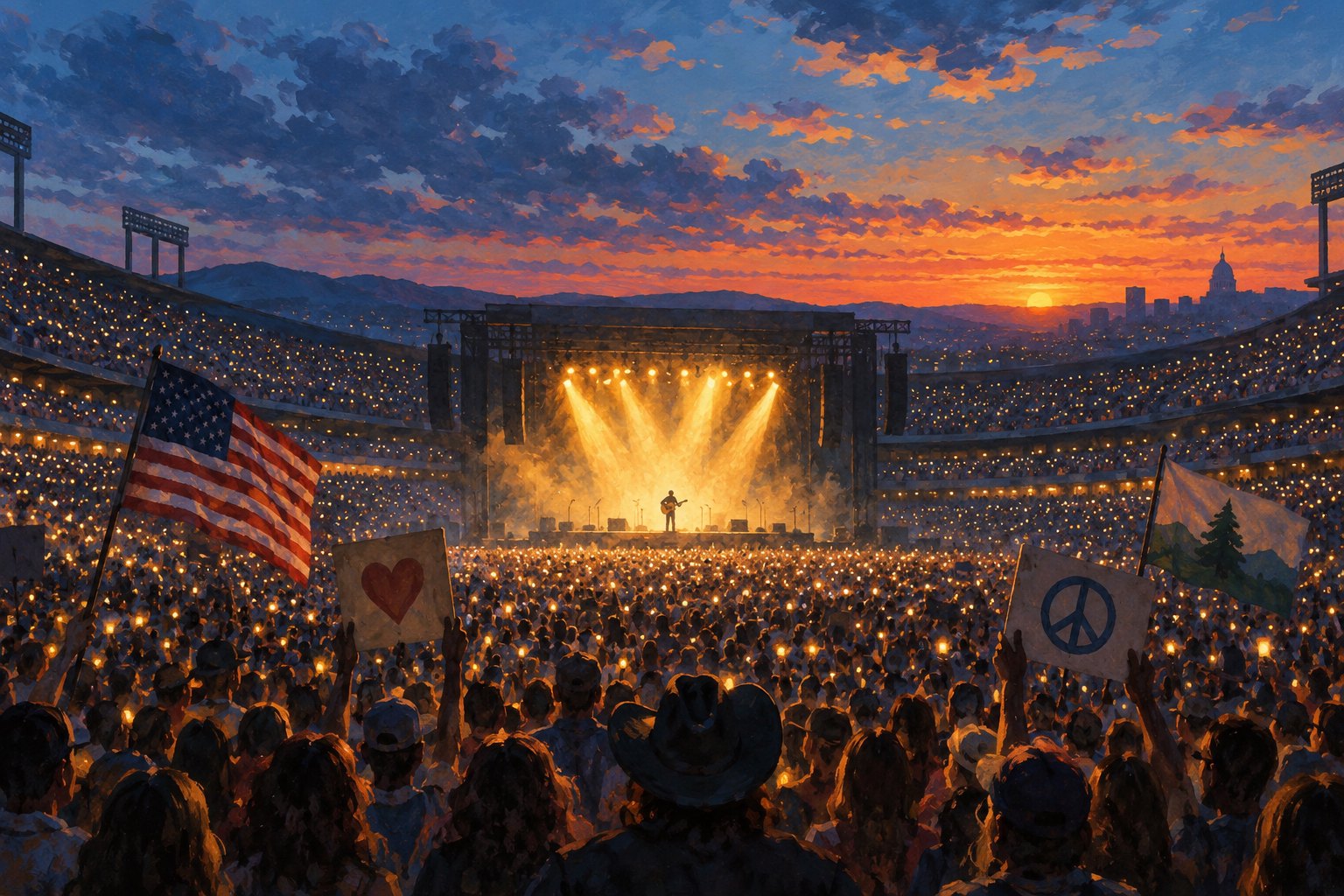
Zach Bryan reportedly broke Gillette Stadium’s attendance record while again wearing a shirt bearing the words “Free Palestine.” Billboard’s coverage brought those two developments together: a major concert milestone and an explicitly political message displayed by the performer. Their combination gives the story its force. A record crowd establishes the scale of an occasion; a message worn onstage helps shape what people remember about it.
The distinction matters because those facts answer different questions. Attendance concerns the size of the gathering. The shirt concerns Bryan’s public expression. Neither fact, on its own, establishes what every person in the stadium believed, why they bought a ticket, or how they experienced the performance.
This is commentary on the concert’s public framing and visual meaning, rather than a review of its musical execution. The most revealing question is how a few words on clothing can become inseparable from an entertainment achievement—and how much interpretation that image can reasonably support.
What the record establishes—and what it leaves open
A stadium attendance record is a substantial achievement. It gives a performer’s drawing power a concrete point of comparison within that venue’s history. In Bryan’s case, the reported milestone deserves attention independently of the shirt. People gathered for a concert, and the scale of that gathering became news.
But a crowd is not a single political speaker. People can attend the same performance for different reasons: affection for the songs, loyalty to the artist, a social occasion, or curiosity about the live experience. Those are possible motivations, not claims about particular attendees. The essential point is that a ticket purchase cannot reliably tell us which explanation applies.
Reading the attendance record as collective approval of the shirt would therefore overstate the evidence. Reading political disagreement into the crowd would make the same mistake in the opposite direction. Without direct evidence about audience responses, the responsible interpretation stops at the artist’s visible message and the event’s reported scale.
Entertainment coverage often asks numbers to settle questions they cannot answer. Our discussion of what commercial results can and cannot tell us about a movie addresses a related distinction. A measurable outcome can be consequential without becoming a complete account of artistic value, personal motivation, or public opinion.
Why the shirt becomes the central image
“Free Palestine” is short enough to be understood in a glance. Worn by a performer, it becomes part of the visual presentation of the show. Someone encountering a still image can register the message without hearing a song or watching a full performance. That makes clothing unusually effective at carrying a statement beyond the people physically present.
There is a useful connection here to screen criticism. Costume helps direct attention and frame a figure’s relationship to the surrounding world. Yet the comparison has a limit: Bryan is a real person making a public appearance, not a fictional character whose motives a screenplay has supplied. We can interpret the visible choice without pretending to know his private calculations.
My reading is that the shirt complicates the familiar stadium-success image. A performer before a vast audience usually offers a straightforward picture of achievement. A political statement introduces another subject into that picture. Viewers must decide whether to discuss the music, the message, the setting, or their relationship.
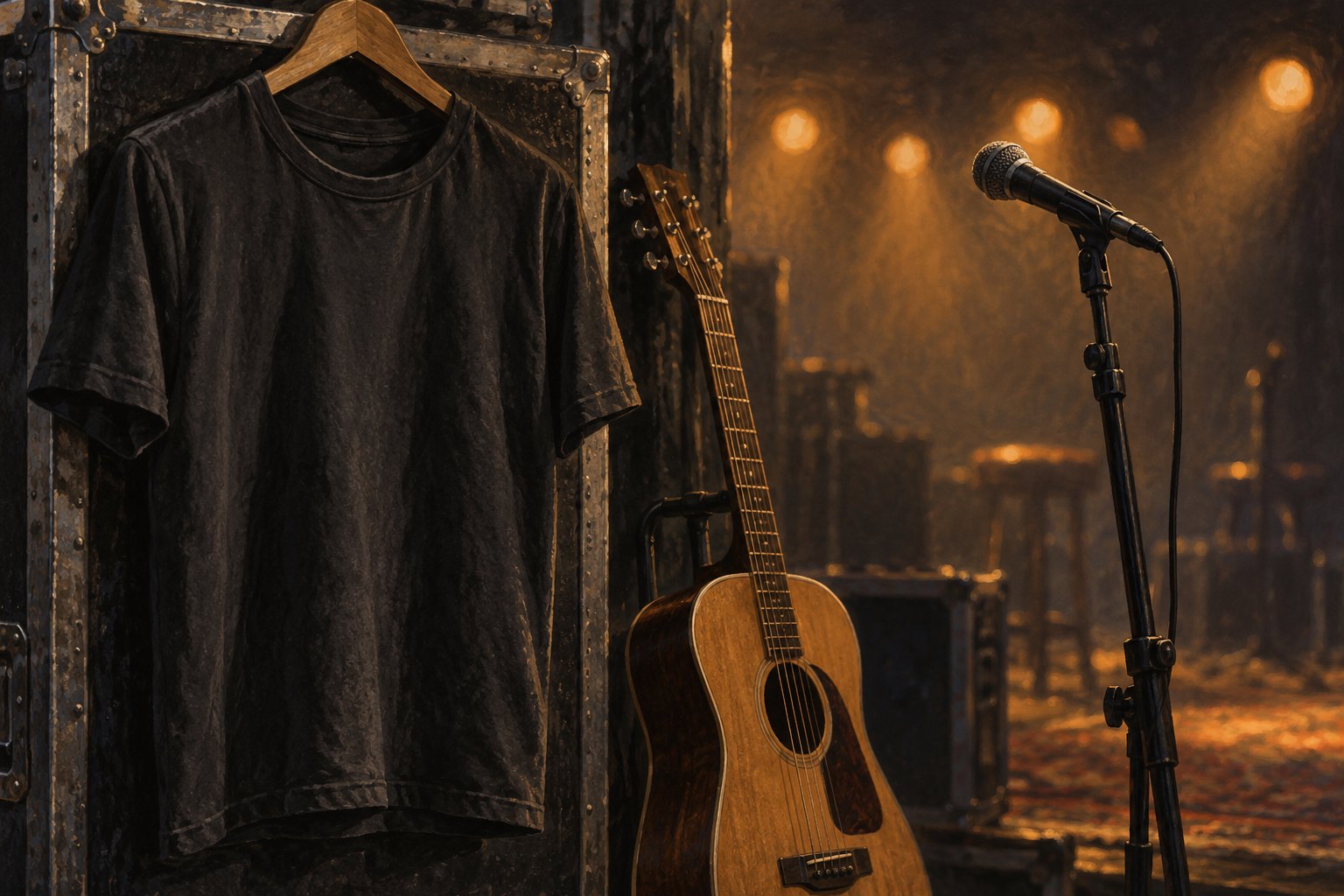
The image can nevertheless communicate less than viewers assume. The words establish an expression of support for Palestinian freedom. They do not, by themselves, supply a detailed policy position, explain the circumstances behind the choice, or document conversations with the venue. A brief slogan gains visibility through compression; that same compression leaves questions unanswered.
What wearing it again adds to the story
The reported repetition gives the clothing choice additional significance. When a message appears again, it becomes harder to treat it as an isolated visual detail. Repetition keeps the statement attached to the performer’s public presence and provides a fresh occasion for attention.
That does not establish a publicity strategy. Nor does it prove the performer anticipated every interpretation. Those conclusions would require evidence beyond the repeated appearance itself. What can reasonably be said is that wearing the message again renews its visibility.
This is also why the shirt can outlast the immediate milestone in public memory. An attendance achievement is usually communicated as a number or a record announcement. Clothing supplies an image that can accompany many different arguments. Supporters, critics, and people chiefly interested in entertainment can all circulate the same picture while describing its meaning differently.
Why the Robert Kraft framing requires care
Several accounts foreground Robert Kraft when describing the Gillette Stadium appearance, and the Boston Herald’s headline characterizes Bryan as defiant. That language gives the event a dramatic structure: a performer, a powerful figure associated with the setting, and a visible statement presented as a challenge.
“Defiant,” however, is an interpretation with implications. It suggests resistance to a person, expectation, or restriction. The fact that a shirt was worn does not independently establish a direct exchange, an instruction to remove it, or a confrontation backstage. Those would be separate factual claims requiring separate reporting.
The setting can still be relevant. Public expression takes on meaning partly through where it occurs, and readers may reasonably consider the relationship between an artist’s platform and the institution hosting the performance. The mistake would be turning that relationship into an unwitnessed scene, complete with imagined dialogue and motives.
For a publication concerned with film and visual storytelling, this is the point at which narrative discipline matters most. Real events can resemble drama without providing a drama’s access to its participants. A compelling antagonist-and-protagonist arrangement is not evidence that the people involved understood the evening in those terms.
A political image cannot review the concert for us
The shirt and the attendance milestone also leave the musical experience largely undescribed. They cannot establish the quality of Bryan’s singing, the pacing of the set, the arrangements, or the relationship between quiet passages and stadium scale. Praise or criticism of the political gesture should be recognizable as such.
A meaningful performance review would need evidence from the performance: particular musical choices, transitions, moments of audience interaction, and the way the show developed over time. Without that foundation, assigning an artistic verdict would amount to reviewing a headline.
The same caution applies to visual evidence more generally. As our commentary on what public photographs can and cannot establish explores, an image can be authentic while offering only a partial account. Its limits do not make it meaningless. They make careful description more valuable.
The larger meaning of the Gillette moment
In my view, the enduring interest of Bryan’s appearance lies in the coexistence of mass entertainment and personal political expression. The reported record makes the platform’s scale visible. The shirt demonstrates that an artist can use that platform to introduce a concern extending beyond the performance itself.
Neither element cancels the other. The concert remains an entertainment event, and the message remains a public statement. Their intersection invites discussion without authorizing a claim that the audience spoke with one voice or that a visible gesture settled the issue it invoked.
Bryan’s Gillette milestone therefore deserves a reading spacious enough to hold both achievement and expression. The record tells us about the size of the occasion. The words on his shirt tell us what he chose to display within it. The strongest criticism begins by seeing both clearly—and resisting the temptation to invent the rest of the scene.
Original content by this site's editorial team. Published: October 5, 2026 at 01:48:38 PDT (Los Angeles time)