William Greaves 100, Film Forum’s centennial tribute, invites a question more interesting than where a filmmaker belongs in the canon: what happens when the people making a movie disagree about what their movie is? Greaves’s Symbiopsychotaxiplasm: Take One makes that uncertainty its dramatic engine. A relationship scene becomes a production problem; the production problem becomes a struggle over authority; and the struggle becomes something the audience must interpret without a dependable referee.
For viewers encountering Greaves through the tribute, this film offers an unusually revealing introduction to his interest in performance and observation. My judgment is that its strongest achievement is making the work of interpretation feel personal. We recognize the discomfort of trying to do a job while wondering whether the person in charge understands it—or understands something we do not.
Spoiler notice: This review discusses the film’s repeated screen tests, the crew’s recorded disagreements, and its treatment of directorial control. The fictional dialogue includes homophobic language and accusations concerning reproductive coercion.
A breakup scene becomes everyone’s problem
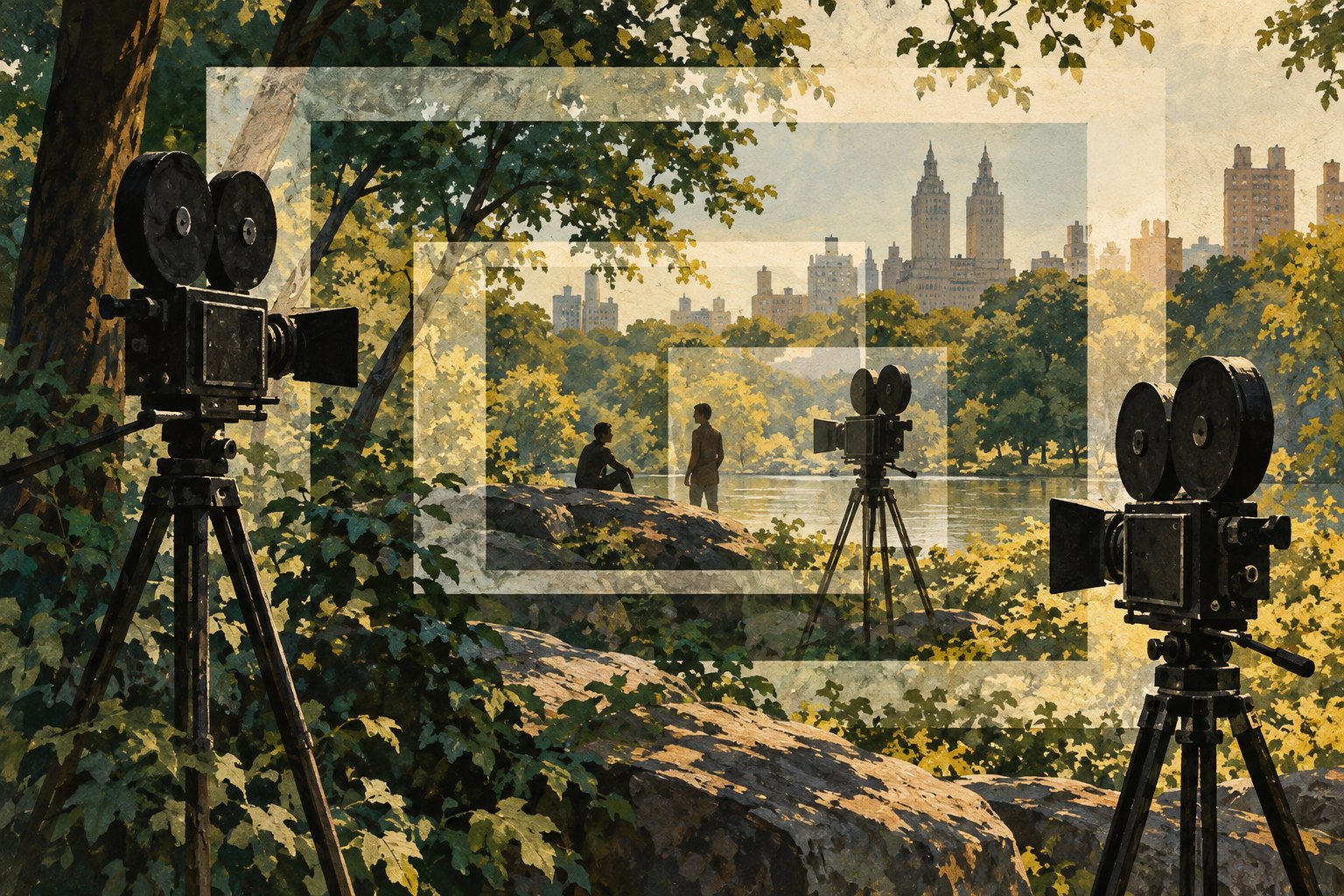
Shot in Central Park in 1968, Take One builds its experiment around actors rehearsing a confrontation between Alice and Freddie. Multiple cameras record different layers: the performers, the crew filming them, and the surrounding activity. The result lets the process of making a scene compete with the scene itself.
That arrangement changes what counts as dramatic progress. In a conventional relationship movie, we might wait for a confession or a decision. Here, another attempt at the same exchange can matter because it changes the atmosphere among the workers. Repetition accumulates pressure even when the fictional situation barely advances.
Alice’s accusations concern Freddie’s sexuality and her experience of repeated abortions. Her distress is presented through abrasive, conspicuously theatrical dialogue. From her perspective, the encounter demands acknowledgment. She wants the other person to recognize damage that cannot simply be talked away.
Yet the film denies us the continuous fictional world that would usually help us assess her claims. We repeatedly encounter the labor of performing Alice. That distinction matters: an accusation within a screen test is not an independently established history. The viewer must separate what the character says from what the production actually demonstrates.
Freddie presents a corresponding acting problem. How can a performer make a coherent person out of a role whose emotional assumptions remain unsettled? Watching that difficulty, I find the film less persuasive as a portrait of a marriage than as a portrait of people trying to manufacture one under uncertain direction. Its limitations as melodrama become productive elsewhere.
“Stop acting” is an impossible instruction
The brief line “stop acting” captures the trap. Within the fictional exchange, it challenges another person’s sincerity. Within a screen test, it also sounds like a demand that someone achieve authenticity while being employed to perform.
The phrase makes an ordinary distinction—real feeling versus artificial behavior—much harder to maintain. An actor can sincerely struggle with an artificial situation. A character can perform sincerity within a fiction. A director can look spontaneous while making calculated choices. None of these possibilities automatically cancels the others.
That is also why the film’s harsh sexual language should not receive an automatic exemption because the project is experimental. A useful viewing question is whether a moment exposes a prejudice, reproduces it, or leaves those functions tangled together. Formal ingenuity does not settle that judgment for us.
The film rewards attention to who gets to define another person’s behavior. Calling someone theatrical can become a way of dismissing pain; calling a performance authentic can disguise the assumptions behind the role. Greaves makes those judgments difficult to deliver with confidence.
The crew becomes a second cast
As frustration grows, crew members record themselves discussing Greaves and the production. Their objections enter the finished film. People assigned to help realize someone else’s vision become visible interpreters of that vision, questioning whether there is a workable design behind the confusion.
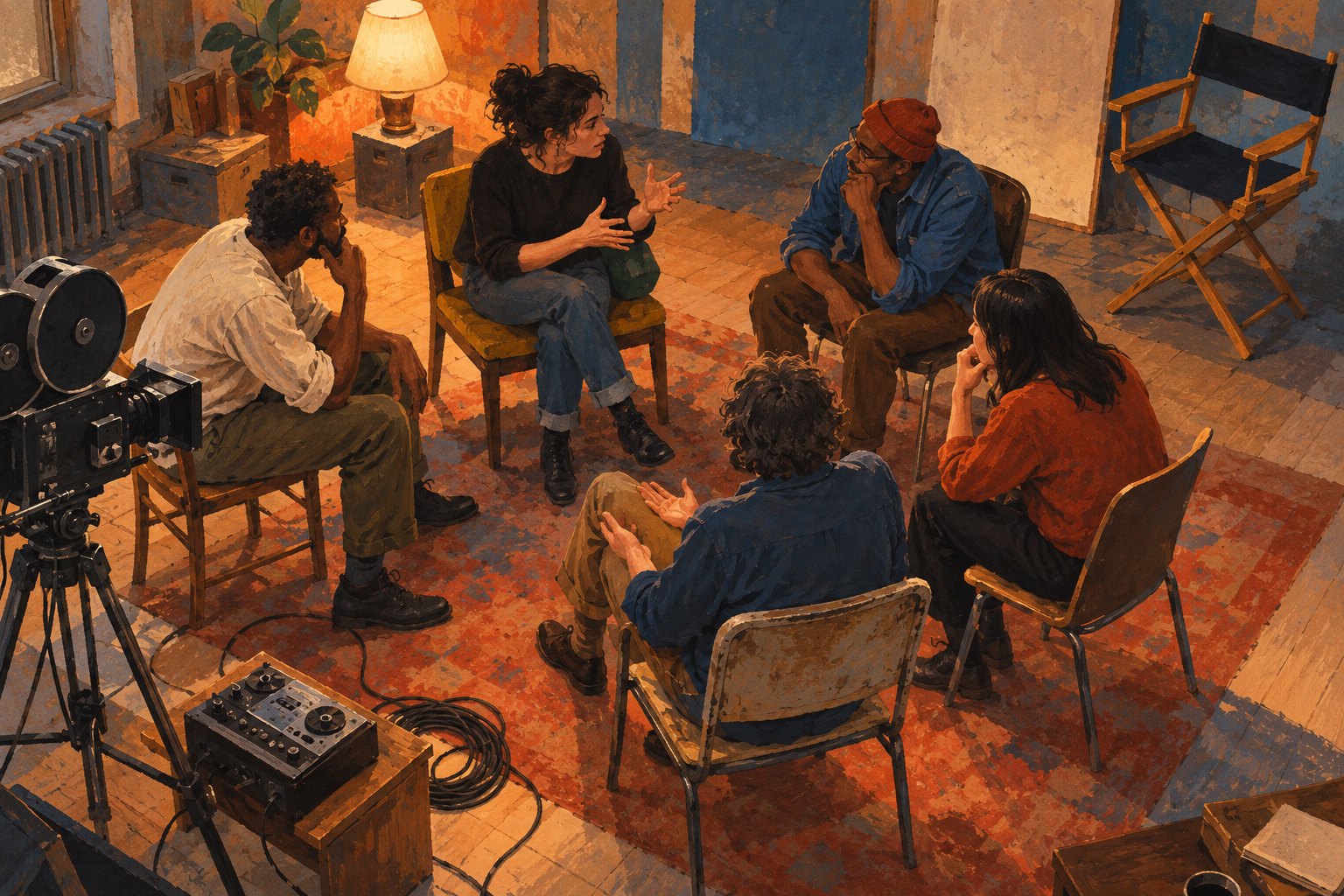
From the crew’s perspective, this is a practical problem before it is a philosophical one. Collaboration requires decisions. If the director withholds the information needed to make them, uncertainty becomes labor that other people must absorb.
That makes their irritation understandable without making their interpretation definitive. A worker can correctly identify a frustrating process and still misunderstand its artistic purpose. Conversely, a director can produce an interesting film without proving that every frustration was necessary. The movie becomes richer when neither side receives an automatic victory.
The recording equipment introduces another complication. Once the crew films its discussion, its members are also presenting themselves: as reasonable colleagues, perceptive critics, or people willing to challenge authority. Their disagreement may be sincere while its expression remains shaped by an audience.
This distinction connects with our discussion of why documentary access does not guarantee understanding. Being allowed to watch a person is only the beginning. We still have to consider what the circumstances encourage that person to reveal.
Greaves plays the person everyone must interpret
Greaves’s on-screen presence gives the film its most stubborn ambiguity. “I represent the establishment,” he says. The statement momentarily makes the production hierarchy explicit: however unconventional the exercise becomes, someone still occupies the position of director.
I read that moment as an invitation to examine authority at close range. The establishment need not appear as a distant institution. It can be the approachable person whose decisions determine what everyone else spends the afternoon doing.
His further remark, “It doesn’t matter whether or not you understand,” sharpens the problem. For a collaborator, understanding can be essential to meaningful participation. For a director pursuing an experiment, explanation might change the behavior being observed. Those interests cannot be reconciled simply by declaring the finished work successful.
The viewer faces a related temptation: to make Greaves either an all-knowing strategist or an inadequate organizer. Both judgments offer relief because they stabilize the situation. The more interesting response is to remain alert to what the film shows without pretending it grants access to every intention behind it.
Why the experiment earns its difficulty
Take One will frustrate viewers seeking steadily developing characters or a resolved relationship story. Its repetitions can be abrasive, and its fascination with its own construction demands patience. Those are meaningful reservations, not evidence that an audience has failed to understand experimental cinema.
For me, the film earns that patience by making spectatorship an active responsibility. Each layer changes the significance of another. An instruction becomes a provocation; a complaint becomes material; a supposedly incidental reaction becomes the thing worth watching. The pleasures are discoveries of relation rather than revelations of plot.
There is a useful connection here to our commentary on what happens when documentary subjects and audiences bring their own authority. A filmmaker’s framing is consequential, but it does not exhaust what other participants can know.
The deeper question behind William Greaves 100
The centennial provides a reason to revisit Greaves; the film provides a reason to keep arguing with him. Its deepest question, in my reading, concerns the difference between permitting disagreement and sharing control. A director can include criticism of his methods while retaining the power to select and arrange that criticism.
That does not make the gesture empty. It makes it incomplete in a revealing way. The finished film preserves a conflict that its own authorship cannot fully resolve. Its lasting force comes from allowing us to see collaboration as both creative possibility and unequal negotiation—and from leaving us responsible for deciding when uncertainty opens a conversation and when it prevents one.
Original content by this site's editorial team. Published: October 26, 2026 at 00:52:06 PDT (Los Angeles time)