
Wicker makes a wonderfully awkward proposition: what if the most considerate husband in the village had to be woven into existence? Its central romance places a lonely Fisherwoman beside a living wicker man, then turns outward to examine the people offended by her happiness. The most compelling idea here is that affection can become socially disruptive simply by exposing how little of it everyone else has accepted.
Spoiler note: This character-focused critical reading discusses the premise, marriage customs, and relationship conflicts described in published coverage. It leaves the ending unrevealed and does not offer a firsthand assessment of the complete film’s performances or visual execution.
The Fisherwoman Wants More Than Permission to Marry
Written and directed by Alex Huston Fischer and Eleanor Wilson, Wicker stars Olivia Colman as the Fisherwoman, Alexander Skarsgård as her unconventional husband, and Peter Dinklage as the craftsman who makes him. The adaptation draws on the short story The Wicker Husband. These credits and its central romantic premise are documented in [Moviefone’s coverage](https://www.moviefone.com/news/movie-review-wicker/).
The Fisherwoman’s situation matters before the magic does. Her neighbors mock her appearance, smell, and unmarried status. Their contempt attaches itself to someone whose work brings her into contact with the physical business of survival. Fish are useful; the woman who catches them is treated as embarrassing. That contradiction gives the fairy-tale setup a recognizable social foundation.
From her perspective, commissioning a husband is an attempt to act inside a world that has already decided what she deserves. She cannot make her neighbors kinder. She can, however, stop waiting for their judgment to change before pursuing companionship.
There is a useful distinction between wanting love and wanting admission to respectable society. Her request can contain both impulses without making her weak or inconsistent. Someone may reject a community’s values while still feeling the injuries it inflicts. Defiance does not erase the wish to be welcomed.
This is where the premise becomes emotionally substantial. A conventional makeover would imply that the Fisherwoman must become acceptable before she can become desirable. A husband made from woven material redirects the question toward the assumptions of everyone looking at the couple.
A Wedding Collar Makes the Village’s Values Visible
An early wedding includes a metal collar placed around the bride’s neck. [The Atlantic’s discussion of the film](https://www.theatlantic.com/culture/2026/10/wicker-movie-marriage-olivia-colman/689122/) identifies this ritual as part of the village’s understanding of marriage. It is a blunt image, but bluntness has a purpose in a fable: an institution’s concealed demands become an object someone must physically wear.
Read through the Fisherwoman’s position, the collar makes the promise of inclusion troubling. Marriage offers status while visibly assigning a burden. Being excluded hurts, yet entry into the approved arrangement comes with its own loss of freedom.
My reading is that the film’s strongest thematic question sits in that tension. Can she seek partnership without accepting the village’s definition of a wife? The invented husband opens a space in which an apparently settled custom can be reconsidered.
Domestic spaces often reveal the beliefs that their occupants would rather leave unspoken. Our analysis of the family home in Poltergeist approaches that idea through fear. Here, marriage provides another way to ask whether a familiar arrangement actually protects the people inside it.
The Wicker Husband Makes Ordinary Care Look Extraordinary
The husband’s appeal rests on more than his unusual body. Published accounts describe affection, practical help, and a willingness to speak tenderly. Two brief lines reported in [Movie Nation’s review](https://rogersmovienation.com/2026/10/30/movie-review-a-wicker-skarsgard-is-catnip-to-the-ladies-in-this-sex-farce-fable-from-jolly-olde/) express his gratitude: “You’re the reason I live and breathe” and “Without you I would never have seen the sun set on the ocean.”
The first declaration carries a literal complication. The Fisherwoman’s request caused his existence. The second shifts attention toward an experience that existence has made possible. Together, the lines invite a question that matters beyond the fantasy: does love mean owing someone your life, or sharing a life that has become your own?
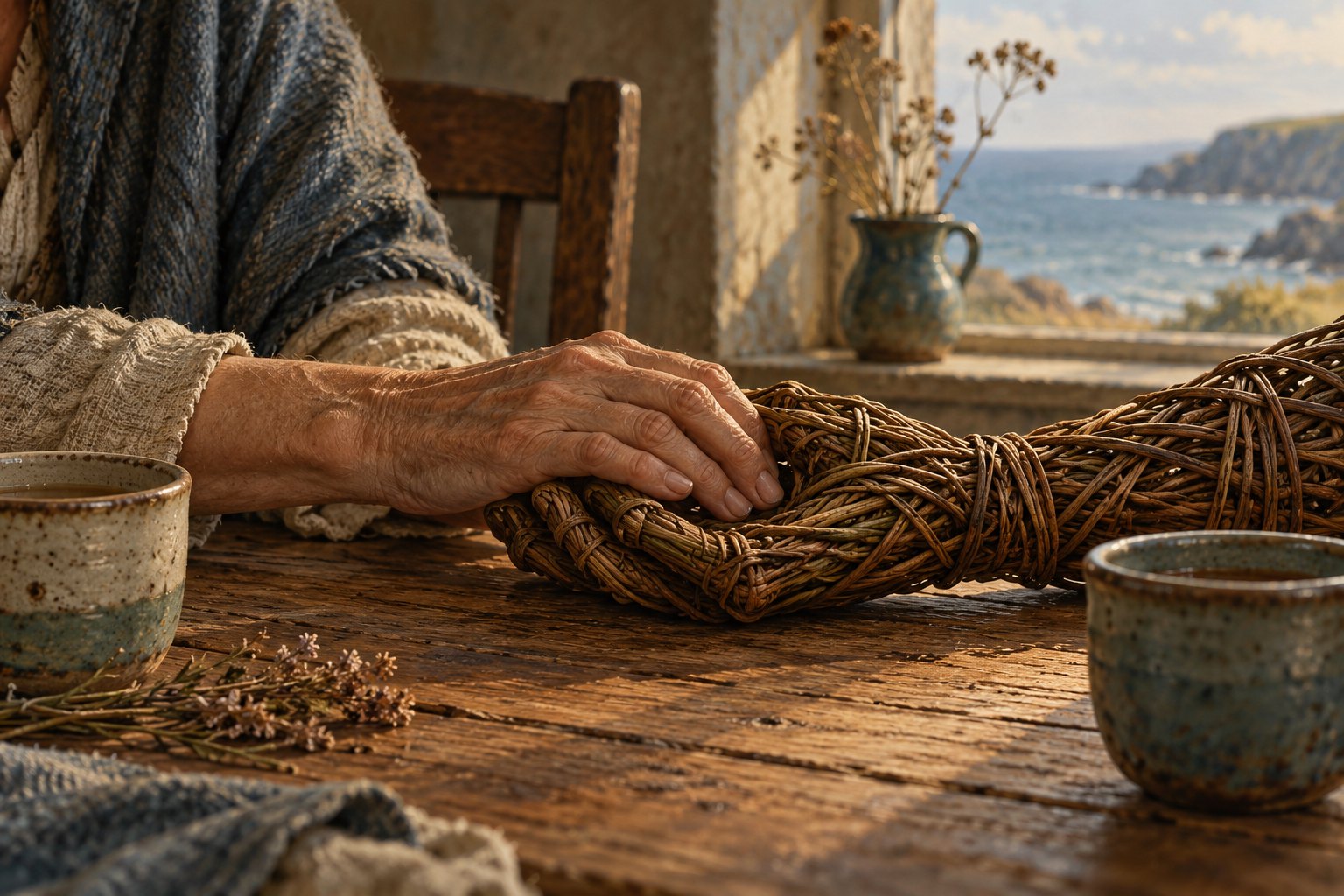
For the Fisherwoman, tenderness challenges an expectation built through repeated humiliation. Being treated well may be unfamiliar enough to feel precarious. For the husband, the interpretive challenge runs in the other direction: a being created to provide companionship must still be understood as someone capable of participating in it.
That is the premise’s most productive discomfort. A perfect partner can become an object in the imagination of the person seeking perfection. The romance gains meaning when we ask what the husband experiences, rather than measuring him only by how effectively he meets another person’s needs.
Why the Neighbors Cannot Leave Happiness Alone
Elizabeth Debicki’s Tailor’s Wife belongs to the social world that polices the Fisherwoman’s place. Coverage describes jealousy and gossip surrounding the new marriage; the community’s response is central to the conflict, rather than incidental background.
From the neighbors’ perspective, the couple creates an unwelcome comparison. If someone they dismissed can receive attentive affection, their own status no longer guarantees that they have made the better bargain. The Fisherwoman’s pleasure becomes evidence they would prefer not to examine.
This gives gossip a specific function. It can move attention away from an uncomfortable comparison and toward the supposed impropriety of the people causing it. Instead of asking why their own relationships disappoint them, the villagers can question whether this relationship should exist.
The women’s dissatisfaction also deserves consideration without excusing their cruelty. People with limited power may defend the small distinctions that let them feel superior to someone else. The Fisherwoman’s happiness threatens those distinctions. A useful character reading holds both truths together: their resentment has a social context, and they remain responsible for where they direct it.
Where the Fantasy Becomes Most Challenging
For me, Wicker is most interesting as a question about reciprocity. The easy appeal is a partner who offers everything an injured person has been denied. The harder question concerns what that person must learn to offer in return.
This is also a useful standard for judging the story’s dramatic depth. Does the husband’s difference allow him an independent perspective? Does the Fisherwoman’s vulnerability complicate her choices? Do the villagers reveal distinct motives, or merely repeat the same objection? Those questions distinguish an engaging premise from fully developed characterization, a concern also explored in our commentary on why character and consequence matter in original movies.
The Deeper Meaning: Affection Without Ownership
The contrast between a collared bride and a constructed husband gives the story an unsettling symmetry. One person enters marriage through a ritual of possession; another enters life through a commission. Both situations raise the possibility that intimacy can conceal a claim of ownership.
My interpretation is that the most valuable question in Wicker is therefore larger than whether the Fisherwoman deserves happiness. She does. The question is what kind of relationship allows both partners to remain people, even when one has been treated as an outcast and the other has literally been made.
Its woven husband turns an ordinary ethical demand into something strange enough to notice: care should recognize another person’s freedom. The village may judge a marriage by its approved shape. A more demanding judgment asks whether the people within it can be vulnerable, valued, and free.
Original content by this site's editorial team. Published: October 29, 2026 at 23:51:10 PDT (Los Angeles time)