Wicker began with Ursula Wills’s short story The Wicker Husband, which spent years online before finding its way to the screen. That unusual route helps explain the film’s appeal: beneath Olivia Colman, Alexander Skarsgård, and an extravagantly improbable romance sits a compact storytelling idea. A woman commissions a husband. He becomes someone whose existence changes the people around him.
Rebecca Onion’s Slate interview with Wills traces that journey from an obscure online home to a feature film. Written and directed by Eleanor Wilson and Alex Huston Fischer, the adaptation turns the tale into an adult romantic comedy about an ostracized Fisherwoman, a Basketmaker, and the extraordinary companion he constructs. The interesting critical question is how such a small narrative can expand without losing its shape.
Spoiler note: This analysis discusses the premise, wedding imagery, intimate comedy, and character tensions. It does not reveal the resolution.
A short story with room for actors
The appeal of adapting a short story is often described as freedom: fewer pages to compress, more space to invent. But freedom alone does not supply a dramatic structure. Here, the central transaction already contains several competing expectations. The Fisherwoman wants companionship. The Basketmaker must produce something impossible. The resulting husband enters a community that has opinions about both his maker and his wife.
Speaking to The Projection Booth, Wilson and Fischer explained that a producer brought them Wills’s story and that its fable structure gave them a strong foundation. Their curiosity also had a specifically cinematic dimension: what would this husband actually look like?
That distinction matters. A reader can accept a woven man in a sentence. A film must give him weight, movement, a voice, and a convincing relationship with another body. Adaptation becomes an act of interpretation before anyone changes the plot. Every choice about his appearance also suggests how viewers should understand him.
Our discussion of the character challenge in adapting Mouthwashing considers a related problem: carrying events into another medium does not automatically preserve the audience’s relationship with the people experiencing them.
The Fisherwoman’s request is only the beginning
Colman’s Fisherwoman commissions her companion from the Basketmaker, played by Peter Dinklage. Taken literally, the request sounds like the perfect shortcut around romantic disappointment. She can seek a partner without first persuading the village to recognize her as someone worth choosing.
Yet a commission is an awkward foundation for intimacy. Objects can be specified; people can surprise us. The premise therefore contains a tension that a feature film can keep revisiting: does she want a husband who fulfills a purpose, or a person with whom she must build a relationship?
The difference becomes especially clear in the wedding imagery. The film’s village uses collars as part of marriage, turning an institution into a visible arrangement of possession. The Fisherwoman declines hers: “We won’t be needing that.” It is a small sentence with a substantial implication. She intends to participate in marriage while refusing one of its governing assumptions.
From her perspective, that refusal is a declaration of possibility. From a storytelling perspective, it sets a standard against which her later behavior can be measured. Announcing a different kind of relationship is easier than sustaining one when insecurity arrives.
Why the husband needs a physical presence
Skarsgård’s Wicker Husband makes the adaptation’s central problem visible. His body must remain unmistakably constructed while allowing the audience to register attention, tenderness, and vulnerability.
The filmmakers described working with Wētā Workshop on practical prosthetics, with visual effects supporting details such as hollowness. Their account emphasizes the value of Colman and Skarsgård being physically present together. The romantic encounter could develop between performers sharing the same space.
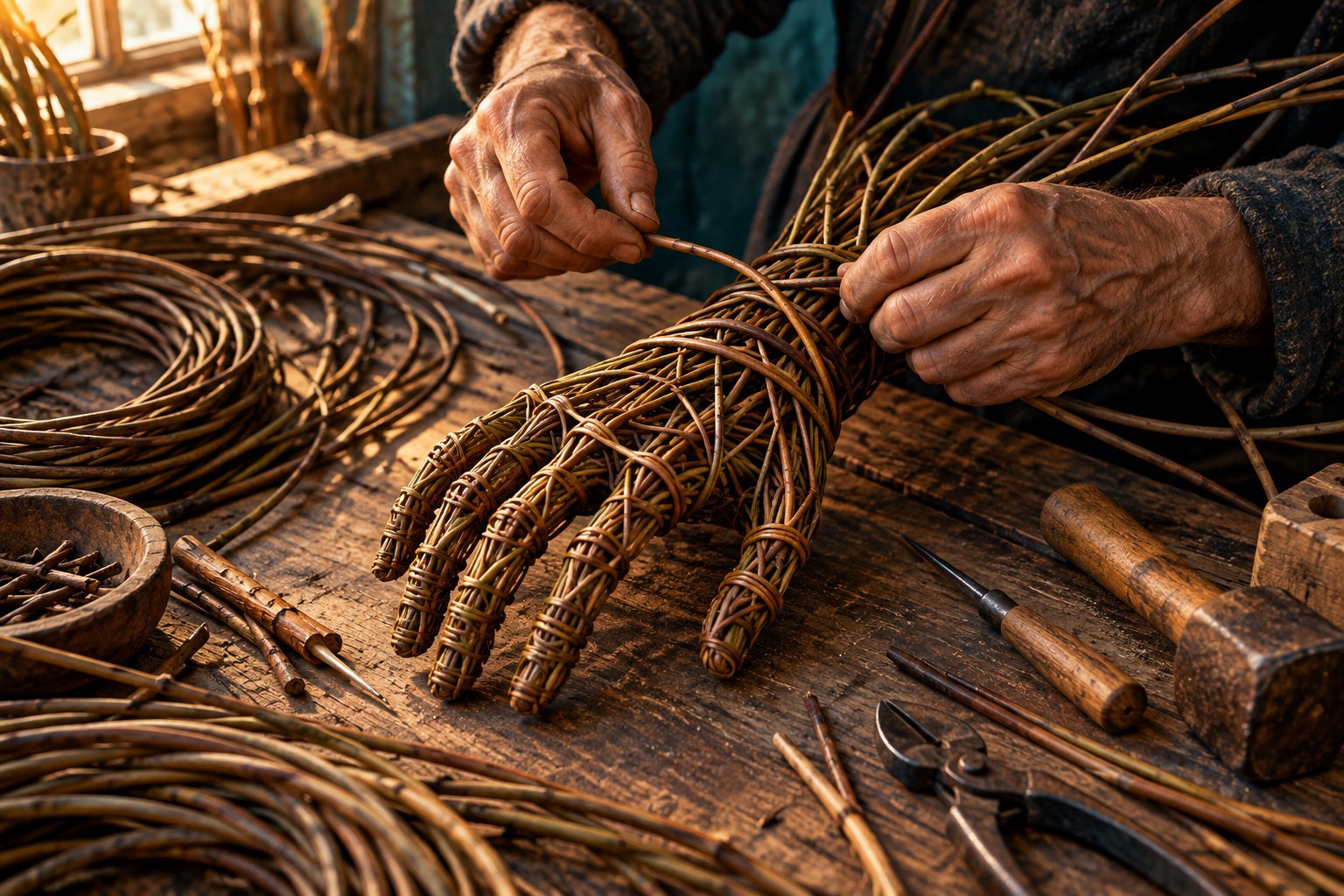
My reading is that the visible construction gives the romance its most productive contradiction. We can recognize something made for use and still respond to it as a being capable of feeling. The film asks viewers to make that adjustment before asking its characters to do the same.
This also gives the short story’s transformation a pleasing material echo. A writer creates a person through language; artisans and an actor create a screen presence through physical work. Neither process is complete until an audience grants that presence an interior life.
A broken bed and the meaning of usefulness
One of the film’s clearest comic exchanges follows the couple’s exuberant intimacy. The husband responds to the damage with practical directness: “This bed is broken. Bring me a hammer. I will fix it.”
The joke depends on how little performance of masculinity the statement contains. He notices a problem and offers a solution. There is no elaborate self-congratulation. The line also brings the fantasy back to household scale: even an impossible romance produces ordinary maintenance.
That makes usefulness an appealing quality, but also a potentially limiting definition of a partner. A good husband may repair things, listen, and offer comfort. If those services become the entire basis of his value, however, the person disappears behind the job description.
For me, this is where the film’s premise becomes more interesting than a wish for the perfect man. A partner who is literally manufactured makes it unusually difficult to ignore the distinction between receiving care and assuming ownership of the caregiver.
Giving the village more than a moral function
In their interview with Nell Minow, the directors described expanding the short story’s archetypal figures through psychology and individual behavior. Elizabeth Debicki’s Tailor’s Wife is particularly important to that approach. They wanted her conduct to be understandable without making it admirable.
This is an essential adaptation choice. In a brief fable, a jealous neighbor can efficiently embody envy. Over a feature’s running time, the same figure needs a relationship to her own disappointment. Otherwise, every appearance simply repeats the lesson.
Understanding her resentment does not require excusing it. Instead, it allows the village’s opposition to emerge from frustrated lives. Someone else’s happiness can expose a compromise that previously felt unavoidable. The disturbing response is to attack the evidence rather than reconsider the compromise.
Our earlier examination of desire and exclusion in Wicker explores the couple’s position within that community. The adaptation question goes further: how much individuality can the film give its antagonists while preserving the clarity of a fable?
The deeper question: can a creation belong to itself?
The most compelling interpretation of Wicker begins with a shift in emphasis. The Fisherwoman’s original problem is loneliness. The relationship introduces another problem: accepting that someone who makes her happy cannot simply become her possession.
That is why the story’s online beginnings deserve more than a novelty paragraph. Wills supplied a premise capable of generating different questions as it moved into performance. A made-to-order spouse starts as an absurd solution and becomes a test of what the person placing the order actually understands about love.
My judgment is that this tension provides the strongest reason to take the film seriously beneath its bawdy comedy. The woven body is funny; the emotional obligation it creates is demanding. To recognize a person inside something manufactured is to accept that creation does not confer unlimited authority. The romance matters most when the husband can be understood as someone to know, rather than something to have.
Original content by this site's editorial team. Published: October 30, 2026 at 13:00:07 PDT (Los Angeles time)