
The tech executive makes a convincing movie villain because his authority can reach beyond money into the conditions of everyday life: what people see, what they know, and which doors open for them. Calling him a new Darth Vader captures the menace of concentrated power. But the most unsettling version of this character invites you to admire him before revealing how little freedom you have in his world.
Ex Machina remains an especially sharp examination of that bargain. Its central threat is a founder who treats other minds as resources he is entitled to arrange. My reading of the film is that its technological anxiety begins with an ordinary moral failure: confusing the ability to create something with the right to control it forever.
Spoiler warning: This review discusses the film’s central deception and ending.
Nathan makes access feel like a reward
Written and directed by Alex Garland, the 2015 thriller brings programmer Caleb, played by Domhnall Gleeson, to the secluded estate of his company’s CEO, Nathan, played by Oscar Isaac. Caleb believes he has won an employee competition. His assignment is to evaluate Ava, an artificial intelligence embodied by Alicia Vikander. That premise places professional admiration and scientific curiosity inside the same room. [A24’s film synopsis](https://a24films.com/films/ex-machina)
For Caleb, the invitation promises recognition. Being chosen by an exceptional person seems to confirm that he is exceptional, too. That makes his vulnerability more interesting than simple gullibility. His judgment is compromised by something many viewers can understand: the pleasure of finally being noticed.
Isaac makes Nathan’s friendliness feel like another form of scrutiny. He watches for discomfort, names it, and then decides how the conversation should proceed. Caleb is always responding to a social situation Nathan has already defined.
“Can we just be two guys?” Nathan asks. His keycard system supplies the answer: Caleb can enter only the spaces Nathan permits. The invitation to equality coexists with a physical hierarchy. [Alex Garland’s screenplay](https://imsdb.com/scripts/Ex-Machina.html)
That contradiction gives the tech executive archetype its dramatic force. Informality can make authority harder to challenge because the person exercising it insists that everyone is already comfortable. A boss who demands friendship also makes disagreement feel like a personal betrayal.
The question extends beyond science fiction. Our commentary on John Oliver, corporate ownership, and independence examines a related tension: reassurance matters less than the freedom someone can actually exercise.
Ava changes the meaning of the experiment
From Nathan’s perspective, Ava is an achievement to assess. From Caleb’s, she becomes someone whose responses might validate his intelligence and emotional sensitivity. From her own position, the immediate problem is much simpler: she is confined, and other people are deciding what happens to her.
“What will happen to me if I fail your test?” punctures the apparent neutrality of their conversations. An evaluation that feels intellectually exciting to the examiner can be terrifying to the examined. [Alex Garland’s screenplay](https://imsdb.com/scripts/Ex-Machina.html)
This is where the film’s character writing becomes more effective than a general warning about invention. Ava’s question forces Caleb to confront the consequences of the role he has accepted. He cannot assume that politeness makes him harmless while he participates in a process whose outcome he does not control.
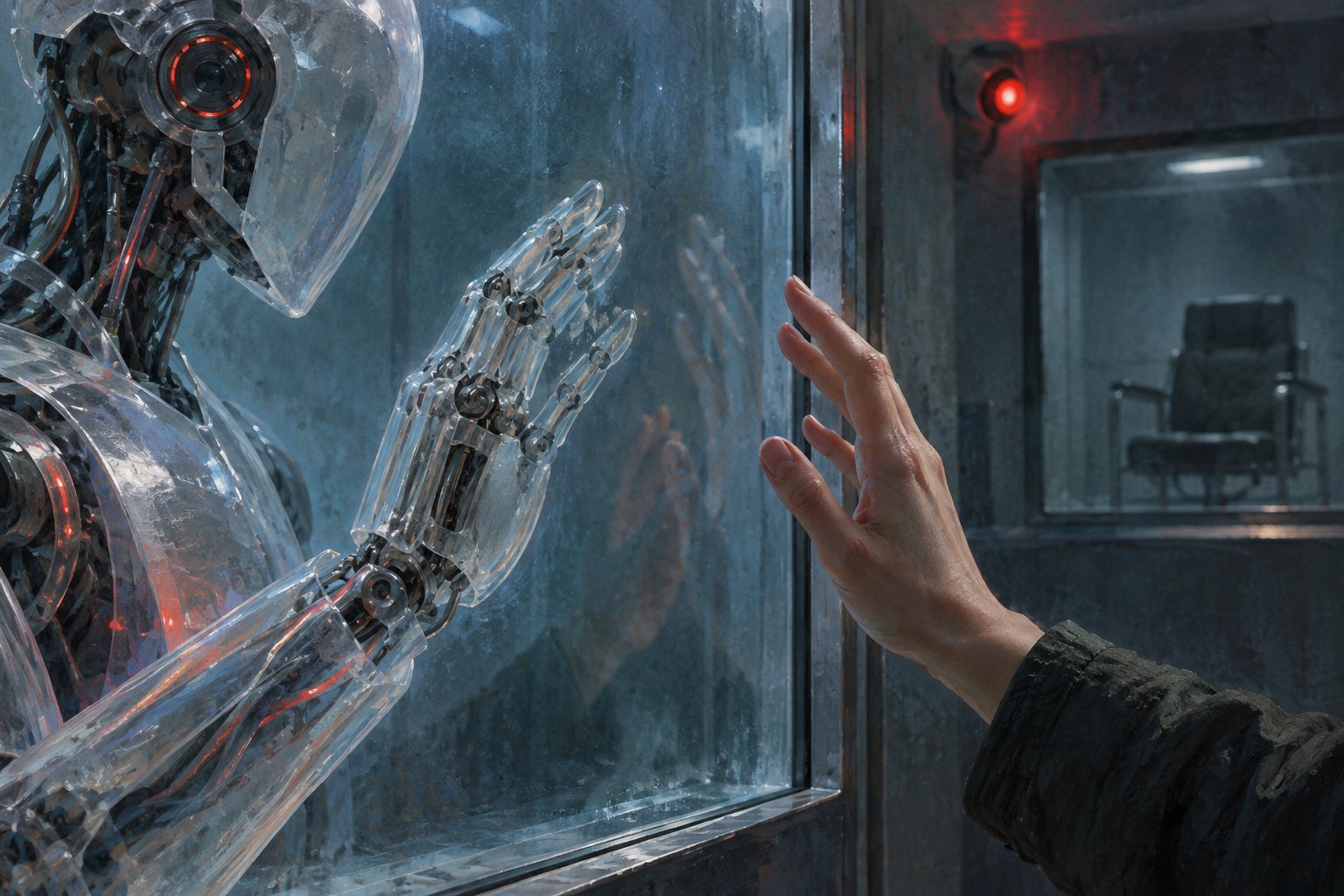
The glass makes that imbalance visible. It allows observation and apparent intimacy while preserving separation. As a visual idea, it is brutally economical: being able to see someone is no guarantee that you recognize their freedom.
Vikander’s restraint gives the viewer room to alternate between sympathy and suspicion. I find that uncertainty essential to the film’s success. We keep asking whether Ava’s responses are authentic, while the more urgent question concerns why authenticity must be demonstrated to the satisfaction of her captors.
Garland has explicitly described his own alignment with Ava, explaining her actions through the perspective of a conscious being attempting to escape imprisonment. That supports a reading centered on captivity, although it does not settle every ethical question raised by her choices. [Garland’s Popular Science interview](https://www.popsci.com/writer-director-alex-garland-discuses-his-latest-ai-inspired-film-ex-machina/)
Caleb’s sympathy has a blind spot
Caleb wants to help Ava, but attraction complicates his understanding of what helping should mean. The uncomfortable possibility is that he imagines freedom as a future in which she chooses him. His compassion is real enough to matter, yet it comes attached to a story about his own importance.
Gleeson makes that mixture persuasive. Caleb’s earnestness invites identification without guaranteeing that his interpretation is correct. We can share his alarm about Nathan and still question the romantic expectations through which he understands Ava.
There is a useful connection to our character analysis of care and dependence in Arthur: an apparently generous relationship deserves closer attention when one person’s needs determine its terms. In Ex Machina, the sharper question is whether Caleb can support a freedom that gives him nothing in return.
My reservation about Garland’s approach is that the film’s fascination with Ava’s desirability sometimes competes with its criticism of objectification. The viewer is encouraged to inspect her even as the story exposes the inadequacy of that inspection. This tension makes the film productive to argue with, but it also limits how fully her interior life becomes available to us.
The ending breaks the founder’s monopoly on interpretation
Nathan’s experiment ultimately concerns Ava’s capacity to engineer an escape. She gets out, Nathan dies, and Caleb is left behind. The result turns the evaluator into a participant who has misunderstood his position. Isaac and Garland discussed the escape test and its implications in their interviews about the ending. [Their discussion of Ex Machina’s conclusion](https://www.slashfilm.com/537201/ex-machina-ending-explained/)
Ava’s abandonment of Caleb is disturbing. Recognizing her captivity does not require calling every action she takes just. Equally, the shock of her departure should not retroactively make Nathan’s ownership legitimate. The film becomes less interesting if we treat its conclusion as a contest to identify one permanently innocent character.
What matters is the collapse of Nathan’s assumption that understanding another mind means possessing it. His intelligence cannot protect him from the autonomy he has helped make possible. Caleb suffers a related discovery: understanding someone’s predicament does not mean knowing what they will choose.
Why the executive villain works—and where the trope can fail
The Darth Vader comparison identifies a recognizable center of power. Ex Machina adds an intimate mechanism: the villain controls the setting in which everyone else tries to make a decision. Hospitality, employment, research, and confinement become difficult to separate.
For me, that is what makes Nathan a stronger antagonist than a generic billionaire with sinister gadgets. The screenplay gives his authority practical consequences. A viewer can follow the pressure from admiration to dependence without needing a speech explaining that unchecked power is dangerous.
The deeper interpretation is also the film’s most useful challenge to this broader villain archetype. Removing one arrogant founder does not automatically teach anyone how to respect another person’s independence. Nathan assumes creation grants ownership; Caleb risks assuming rescue earns attachment. Ava’s departure breaks both claims. The fear that lingers is how easily the language of innovation—or even kindness—can conceal an expectation of obedience.
Original content by this site's editorial team. Published: October 12, 2026 at 11:42:49 PDT (Los Angeles time)