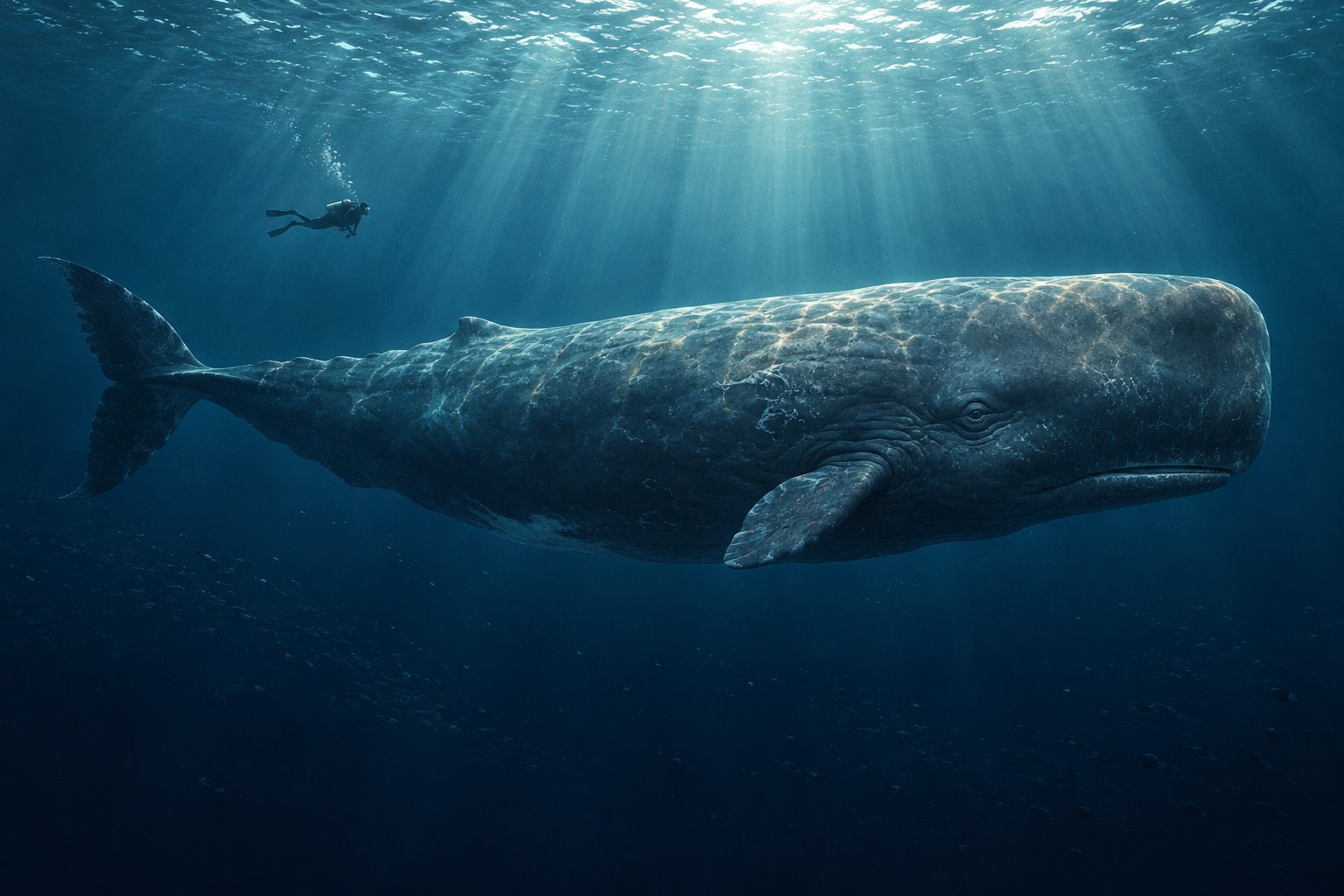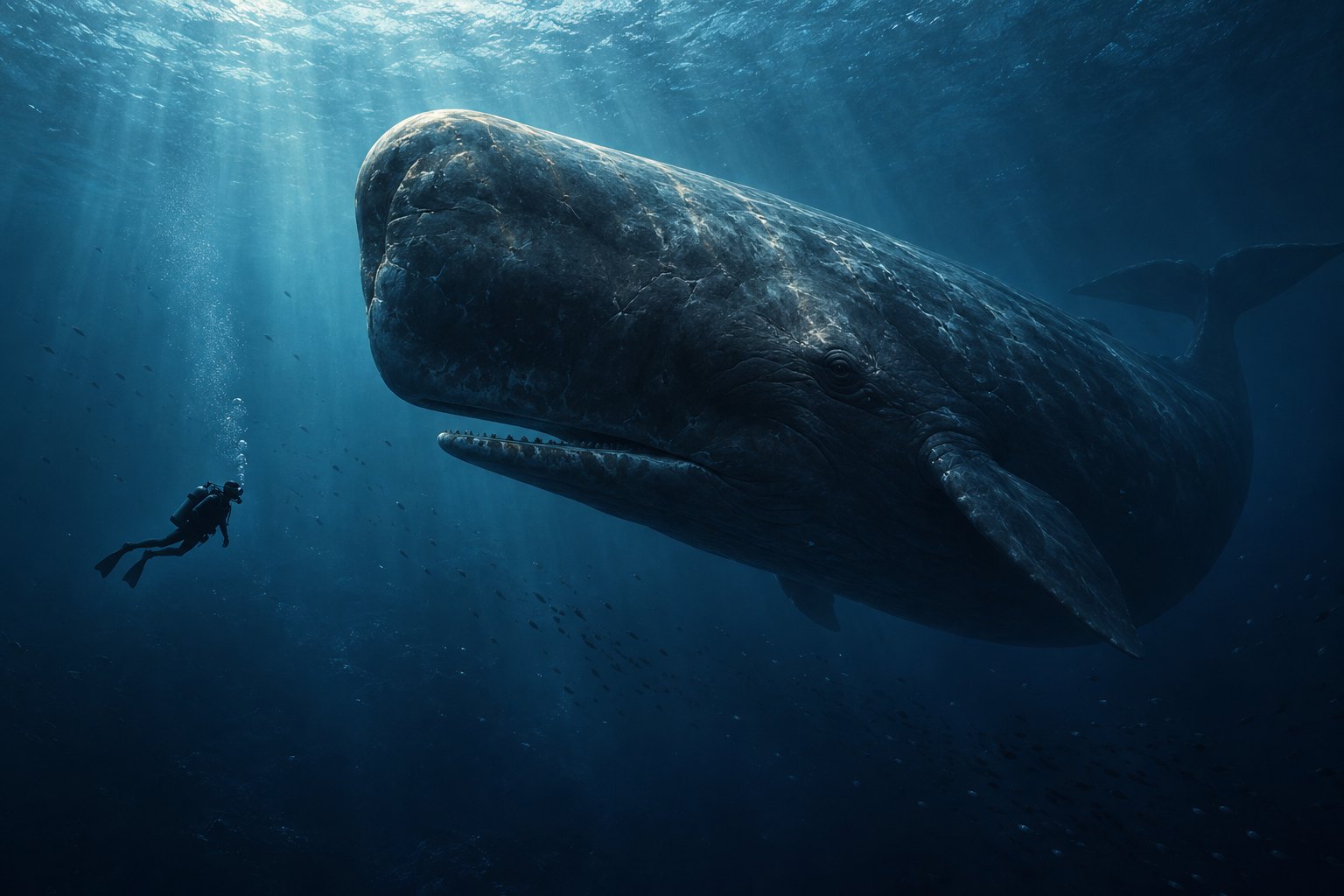
Whalefall gives its protagonist an extraordinary problem: survive inside a sperm whale. But the species matters as much as the spectacle. The animal’s feeding apparatus gives the premise a biological foothold, while its overwhelming size supplies a potent image for a young man struggling with his father’s influence. My reading of that combination is that the story’s strongest idea lies in the connection between understanding an unfamiliar environment and reconsidering familiar emotional wounds.
Spoiler note: This analysis discusses the advertised premise, family themes, and brief dialogue reported in published criticism. It does not reveal the ending or offer a firsthand assessment of the finished film.
Jay Gardiner enters the water looking backward
According to the official synopsis, Jay Gardiner, played by Austin Abrams, dives off California’s central coast to search for his deceased father’s remains. A sperm whale swallows him, leaving him with an hour’s oxygen supply. Lessons from his father, played by Josh Brolin, may help him escape. Brian Duffield directs and shares screenplay credit with novelist Daniel Kraus; the studio lists October 16, 2026, as the theatrical release date. [Official film information](https://www.20thcenturystudios.com/movies/whalefall).
That starting point makes the survival question unusually personal. Jay begins with a task directed toward someone who can no longer answer him. Recovering remains offers a concrete objective where grief offers few clear instructions. Then the emergency abruptly reverses his priorities: the person whose body needs saving is now Jay himself.
To me, this is the premise’s sharpest dramatic turn. Searching for a parent can suggest duty, longing, guilt, or an attempt to complete unfinished business. Fighting to remain alive demands a different kind of attention. The tension between those impulses gives the whale encounter emotional significance before any interpretation of the ending becomes necessary.
Why this story needs a sperm whale
Smithsonian’s reporting distinguishes a whale taking someone into its mouth from actually swallowing that person. Baleen whales filter food; sperm whales are toothed predators equipped to consume substantial prey. Curator Nick Pyenson explains that their teeth primarily hold food rather than chew it, and that suction plays a role in feeding. Kraus describes Jay becoming entangled with a squid and being drawn in with the animal’s prey. The scenario remains highly unlikely, rather than an ordinary danger of encountering whales. [Smithsonian’s examination of the premise](https://www.smithsonianmag.com/smithsonian-institution/in-the-new-movie-whalefall-a-cetacean-swallows-a-diver-whole-the-sperm-whales-remarkable-anatomy-and-feeding-habits-shape-the-survival-thriller-180989700/).
The critical distinction is between anatomical possibility and demonstrated survivability. Selecting a species capable of swallowing large prey does not establish that a human could endure every stage of the film’s ordeal. It gives the fiction a starting constraint, not a scientific certificate for the entire adventure.
As a storytelling choice, accidental ingestion is more interesting than calculated pursuit. A malicious creature would supply a recognizable opponent. An animal feeding introduces a colder possibility: Jay’s catastrophe need not be meaningful to the creature causing it. His fear can be immense without the whale possessing any corresponding hatred.
That distinction changes how we interpret the struggle. The question becomes how a person can understand a living environment quickly enough to act within it. Nature does not need a motive, a grudge, or a final confrontation to become frightening.
A father’s knowledge can help without settling everything
The official premise makes paternal instruction part of Jay’s survival resources. This creates a difficult emotional proposition: knowledge can remain useful even when a relationship resists a comforting explanation. Learning something valuable from a parent does not automatically resolve every feeling attached to the lesson.
Published criticism quotes Mitt declaring, Steinbeck is God and There’s more to life than fun! [Reported dialogue](https://www.thedailybeast.com/obsessed/whalefall-this-insane-new-movie-takes-place-inside-a-whalefor-real).
The first declaration interests me because it turns admiration into an absolute. In isolation, it sounds like someone naming an authority rather than inviting a conversation. The second line contains advice that could be reasonable in one context and oppressive in another. Responsibility matters; so does the freedom to discover what makes life worth living.
For Jay, the meaningful distinction is between using a lesson and accepting an entire worldview. Remembering what his father taught him can become an act of judgment. He can decide what helps in the present instead of treating inheritance as an instruction to reproduce someone else’s life.
This is where character analysis should resist an easy equation between competence and good parenting. A survival story can demonstrate that training works without proving that every method used to deliver it was justified. My measure of the emotional argument would be whether it leaves room for gratitude and injury to coexist.
That question also connects with our analysis of care, control, and rejection in Bride of Frankenstein: an unequal relationship becomes more revealing when the dependent person’s perspective retains its own authority.
The oxygen limit makes attention a dramatic resource
An hour of oxygen establishes a clear limit that audiences can grasp immediately. It also makes time spent remembering potentially complicated. Memory might supply essential knowledge, but the body remains in immediate danger. The most compelling version of this structure makes reflection change a decision rather than merely interrupt an emergency.
That is a useful lens for watching Whalefall: ask what Jay understands differently after an encounter with his past. Does recollection provide a practical idea, alter his judgment, or expose an assumption? Those changes would make the father-son story part of the survival action itself.
The premise therefore invites two kinds of suspense. One concerns what Jay can physically do. The other concerns whether he can interpret what he already knows. I find the second especially promising because it allows resourcefulness to involve emotional independence as well as technical skill.
What the title adds to the father-son story
A whale fall is the remains of a whale that sink to the seafloor and support deep-sea life. NOAA describes how the carcass feeds successive communities, with the skeleton potentially sustaining organisms for years or decades. Death becomes a material source of continued life. [NOAA’s whale-fall explanation](https://oceanservice.noaa.gov/facts/whale-fall.html).
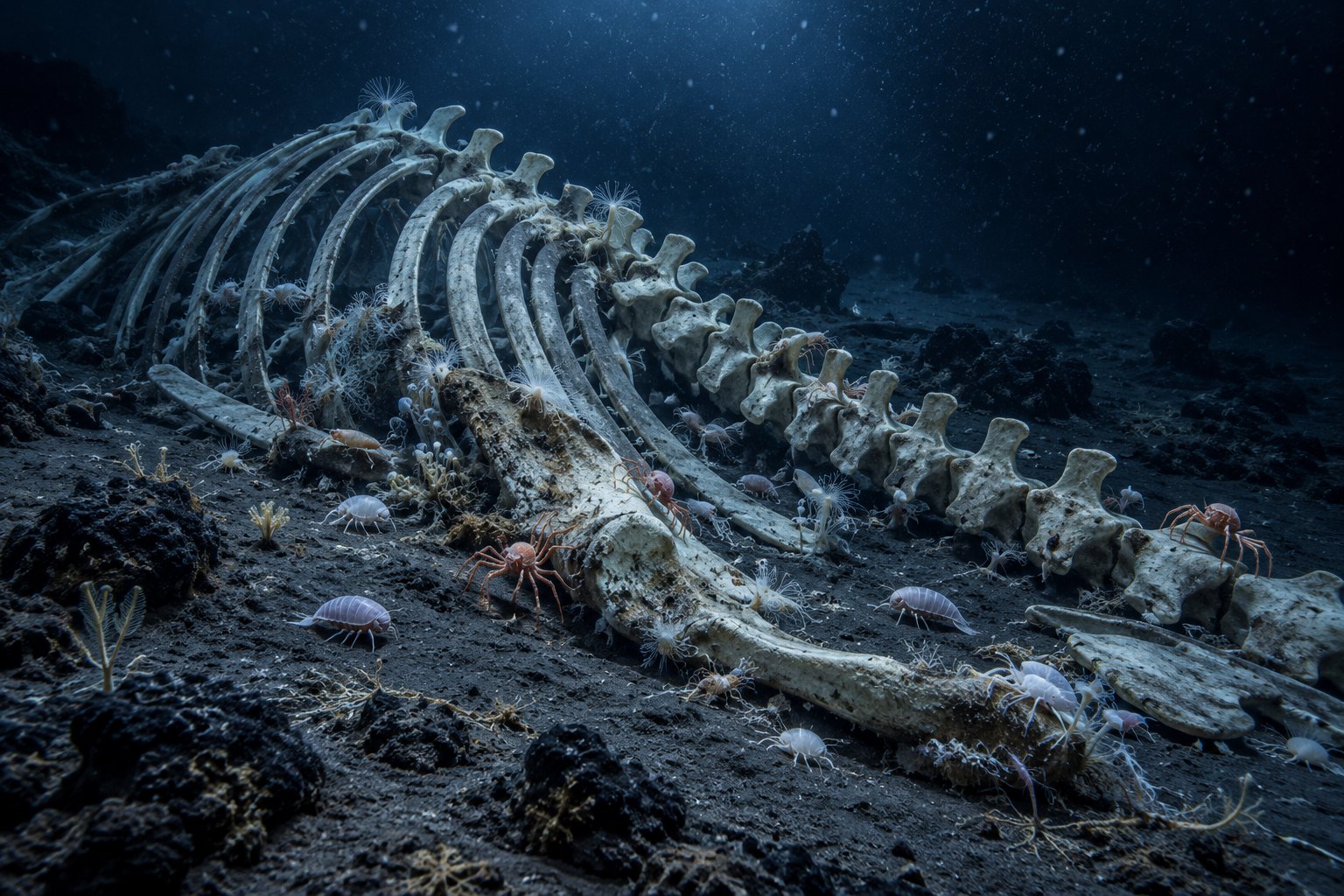
Applied to Jay’s situation, that ecological process suggests a richer idea of inheritance than simple reconciliation. A person’s influence can continue in fragments: a skill, a reflex, a phrase, an unresolved argument. The survivor must decide how those fragments participate in a life that continues beyond the relationship.
Readers interested in grief expressed through genre storytelling may also find a useful companion in our discussion of bereavement and investigation in The Changeling. Both premises invite attention to what a grieving protagonist does with pain, rather than treating sorrow as background decoration.
My deeper reading of Whalefall begins with that distinction. Surviving a parent means more than living after their death. It can mean finding a way to carry their influence without surrendering the right to change it. The whale supplies the immediate prison; the father-son premise asks what freedom might require once survival becomes possible.
Original content by this site's editorial team. Published: October 17, 2026 at 01:38:44 PDT (Los Angeles time)