Whalefall puts Austin Abrams inside a whale and builds a survival thriller around his struggle to escape. The premise practically invites disbelief. Yet it also contains a compelling dramatic question: what does determination mean when a person has almost no control over the conditions determining whether he lives?
My reading of that premise centers on vulnerability. A trapped human being does not become interesting simply because his surroundings are extraordinary. He becomes interesting because his desire to survive must operate within limits that desire alone cannot remove. That distinction gives this outlandish setup something worth examining beyond its shock value.
Scope and spoilers: This is a critical interpretation of the established premise, rather than a firsthand, scene-by-scene review. It discusses the central predicament without describing the ending. Specific escape maneuvers, unverified dialogue, and claims about hidden references are excluded.
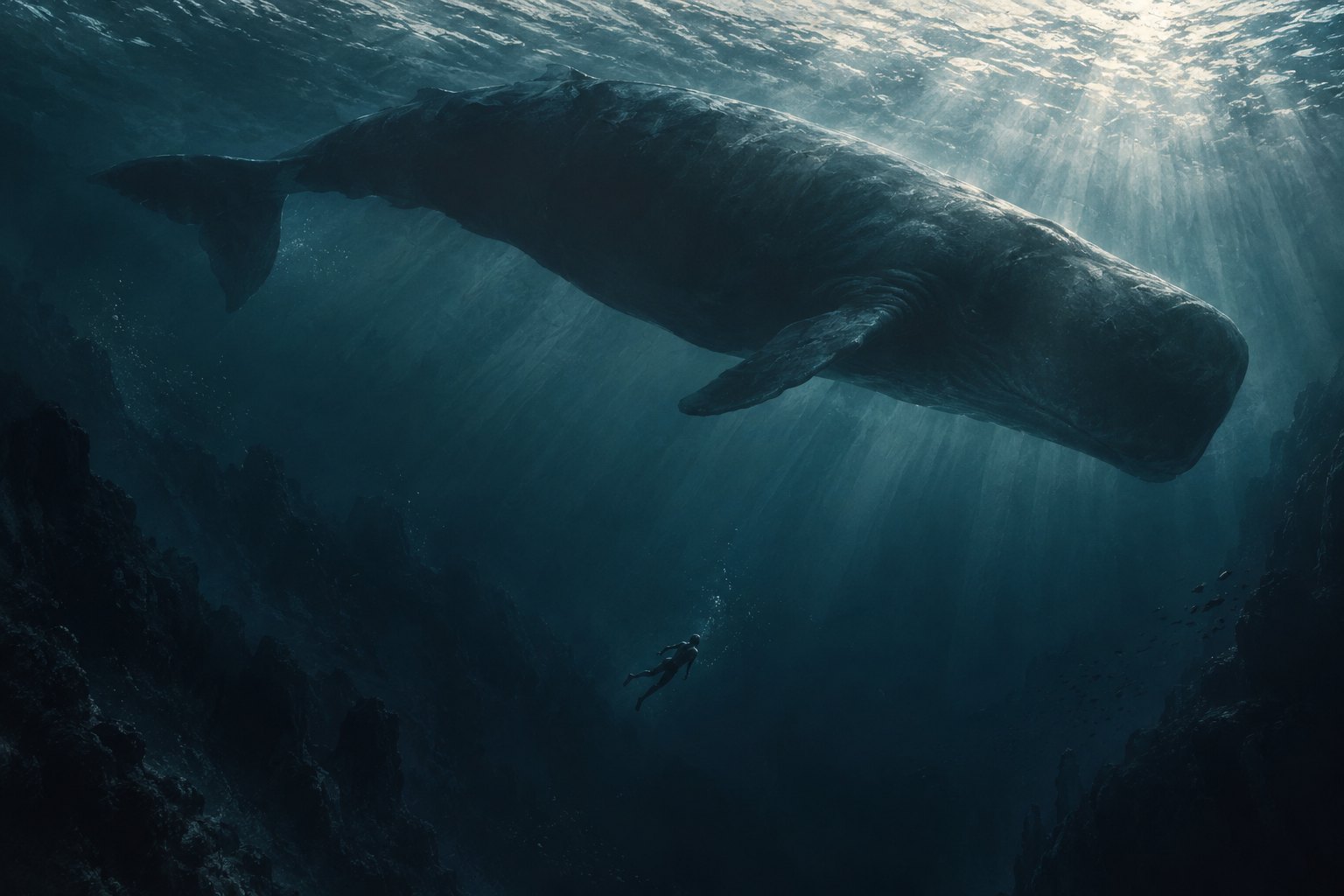
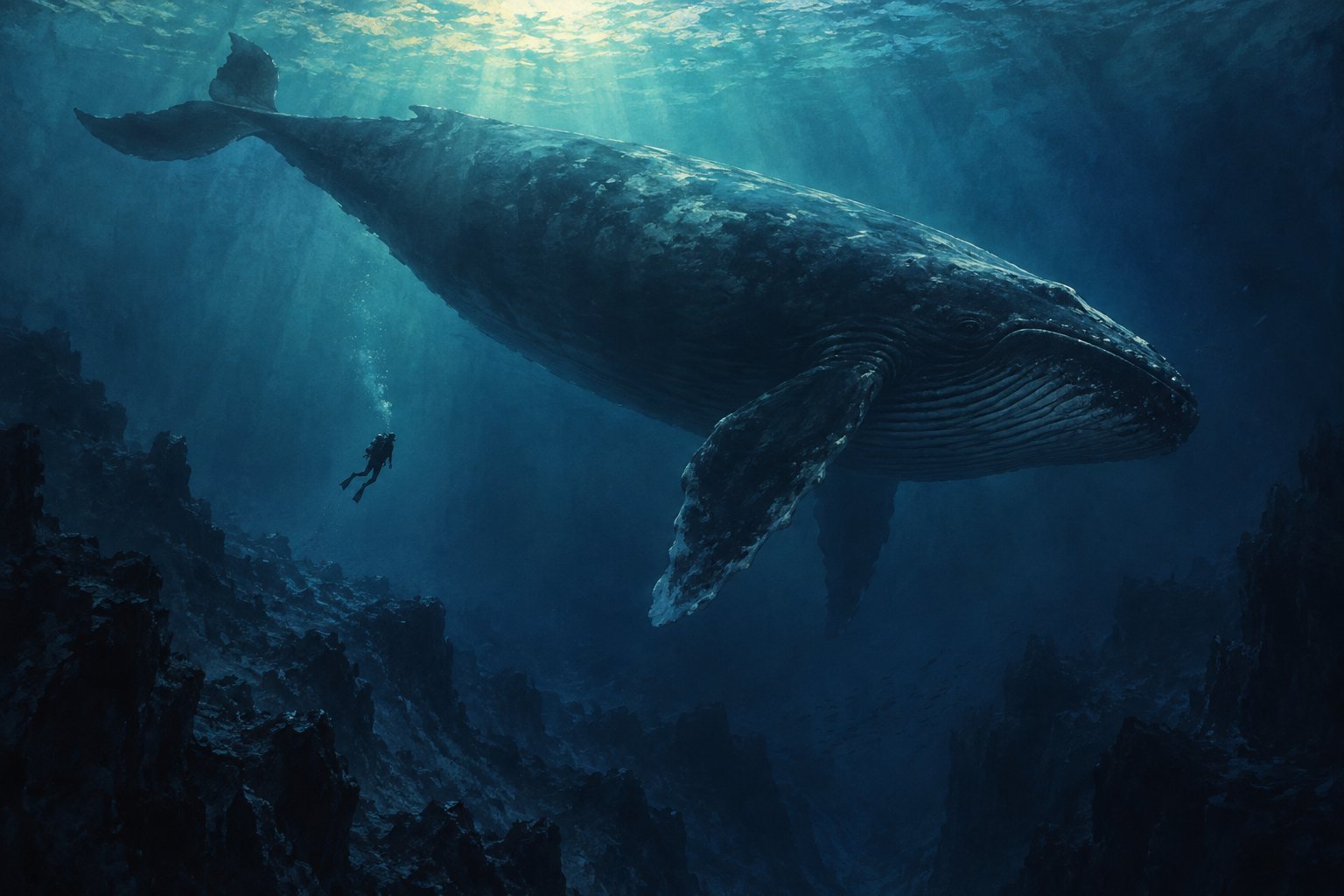
Being swallowed changes the scale of the story
From outside the situation, a man swallowed by a whale sounds like a spectacle: enormous animal, tiny human, impossible predicament. From the trapped character’s perspective, scale becomes a practical restriction. His surroundings are larger than he can master, while his own body remains stubbornly finite.
That reversal matters. Many action stories give their heroes increasing command over space. They learn the terrain, identify an opponent, and turn apparent disadvantages into tools. The premise of Whalefall starts by stripping away the assumption that the environment can be brought under human control.
Consequently, the most useful character question is not whether Abrams’ protagonist can appear heroic. It is whether he can still make consequential choices while profoundly helpless. Those conditions can coexist. A person may lack control over the larger emergency and still retain responsibility for the next decision.
This offers a different emphasis from our discussion of the critical disagreement surrounding Whalefall. Here, the concern is the survivor’s relationship to his own limited power, rather than the distance between reviewers’ reactions.
Fear does not disqualify a character from courage
Survival stories can encourage an unfair expectation: the protagonist should become more composed as circumstances become more extreme. Audiences admire competence, and competence is easy to mistake for an absence of fear. But panic, uncertainty, and determination are not mutually exclusive states.
Viewed from inside this predicament, fear would be an intelligible response to danger. The dramatic distinction is between feeling fear and losing every capacity to respond. A character need not achieve perfect calm before his efforts become meaningful.
That is the interpretive standard I would bring to Abrams’ role. Vulnerability can make a survival protagonist more credible than unbroken toughness. It permits the audience to recognize the gap between what someone wants to do and what his body or circumstances allow.
There is also room for frustration in that gap. Watching someone struggle can be uncomfortable precisely because effort does not produce immediate progress. If every attempt promptly paid off, perseverance would become a mechanical transaction: work hard, receive rescue. Uncertainty gives the effort its emotional weight.
The next decision matters more than an abstract will to live
Calling a story a testament to perseverance can flatten the very behavior that makes perseverance interesting. Determination is an attitude; drama requires actions and consequences. For a trapped character, the crucial issue is how the wish to survive becomes a sequence of decisions.
A useful way to assess this kind of thriller is to follow three questions. What does the character understand about his situation? What options does he believe remain? How does the result of an attempt change that understanding? These questions keep attention on a thinking person instead of an endlessly endangered body.
They also clarify why limitations matter. An obstacle acquires dramatic force when it restricts an identifiable choice. Mere unpleasantness can create disgust, but suspense depends on a relationship between danger, possible action, and uncertain outcome.
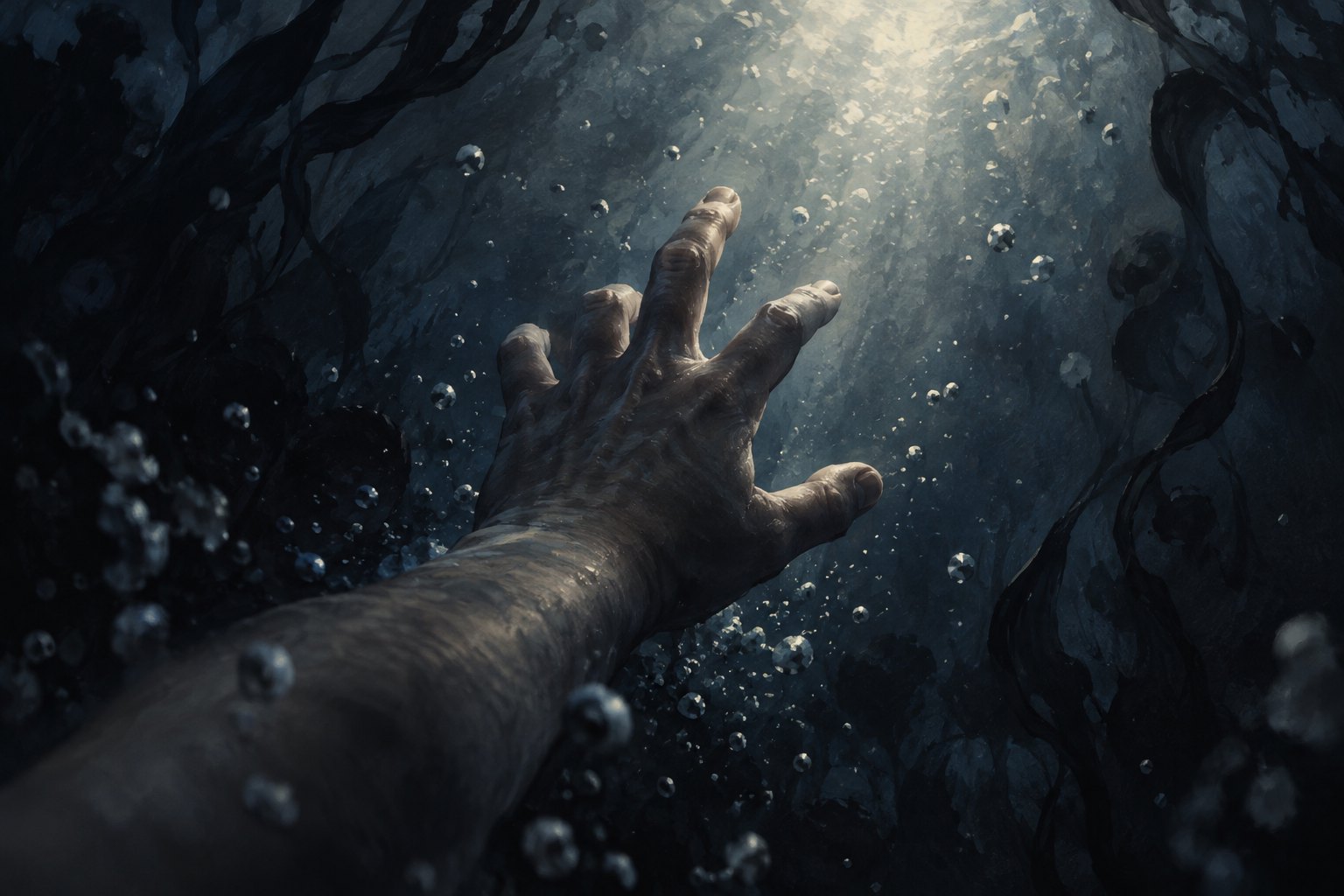
The accompanying illustration expresses that imbalance symbolically; it does not depict a verified scene. A reaching hand suggests intention without guaranteeing arrival. That is a productive image for the premise: human agency remains visible even when success remains beyond reach.
Physical suffering is not a measure of moral worth
The language surrounding survival often turns endurance into an award. Someone survives because he is strong enough, brave enough, or sufficiently committed to living. As emotional shorthand, that idea is understandable. As an interpretation, it deserves resistance.
A character’s commitment can matter without explaining every outcome. Physical conditions, available resources, and chance can all limit what determination accomplishes. A thoughtful account of perseverance should leave room for those limits instead of implying that catastrophe sorts people according to character.
For Whalefall, this distinction is especially useful because its central situation is so disproportionate. One human being faces an overwhelming predicament. Reading that imbalance solely as an opportunity to demonstrate greatness risks making the person less recognizable.
Our analysis of perfection and bodily cost in Black Swan approaches a related question from another direction: what happens when suffering becomes entangled with our idea of achievement? The comparison is thematic, not a claim that the films share a plot or outcome. In both discussions, a person’s body deserves attention beyond what it can prove.
Why the premise calls for humility
There is an appealingly modest interpretation available beneath Whalefall’s extravagant hook. Perseverance need not mean discovering that the self is limitless. It can mean discovering that action remains possible even after the fantasy of limitless control has disappeared.
This reading does not require an invented speech, a presumed revelation, or knowledge of the ending. It follows from the tension already present in the premise: the protagonist wants something urgently, but wanting it cannot make his environment cooperate.
That tension also gives viewers a more precise basis for judgment. The meaningful question is how the film connects effort to consequence. Does vulnerability remain part of the character’s experience? Can uncertainty survive alongside hope? Does suffering reveal a person, or merely decorate an ordeal?
For me, the strongest possibility within Whalefall is that survival might be understood as continuing to participate in life without a guarantee of mastery. The trapped man’s significance would then rest in the fact that he keeps responding while frightened and constrained. An enormous predicament can contain a very small, very human form of courage: deciding that the next attempt still matters.
Original content by this site's editorial team. Published: October 14, 2026 at 18:50:15 PDT (Los Angeles time)