
Werewulf has another trailer and a mysterious alternate reality game to solve, according to Forbes. That pairing gives horror fans two different invitations: experience the fear, then investigate it. The intriguing question is whether looking closer will make the mystery more unsettling—or make it feel comfortably manageable.
This is spoiler-free commentary on the reported promotional approach, not a review of the completed film or a verified ARG walkthrough. No puzzle solution, character fate, or hidden connection is established here. The appeal worth examining is how a horror story can invite participation while protecting the uncertainty that makes it frightening.
What the New Trailer and ARG Promise
A trailer controls what viewers see and when they see it. An alternate reality game, or ARG, typically asks participants to investigate fragments of a fictional mystery, sometimes across different formats. One experience moves at the editor’s pace; the other gives the audience some responsibility for moving forward.
For Werewulf, the reported combination creates a useful creative tension. A trailer can leave viewers with a question. A game can make them spend time with that question, testing possible answers and returning to details they initially overlooked. The campaign’s potential lies in turning an impression into sustained attention.
That potential should remain separate from a verdict. Calling a trailer terrifying describes a reaction, not a measurable property of the movie. Likewise, the existence of an ARG does not establish how elaborate it is, whether its answers affect the film’s story, or how rewarding it will be to finish.
Why Solving a Mystery Can Change the Fear
My view is that a horror ARG works best when discovery changes the meaning of something familiar. Finding an answer can be satisfying, but finding an answer that makes an earlier detail disturbing is more valuable to the story. Progress should occasionally complicate the player’s understanding.
There is a practical difference between difficulty and dread. A difficult puzzle may demand patience, pattern recognition, or collaboration. Dread requires an emotional reason to hesitate. If every discovery simply produces another task, participation can become an administrative exercise: collect, decode, submit, repeat.
The more interesting possibility for Werewulf is that investigation itself becomes uncomfortable. That is a critical expectation, not a description of an established game mechanic. The campaign would earn its horror identity if additional knowledge made the fictional situation feel more precarious, even as players became better at navigating it.
It would also need restraint. A promotional mystery can explain away too much. Once viewers believe they have a complete rulebook, the unknown becomes a system they expect to master. Some uncertainty deserves to survive the solution.
The Characters Must Have More at Stake Than the Audience
An audience member approaches a horror puzzle with the freedom to stop. A character inside a frightening story may have to act on incomplete information because someone’s safety, loyalty, or survival depends on the decision. That difference is where a campaign can become thematically interesting.
A character-centered reading of the eventual film should therefore ask more than who understands the threat first. Who can afford to believe a warning? Who risks losing a relationship by speaking? Who interprets the same evidence differently because accepting it would demand an unbearable choice?
Those are questions for the film, not claims about its plot. They establish a useful standard: information should exert pressure on people. A revelation matters dramatically when it changes what someone chooses, whom they trust, or what they can continue telling themselves.
Our discussion of human vulnerability in Resident Evil approaches horror through a related concern. The threat becomes more involving when viewers understand the limits of the person confronting it. For Werewulf, any elaborate mythology will ultimately need that human scale.
How to Investigate Without Turning Guesses Into Facts
Anyone approaching the reported ARG can benefit from a simple distinction: an observation records something present; an interpretation explains what it might mean. Keeping those separate preserves the pleasure of discovery and prevents an appealing theory from hardening into an assumed plot point.
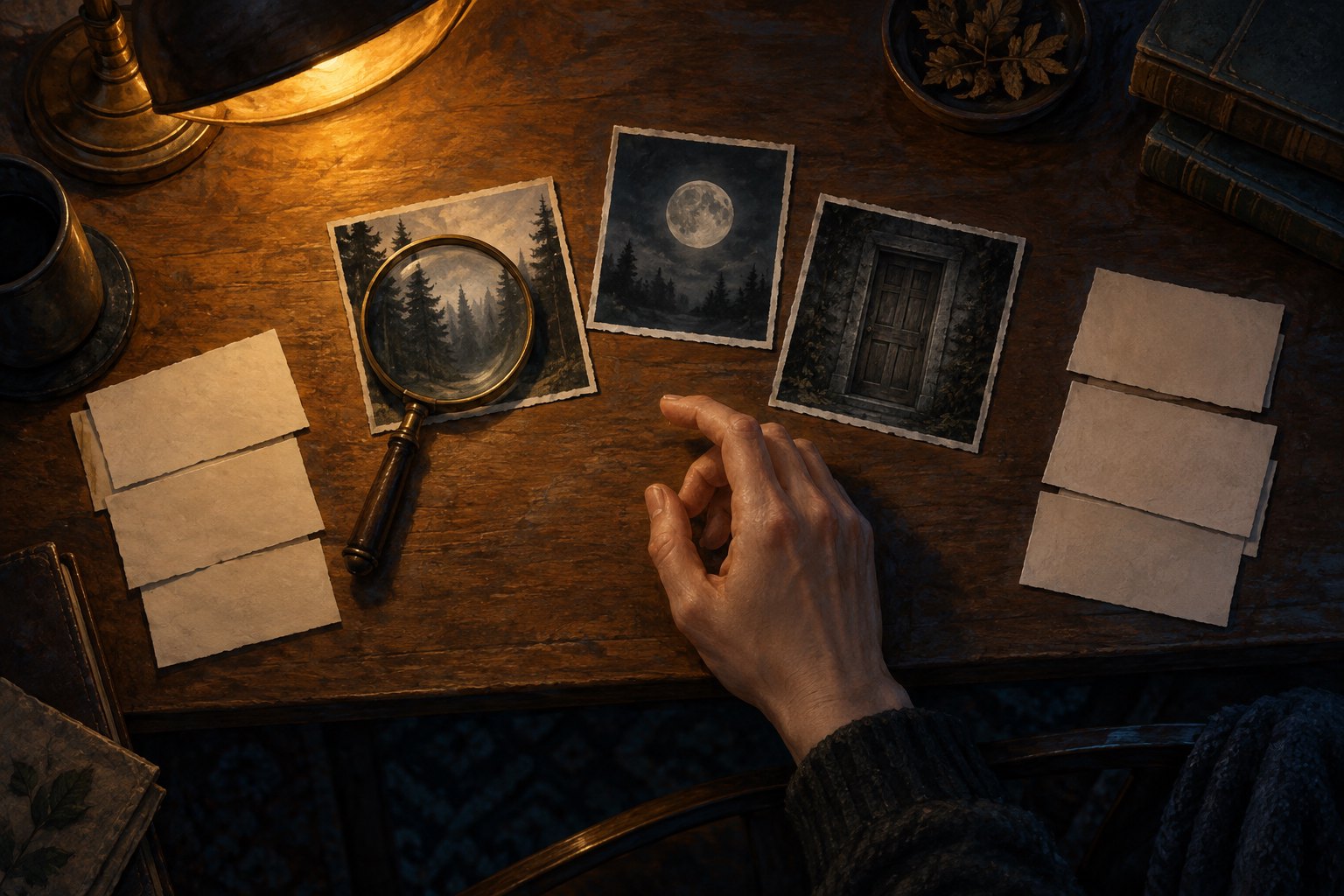
The illustration above is an imagined investigation scene, not a reproduction of actual game clues. For the real mystery, a disciplined approach is more useful than assuming every visual irregularity contains a secret.
- Establish the starting point. Begin with material explicitly connected to the film’s official promotion. A fan-made extension may be entertaining without belonging to the campaign.
- Record the literal detail. Note what appears or what can be heard before assigning significance. Preserve surrounding context rather than relying on an isolated screenshot.
- Write down competing explanations. A repeated image might be a clue, a thematic motif, or ordinary visual continuity. Let evidence narrow those possibilities.
- Look for confirmation. A theory that sounds convincing is different from an answer accepted by the game or supported by additional material.
- Keep solutions separate from film spoilers. Completing a promotional task does not automatically establish how the movie ends or what a character knows.
This approach also makes collaboration better. Other participants can evaluate an observation, reproduce a step, or challenge an interpretation. An unexplained declaration of certainty gives them much less to work with.
What to Watch for Beyond Hidden Clues
A second viewing of a horror trailer does not have to become a frame-by-frame search. It can be more revealing to watch for perspective. Whose reactions organize the footage? Does the editing encourage sympathy, suspicion, or distance? Is a frightened face allowed to register as a person, or used mainly as punctuation between shocks?
These questions help distinguish atmosphere from emotional investment. An arresting image may promise a memorable visual experience. A reaction that suggests conflicting feelings can promise something deeper: a character whose relationship to danger is not immediately obvious.
The same attention to meaning informs our analysis of folklore and friendship in Forgotten Island. Supernatural material gains dramatic force through its consequences for relationships. That remains a useful lens here without importing another film’s mythology into Werewulf.
The Deeper Appeal: Wanting to Know, Fearing the Answer
The most compelling interpretation of this trailer-and-ARG pairing is a conflict between curiosity and self-protection. Horror invites us to approach something we might otherwise avoid. A puzzle makes that approach feel purposeful: we are investigating, making progress, getting closer.
Yet getting closer need not mean becoming safer. That possibility gives the reported campaign its strongest conceptual appeal. The audience’s desire to understand could echo the uncertainty that makes a frightening story emotionally persuasive, provided the movie establishes that connection through its characters.
My provisional judgment is that the pairing offers a promising way to sustain curiosity. Its eventual value will depend on what the discoveries add. The strongest outcome would leave puzzle solvers with richer associations while allowing every viewer to experience a complete, affecting film. The mystery should deepen the encounter; the people on screen still have to make it matter.
Original content by this site's editorial team. Published: September 27, 2026 at 00:12:05 PDT (Los Angeles time)