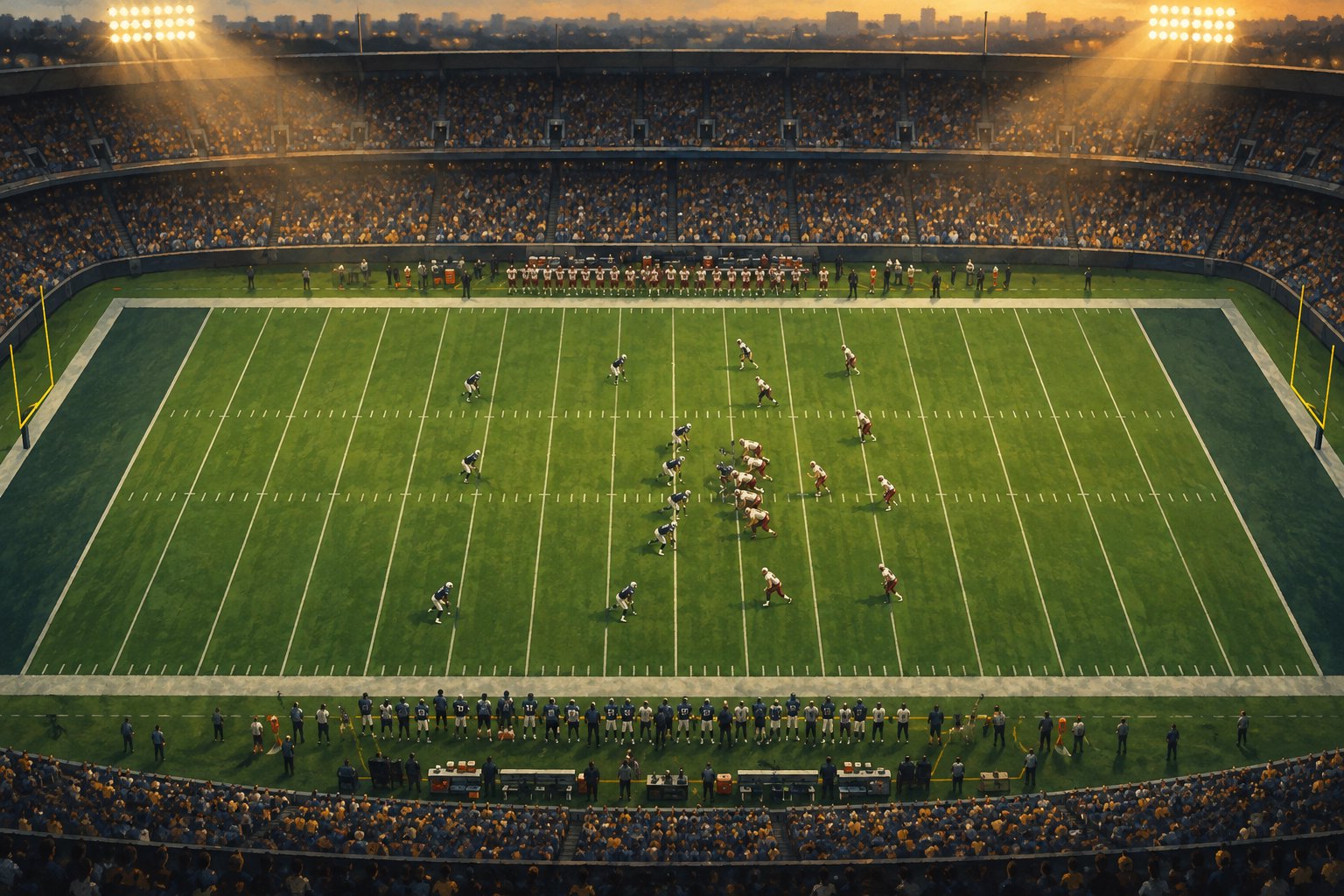
Week 1 film review begins with a change in attention: stop following the ball long enough to notice what makes its movement possible. In All-22 footage, the wider view brings players away from the immediate action into the story. A receiver’s route, a defender’s first steps, or a block that holds briefly can become more revealing than the finish that makes the highlight.
The subject of Week 1 Film Review: Highlights from the All 22 is football footage. Here, film analysis means examining positioning, movement, and decisions rather than reviewing a theatrical release. This guide explores how to read that footage; it does not assign player grades or claim a firsthand review of the complete Week 1 game tape.
What the wider frame lets you see
All-22 takes its name from the 22 players on the field. Its broad perspective is useful because football involves simultaneous actions that a tighter shot cannot always hold together. Watching only the ball can conceal the movement that opens a space or closes an opportunity.
For a movie viewer, the useful comparison is an ensemble scene held in a wide shot. The person speaking attracts attention, but another person’s movement may change the meaning of the exchange. On a football field, the player receiving the ball attracts attention while other players influence the available space.
The comparison has limits. Athletes are making competitive decisions, not performing a scripted drama. A wide image can show where someone moved; it cannot automatically establish what that person was instructed to do. Visibility gives the viewer more evidence, not complete knowledge.
That distinction also matters in our examination of framing and small details in festival photographs. A detail becomes meaningful through its relationship to the larger image. Isolating it too early can produce an impressively specific but misleading interpretation.
Read the play from the player’s position
The quarterback: an opening has a deadline
A paused replay makes every visible option seem equally available. The player handling the ball has a moving pocket, bodies obstructing sightlines, and a limited interval in which to act. A receiver appearing open later does not establish that the throw was available earlier.
When studying a passing play, watch the receiver’s separation alongside the quarterback’s movement. Identify when the potential throwing window appears. Then consider whether pressure, balance, or the flight time of the ball complicates the apparent opportunity. These are questions to investigate, not automatic excuses for a decision.
A stronger observation describes timing: the space appeared before, during, or after the passer began moving away. A weaker observation simply freezes an open receiver and treats the image as a verdict.
The receiver: follow the route without expecting a catch
A route can matter without ending in a target. In a hypothetical example, a receiver running toward one area may draw a defender with him, leaving more room elsewhere. The useful evidence is the relationship between those movements, not merely the receiver’s distance from the ball.
Watch the route from its beginning. Does the defender follow, hesitate, or pass responsibility to another player? Does the movement coincide with space opening elsewhere? Describe those visible changes before deciding whether the receiver served as a deliberate distraction. Intent requires more support than an attractive replay.
The defender: separate recovery from control
A dramatic recovery can obscure the position that made recovery necessary. Conversely, an uneventful play may reflect a defender maintaining a useful position throughout. The most noticeable effort and the most effective execution are not always the same thing.
Start with the defender’s alignment and first steps, then follow the response to the developing play. Avoid turning body language into claims about confidence, effort, or understanding. Footage can support a description of movement much more readily than a diagnosis of someone’s state of mind.

A practical way to watch each highlight
Repeated viewing helps most when each pass has a different purpose. Replaying a clip while staring at the same player can reinforce an initial impression without testing it.
- Watch once at normal speed. Establish the sequence and preserve a sense of how quickly the action develops.
- Return to the moment before the snap. Note the spacing and the positions visible in the frame.
- Follow one relationship. Watch a receiver and defender, or a blocker and rusher, rather than trying to track everyone.
- Locate the decisive change. Identify the step, contact, hesitation, or movement that alters the available space.
- Replay the entire sequence. Check whether the detail still seems decisive when restored to normal speed.
- Record what remains uncertain. Separate the movement you can see from the assignment or intention you infer.
A useful note might say that a defender moved toward an outside route as space opened inside. Calling that movement a blown assignment adds a claim the image alone may not resolve. Precise language makes the analysis stronger because another viewer can test the observation.
Why Week 1 highlights need context
A highlight selection creates emphasis. It directs attention toward certain plays while leaving others outside the presentation. That makes it useful for examining individual sequences, but insufficient on its own for judging how consistently a player performed.
Keep three questions separate: What happened in this clip? What might explain it? How often did comparable situations occur? The first may be visible. The second may support several interpretations. The third requires a broader sample than a handful of memorable moments.
Week 1 also encourages large conclusions because viewers are eager to identify what a team will become. My preference is to treat an opening-week observation as a proposition to revisit. A technique that works once deserves attention; whether it remains effective under different conditions is another question.
This is closely related to the distinction between an early impression and a lasting critical verdict. An arresting moment can justify curiosity without settling the assessment of the whole.
The deeper lesson: attention changes who receives credit
The most rewarding aspect of All-22 viewing is how it redistributes attention. The player at the end of an action remains important, but the wider frame lets other contributions become visible. It encourages a more patient account of how an outcome develops.
That patience should apply to blame as well as praise. A failed result does not identify its cause automatically, and a successful result does not prove that every decision was sound. Good analysis traces the sequence carefully enough to explain that difference.
For Week 1 film review, the most useful highlight is therefore one that changes a specific understanding: when space opened, how a defender reacted, or why an apparent option was less simple at full speed. The wider view earns its value when it leads to a more precise explanation—and leaves unresolved questions open.
Original content by this site's editorial team. Published: September 16, 2026 at 02:42:50 PDT (Los Angeles time)