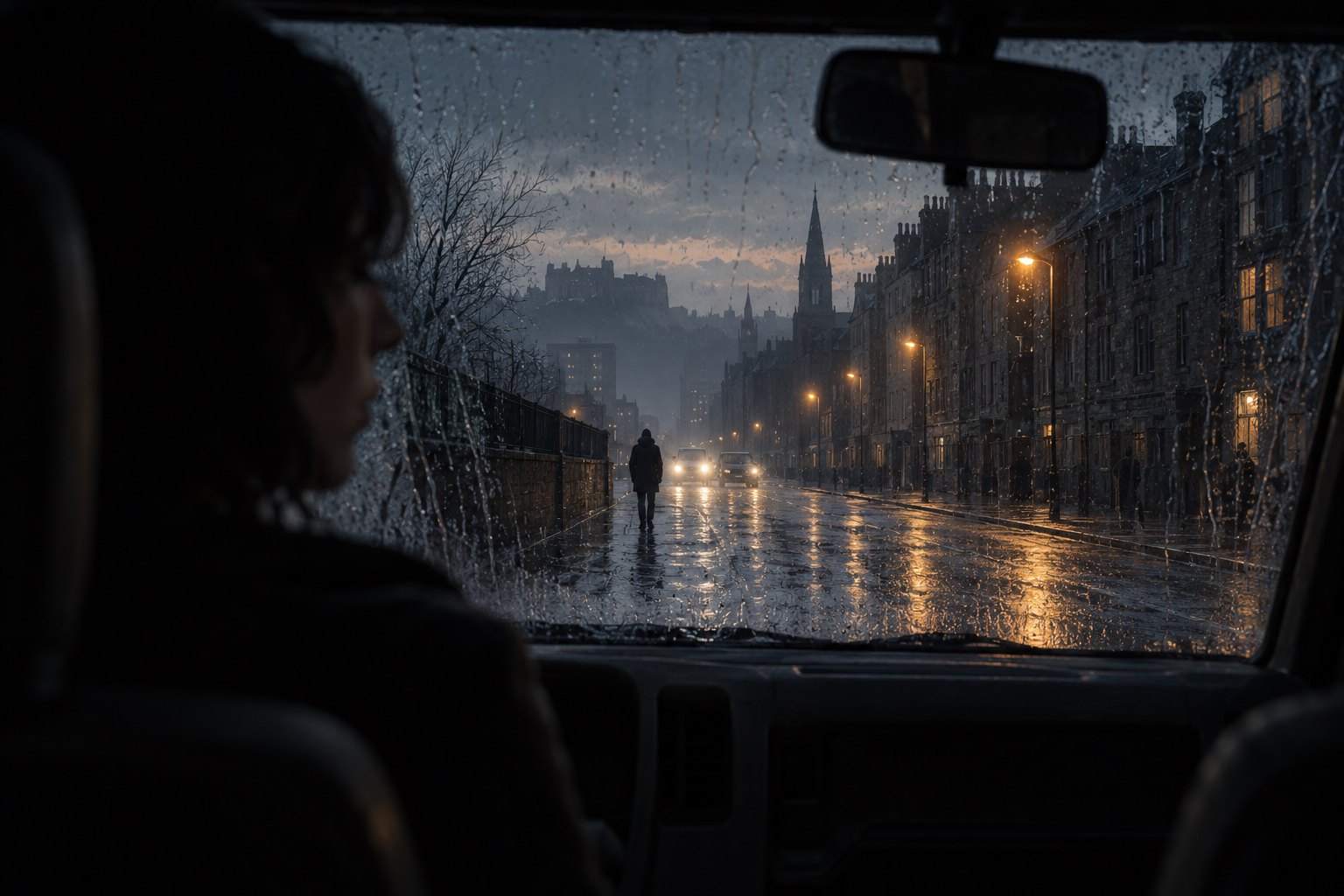
Under the Skin makes a frightening proposition: learning to recognize another person’s humanity might leave you less equipped to survive. Jonathan Glazer’s film follows an alien, played by Scarlett Johansson, who approaches men in Scotland and leads them toward an incomprehensible death. Its extraordinary achievement is making her gradual uncertainty more absorbing than an explanation of her origins would be.
My verdict: this is an exceptional, deliberately disorienting film, strongest when a small gesture changes the meaning of everything around it. Viewers seeking brisk plotting or explicit answers may find its repetitions taxing. For those willing to watch expressions, movements, and spaces closely, those repetitions become the foundation of a devastating character study.
Full spoilers follow, including the ending. Discussion includes sexual violence, death, and a child in danger.
A predator who knows the script of friendliness
Johansson’s unnamed protagonist initially treats conversation as a practical instrument. Driving a van, she asks for directions and steers exchanges toward whether a man is alone. Questions that might indicate interest also establish whether someone is expected elsewhere. Sociability becomes a way of assessing vulnerability.
“Do you think I’m pretty?” sounds like an invitation to flirt. In her mouth, it also resembles a test of equipment. She is checking whether the appearance she inhabits produces the desired response. Johansson makes the transition between smiling engagement and impassive observation disturbingly clean: warmth can disappear as soon as it stops serving a purpose.
The men need not be unusually foolish for the encounters to work. They recognize an ordinary social possibility and proceed within it. Their tragedy is that the encounter belongs to a different system altogether. She understands enough about attraction to direct their behavior without sharing their expectations.
That gap between a convincing appearance and an inaccessible interior also drives our analysis of authority and belief in Verity. Here, however, the missing information extends beyond motive: the men cannot even identify what kind of being is looking back.
The black room takes away the rules
The seduction sequences replace recognizable interiors with an apparently boundless black space. Men follow the woman, undressing as they move, then sink while she remains on the surface. The simplicity is essential. There is little scenery to study for an escape route, and no useful explanation to make the process manageable.
From the victims’ perspective, the horror is a catastrophic failure of interpretation. They believe they are approaching intimacy. By the time the ground contradicts that belief, their understanding of the situation has become useless. A later glimpse beneath the surface makes the consequences bodily and appalling without turning them into a tidy account of alien technology.
Mica Levi’s score gives these passages their queasy momentum. Its sliding tones make attraction feel unstable, as though an apparently familiar signal has been stretched beyond recognition. Music and movement establish a ritual; each repetition teaches us what will happen before the next man understands it.
There is a cost to that rigor. Some stretches hold their emotional temperature so steadily that dread can become distance. I find the repetition justified because the film eventually makes a deviation from routine feel enormous. But its formal control occasionally threatens to flatten the people caught inside it.
The beach establishes the distance she must cross
The beach sequence is the film’s harshest demonstration of her initial indifference. A rescue attempt unfolds in dangerous water. After a swimmer returns exhausted, she attacks him and takes him away, leaving a distressed child behind.
What makes the scene unbearable is the collision between competing priorities. The people entering the water respond to another life in danger. The alien sees an opportunity to obtain a body. The child’s cries have overwhelming significance for the audience and no apparent claim on her attention.
Glazer does not give her a flicker of recognition to soften the moment. That refusal matters later. Her developing sensitivity cannot erase what she has done, and the film never supplies a speech that asks us to forgive her.
Instead, recognition accumulates through encounters. When she falls in the street, strangers help her up. Their response introduces something her hunting procedure cannot account for: people may approach a vulnerable body to support it. The same world contains casual assistance and catastrophic indifference.
The passenger who unsettles her routine
Her encounter with the man played by Adam Pearson changes the film’s balance. He has a facial difference and describes a life constrained by other people’s reactions. His guarded manner makes the familiar seduction routine feel different. Attention that other passengers readily accept is harder for him to trust.
“You’ve beautiful hands,” she tells him. The sentence still belongs to her practiced language of attraction, but the scene gives it an unfamiliar weight. She directs attention toward a part of his body without reproducing the judgments that have organized his experience of strangers.
His question, “Dreaming?”, is especially painful. An experience that ought to be possible within ordinary life feels almost unreal. Her reassurance remains part of a dangerous encounter, yet the exchange interrupts the film’s established rhythm. We begin watching for hesitation instead of merely awaiting the trap.
She ultimately lets him go. That action does not guarantee his safety: the motorcyclist subsequently intercepts him. Nor does it prove that she has suddenly acquired a complete human conscience. What it establishes is narrower and more persuasive. She can now depart from the behavior that previously defined her.
The distinction between understanding someone and excusing them also informs our discussion of fear and responsibility in the Lanterns finale. Johansson’s character becomes more emotionally accessible while remaining responsible for horrors the audience has already witnessed.
A human appearance cannot supply a human life
Once she abandons the hunt, ordinary activities become experiments. An attempt to eat cake fails. A man offers shelter and companionship. Physical intimacy leads her to examine a body whose possibilities she does not fully understand.
These passages are poignant because she lacks the knowledge that makes everyday experience seem effortless. Earlier, her appearance allowed her to control encounters. Now she seems to be asking what living inside that appearance might mean.
Johansson conveys the change through attention. Her stillness becomes searching rather than merely unreadable. Looking at herself no longer appears to be maintenance of a disguise; it becomes an investigation into the relationship between surface and self.

The ending turns recognition into a test
In the forest, a man attempts to sexually assault her. During the attack, her human covering tears, exposing the dark body beneath it. He subsequently returns with fuel and sets her alight.
The reversal is brutal: someone who exploited the desires of strangers becomes vulnerable to a stranger’s violence. But treating this as deserved punishment would disregard the film’s careful movement toward her perspective. The attack is horrific because the film has taught us to recognize a frightened being where we once saw an inscrutable predator.
The image of her holding and examining her human face makes the title newly literal. That face was an instrument, then a possible identity. Separated from her, it remains disturbingly expressive. The moment asks whether an appearance can become part of a self even when it began as camouflage.
What remains beneath the surface
My reading is that Under the Skin locates moral change in the interruption of certainty. The protagonist begins by knowing what other bodies are for. She becomes capable of hesitation, curiosity, and refusal. Those changes do not make her human in any straightforward biological sense, but they make her recognizable to us.
The ending tests whether that recognition survives the loss of Johansson’s familiar face. If sympathy depends entirely on an attractive human exterior, we have learned less than the protagonist has.
That is why the unresolved questions about her species feel secondary. The film’s deeper mystery concerns how a being acquires an inner life that others might acknowledge—and how easily that acknowledgment can fail. Its final cruelty is that learning to care offers no protection. Its lasting force is that we care anyway.
Original content by this site's editorial team. Published: October 5, 2026 at 09:55:59 PDT (Los Angeles time)