
Tick Fever has an immediately uncomfortable hook: Finnish body horror built around a creature small enough to escape your attention and intimate enough to make your skin feel unfamiliar. Variety’s coverage frames Lyme disease as only the beginning of the unease. That positioning promises something beyond a straightforward encounter with a dangerous parasite: horror in which the boundary between a person and an invading threat becomes difficult to defend.
This is a spoiler-free critical preview, not a review of the finished film. The premise supports a discussion of its dramatic possibilities, but it does not establish the quality of the performances, the shape of individual scenes, or the meaning of the ending. No unverified dialogue or character actions are presented here as part of the movie.
Why a Tiny Threat Can Carry a Horror Movie
The appeal of the Tick Fever concept begins with scale. A large monster announces itself. A small parasite raises the possibility that an encounter has already happened before anyone knows to be afraid. As a storytelling device, that changes the emotional starting point: discovery can feel less like the beginning of danger than the belated recognition of it.
For a character, the most unsettling question in that situation might be when an ordinary body stopped being entirely their own. That question creates room for suspense without requiring constant escalation in the size or visibility of the threat. Attention itself becomes uncomfortable. Looking closely offers the possibility of reassurance, but also the possibility of finding something worse.
My interest in this premise lies in that conflict. An effective treatment could make the audience want a closer look while dreading what the camera might reveal. The challenge would be maintaining that tension once the threat becomes familiar. A disturbing creature can command a moment; a character’s changing relationship with their own body can sustain a story.
The Character Must Matter More Than the Affliction
Body horror becomes emotionally thin when a person exists only to undergo something unpleasant. The audience may remember the image while forgetting whose suffering it represents. For Tick Fever, the more demanding dramatic opportunity is to make bodily vulnerability alter choices, priorities, and relationships in ways that remain specific to the people involved.
That does not require a character to behave sensibly at every turn. Fear can make a reasonable decision difficult. What matters is whether viewers can understand the competing needs behind an action: wanting relief, wanting privacy, wanting control, or wanting someone else to believe that something is wrong. Those are useful lenses for judging this kind of horror, rather than claims about particular scenes in this film.
A character’s perspective also determines how much information should reach the audience. Seeing more than the affected person can create dread; knowing no more than they do can create uncertainty. Neither approach automatically produces suspense. Each needs a deliberate relationship between what a character perceives and what viewers are invited to conclude, a concern also explored in our discussion of why point of view matters in horror storytelling.
When Looking Becomes Part of the Fear
The body-horror label makes the act of looking especially significant. Skin is both an everyday surface and a boundary people depend on without usually thinking about it. A parasite-centered concept can make that familiar surface newly suspicious. The dramatic possibility is not simply that something grotesque will appear, but that ordinary self-awareness could become exhausting.
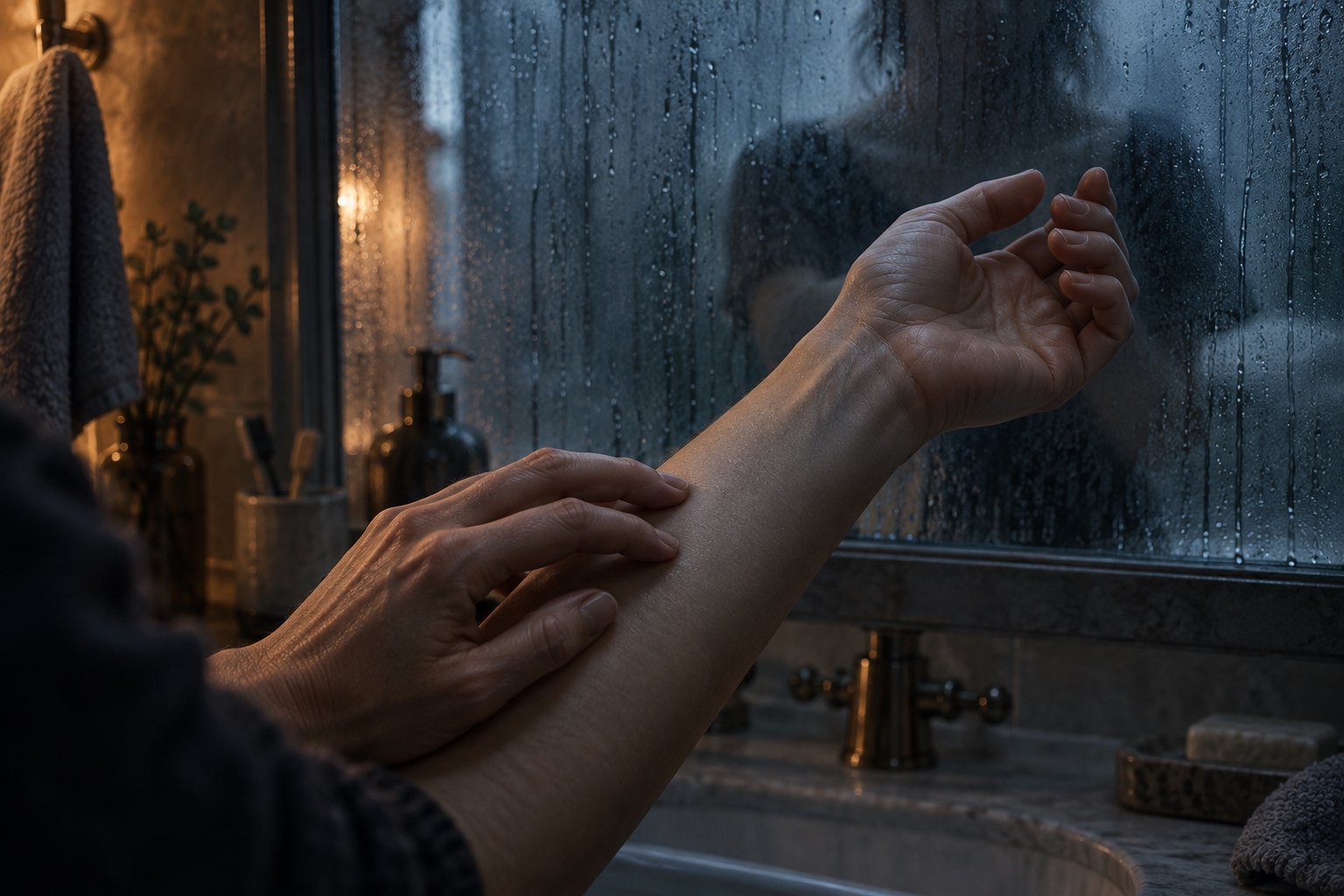
In cinematic terms, framing and duration could do as much work as a reveal. Holding on an apparently uneventful image asks the audience to search it. Cutting away before certainty can leave that search unfinished. These are possibilities suggested by the material, not assessments of the film’s actual camerawork. Their value would depend on whether they express a person’s experience instead of merely delaying an effect.
The same distinction applies to sound. A heightened awareness of contact, movement, or silence could make a body feel impossible to ignore. But stylistic intensity needs variation. If every moment insists on danger, the audience loses the ordinary baseline against which a small disturbance becomes alarming.
Disgust Needs an Emotional Point of View
Disgust is an obvious resource for Tick Fever, but it raises an important critical question: where does the film direct that response? Revulsion toward an intrusion and revulsion toward the person experiencing it are different things. A horror movie can move between those reactions, yet the movement should carry meaning.
My preference is for body horror that preserves a sufferer’s personhood even at its most visually extreme. Physical distress becomes more affecting when the person retains desires unrelated to what is happening to them. Humor, irritation, affection, and stubbornness can give the audience a relationship with someone whose body might otherwise become merely a display.
This is also where uncertainty needs careful handling. A story can leave the cause or extent of a threat unresolved while treating fear as an experience with consequences. Our analysis of the difference between suspicion and sustained suspense considers a related problem: unanswered questions need to change the dramatic situation, not simply accumulate.
Reading the Promise Without Inventing the Payoff
The reference to Lyme disease in the film’s coverage establishes a familiar point of anxiety before suggesting a more extreme fictional destination. It should be understood as horror framing, not as a clinical explanation of illness. The interesting creative question is what the film adds once that initial recognition has done its work.
A deeper interpretation available in the concept concerns ownership. People generally move through the world assuming that their bodies belong to them in an immediate, practical sense. A parasite unsettles that assumption. In horror, the resulting loss of control can become a way to examine dependence, vulnerability, and the limits of self-command without reducing those experiences to a single tidy metaphor.
That is the promise I would bring to Tick Fever: the possibility that its smallest threat will expose something larger about being a person who needs a body, yet cannot fully govern it. Whether the film fulfills that promise remains an open question. Its strongest conceptual asset is already clear, however: it gives fear an intimate address, somewhere a character cannot simply walk away from.
Original content by this site's editorial team. Published: September 30, 2026 at 18:27:58 PDT (Los Angeles time)