The right way to adapt a video game begins with a question about character: what should taking part in this world feel like, and whose experience can make that feeling visible? A movie can reproduce costumes, locations, and familiar objects with extraordinary care. My standard for a successful adaptation is whether those details help us understand what someone wants, what prevents them from getting it, and what their decisions cost.
The challenge is especially interesting because participation changes our relationship to a story. Getting through a dangerous room ourselves and watching a character cross it are different pleasures. An adaptation needs to find the dramatic value of that difference. Its most consequential creative decision may be choosing what the protagonist does when the controller leaves our hands.
Spoiler-free critical commentary on video game adaptation as a filmmaking problem.
Give the Protagonist a Reason to Keep Going
A game can make forward movement immediately rewarding: another space to explore, another skill to master, another obstacle to overcome. A movie needs to make continued movement expressive. Why does this person enter the next room? What would make them turn back? Does completing the mission satisfy their deepest desire, or help them avoid confronting it?
Consider a hypothetical rescue adventure. The objective might be perfectly clear, yet its dramatic meaning changes depending on the rescuer. Someone driven by affection behaves differently from someone trying to erase a previous failure. Someone pursuing a reward may begin making exceptions that undermine their supposedly practical motives. The destination supplies direction; those contradictions supply a character.
This is where fidelity becomes more demanding than visual accuracy. If a film preserves every major encounter but removes the hero’s difficult motives, it can retain the route while losing the story’s emotional logic. Conversely, rearranging an encounter may deepen that logic by placing the character under pressure at exactly the moment their confidence begins to fail.
Translate Player Decisions Into Visible Choices
The absence of audience control does not require an absence of agency inside the movie. Characters can still deliberate, misunderstand, improvise, and choose badly. What matters is that viewers can perceive a meaningful alternative. A decision has little weight when the screenplay makes every other possibility invisible.
In that imagined rescue story, a protagonist might have a chance to escape while a companion remains trapped. The scene should establish the exit, the companion’s predicament, and the narrowing opportunity. Then a glance or a change in direction can carry the decision. Explanatory dialogue would add little if the staging has already made the competing impulses legible.
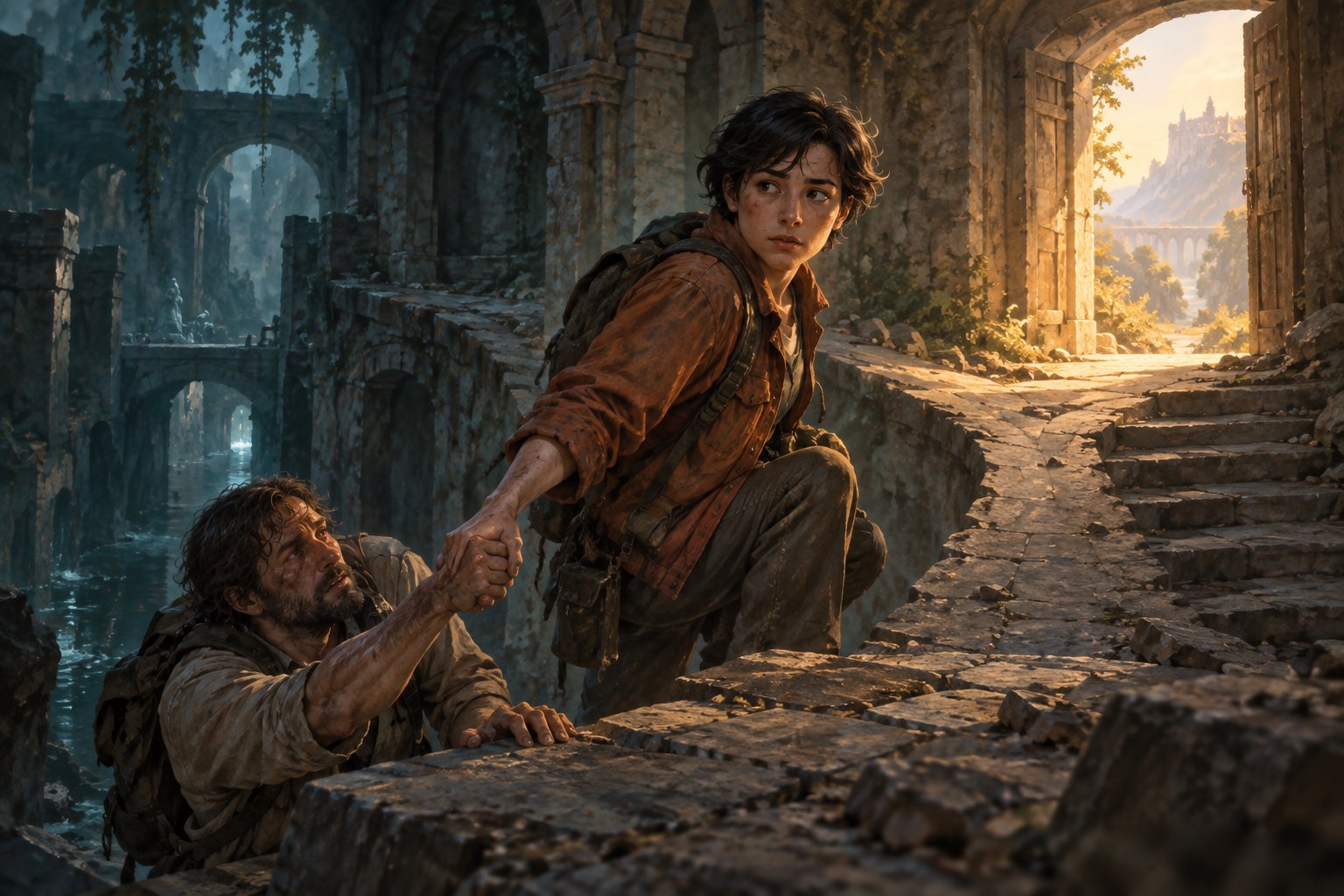
My strongest test is whether the choice changes the next scene. Helping someone might consume time, expose a secret, or create an obligation. Abandoning someone might preserve the mission while destroying trust. When the consequences travel with the characters, action becomes part of their relationship rather than an interruption of it.
The camera also determines whose uncertainty we share. Our discussion of screen authority and who controls the camera approaches perspective from another direction, but the critical question connects: whose understanding organizes what we see, and where does that understanding break down?
Make Action Reveal How a Character Thinks
An action sequence earns its place when its choreography expresses a mind at work. A cautious character searches for cover. An arrogant one assumes the obvious route will remain open. A frightened companion watches the exits while everyone else watches the threat. These behaviors can establish personality without pausing the film to explain it.
For that reason, copying the appearance of gameplay is only a starting point. A recognizable movement becomes dramatically useful when the film gives it context. Has the character practiced it? Are they attempting it out of desperation? Does someone else bear the risk if it fails? The same physical act can read as competence, vanity, or sacrifice.
Editing should preserve enough spatial information for those distinctions to register. If viewers cannot understand the distance to safety or the position of a vulnerable companion, they cannot fully assess the hero’s choice. Speed alone cannot provide that understanding. A held shot that lets us notice an obstacle may generate more suspense than several rapid cuts.
Preserve the Feeling Behind a Game Mechanic
Different forms of play suggest different cinematic priorities. A puzzle invites attention to relationships between details. Exploration rewards curiosity. Resource scarcity can make an ordinary decision feel dangerous. The adaptation’s task is to identify which experience matters most and build scenes capable of producing a related response.
For a hypothetical puzzle sequence, the satisfying screen equivalent might involve planting a visual clue, allowing the protagonist to misread it, and giving the audience a moment to reconsider before the solution arrives. The pleasure comes from discovery. A character simply announcing the answer would preserve the result while discarding the experience.
Scarcity requires a different approach. Establish that a useful resource is limited, show a tempting reason to spend it, and let the earlier expenditure matter later. The viewer does not need an inventory display to understand the pressure. They need to remember a choice and recognize its consequence.
These are useful standards for film analysis because they explain why two equally recognizable adaptations can feel so different. One may reproduce the objects associated with an experience; another may reconstruct the attention, anticipation, or anxiety that gave those objects meaning.
Let Supporting Characters Have Their Own Stakes
A companion becomes dramatically thin when their only responsibilities are explaining the world and approving the hero. Give that person a conflicting priority, and the same journey becomes less predictable. They might share the destination while disagreeing about the acceptable cost of reaching it.
This is also a practical test for exposition. Information becomes more engaging when delivering it serves a character’s purpose. A warning could be an attempt to protect someone, assert authority, or discourage an unwanted investigation. The audience learns something about the world while also learning how the speaker uses knowledge.
Our commentary on the creative stakes of adapting online horror raises a related concern about recognizable material. Familiar imagery offers an entrance into a story; character perspective gives the audience a reason to remain there.
Judge Familiar Lines and References by Their Dramatic Function
A beloved line deserves the same scrutiny as any other piece of dialogue. What does the speaker want from the listener? Does the delivery expose confidence, embarrassment, affection, or fear? Recognition can intensify a moment, but the moment should remain intelligible to someone hearing the words for the first time.
The same principle applies to background references. A familiar object can enrich a setting without demanding attention. Trouble begins when the film suspends a developing emotion to announce that viewers should recognize something. The reference then competes with the scene instead of contributing to it.
A useful viewing exercise is to imagine removing your prior knowledge. Can you still follow the conflict? Does the joke still have a setup? Does the reunion still communicate why these people matter to each other? An adaptation that answers those questions convincingly has made its pleasures available beyond recognition alone.
The Deeper Challenge Is Responsibility
For me, the richest possibility in video game adaptation is the transfer of responsibility. During play, we may concentrate on finding a workable solution. Watching a film gives us room to study the person pursuing it: their blind spots, the people they overlook, and the explanations they offer afterward.
That shift can make a familiar adventure newly revealing. Success may fulfill the objective while damaging the protagonist’s relationships. Failure may expose a loyalty that victory would have concealed. The strongest adaptation makes those outcomes feel inseparable from the person who chose them. By the ending, we should understand more than how the hero completed the journey. We should understand what completing it has made them willing to live with.
Original content by this site's editorial team. Published: September 26, 2026 at 00:21:39 PDT (Los Angeles time)